This video is about the everlasting hope that is found in the risen Lord Jesus Christ. Why do millions of people around the world celebrate Easter? What evidence is there that Jesus Christ is alive today? Discover the answers to these questions and much more. Please share this video with those you want to see in heaven.
Scriptures are from the New King James Version unless otherwise noted. Pictures are used with permission from Good News Productions International and College Press Publishing/ www.Freebibleimages.org, www.Goodsalt.com, or they are creative common licenses.
We are living in a day when much hatred and division centers around the color of one’s skin or the political party with which one associates. The truth of the matter is that one’s skin color or political party is not what drives these conflicts. I believe the apostle Paul would want us to understand that behind these divisions and hate there is an unseen enemy who knows our histories and our weaknesses, and he is bent on getting us to fight one another instead of taking a stand against his kingdom of darkness. This foe would like nothing more than for people to think he does not exist.
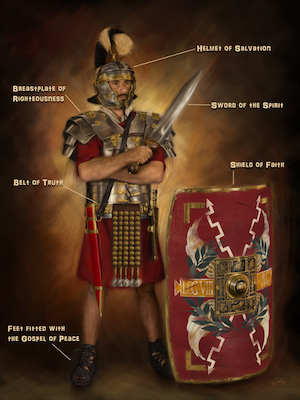
But the apostle Paul would have us believe otherwise. In his letter to the Christians in the city of Ephesus he concludes with ways to protect themselves from spiritual attacks. He instructs his Christian readers (including you and me), to wear the whole armor of God so we may stand against the “wiles” or deceitful methods of the devil (Eph. 6:11). He wants us to understand that our battle is not with “flesh and blood” (i.e., human beings regardless of their skin color or political differences, etc.), but with the kingdom of darkness (Eph. 6:12). Therefore, we are to take up the whole armor of God so we may stand against the enemy “in the evil day” when all of hell attacks us (Eph. 6:13).
Just as a soldier needs to know the strategies of his enemy, so Christians need to understand the schemes or “wiles” of the devil (Eph. 6:11). Some of the “wiles” of Satan may include the following: [1]
Deception: Satan is the father of lies (John 8:44) and he deceived Eve with bad doctrine (1 Tim. 2:14). Hence, Christians are to wear the belt of truth to expose Satan’s lies and replace them with God’s life-giving truth (Eph. 6:14a).
Deviation: The devil wants to conform us to his world system and cause us to deviate from God’s will (Eph. 2:1-3; I John 2:16; 5:19b). He wants us to lower our standards of righteousness by tempting us to open our lives to a little sinfulness or worldliness. He may whisper in our ears, “It won’t hurt you to try that. Everyone else is doing it. Go ahead and do it. It’s fun.” This is why we need the protection of the breastplate of righteousness (Eph. 6:14b).
Division: The book of James informs us that the kind of wisdom that causes strife, envy, and self-seeking (power struggles) in our homes, churches, and workplaces originates from hell, and it is earthly, sensual, and demonic (Jas. 3:14-16). Therefore, we need to wear the sandals of the gospel of peace (Eph. 6:15).
Doubt: Satan caused Eve to doubt God’s Word (Gen. 3:1). This is one of his primary attacks against Christianity as a whole and the individual Christian in particular. Anderson writes, “When the Age of Reason rose up, European scholars discounted anything supernatural, which included a written revelation (the Bible) from a supernatural being (God). Thomas Jefferson swallowed the poison of doubt and decided to create his own New Testament by pulling the miracles of Christ out of the Gospels. If we doubt whether the Bible is God’s Word, why should we live by it or obey it?”[2] Hence, we need to take up the shield of faith to renew and strengthen our faith in the Lord and His Word (Eph. 6:16).
Disillusionment: Satan tries to put thoughts in our minds to make us think that his thoughts are our thoughts. When Job encountered severe trials, Satan used Job’s wife and friends to encourage Job to give up on God. They reasoned that any God-fearing believer assumes God will bless him for his obedience, not realizing that is the essence of legalism. We can never put God in our debt (cf. Rom. 4:4; 11:6). The other misunderstanding is to look at our trials as curses instead of blessings. God’s plan for our Christian growth is to mold us and sculpt us into the likeness of His Son. Often trials are the best ways to get us there. But the devil will try to give us thoughts that are contrary to God’s thoughts. And so, we are to wear the helmet of salvation (Eph. 6:17a).
Discouragement: One of the “devices” (noēmata) of Satan is extreme sorrow or discouragement over our failures (cf. 2 Cor. 7:7-11). When the Christian community treats a repentant Christians like a leper, his discouragement may cause him to give up completely. Satan will use discouragement to keep a believer from reading or memorizing the Bible. Hence, we are to take up the sword of the Spirit, the word of God (Eph. 6:17b).
Paul addresses six pieces of armor in the order that a Roman soldier would put them on (Eph. 6:14-17). The first three pieces of armor are introduced with the verb “to be.” The belt of truth, the breastplate of righteousness, and the shoes of peace we have with us all of the time [3] (“having girded… put on… shod…” – Eph. 6:14-15). [4] This is the state we are always to be in. But the last three pieces of armor – the shield of faith, the helmet of salvation, and the sword of the spirit – we are called to take and use as needed [5] (“taking … take…” Eph. 6:16-17). [6] Today, we will look at the second of these last three pieces of armor, “the helmet of salvation” (Eph. 6:17a).
The Location of the Helmet
The placement of the fifth piece of armor is very significant. After putting on his belt, breastplate, sandals, and taking up his shield, the Roman soldier would put on his helmet to protect his head, especially his brain, because injury to one’s head can be lethal.
And the world recognizes this. Whenever we are in a situation that could be dangerous to our heads and brains, we are often required to wear a protective helmet. For example, construction workers wear a hard hat to protect their heads from falling debris in a construction area. Motorcyclists wear a helmet to shield their brains from serious injury in case they are in an accident. Those who refuse to wear a helmet when riding a motorcycle are flirting with tragedy because the likelihood of being killed in an accident increases significantly when a motorcyclist does not wear a helmet. [7]
In American football,[8] a player wears a helmet to absorb the impact of colliding with another player so that the brain is not injured. Because the understanding is, if the brain is injured, bodily function is impeded. When you have players, whose heads are constantly absorbing violent collisions on the playing field, experiencing concussion after concussion, the brain can be severely damaged. And if the brain gets damaged, bodily function is impaired.
The apostle Paul is saying in Ephesians 6:17a that the mind must be protected to absorb the shocks of being hit in the spiritual realm by the enemy. If our minds are not protected from these blows, our spiritual lives can be greatly impaired.
Some of us know people who have contracted a debilitating disease known as Alzheimer’s whereby the brain is not able to function as it once did. And it progressively deteriorates over time so that the person is not able to care for themselves. The worse the brain problem gets, the less the person with Alzheimer’s can control.
The less control you and I have in our Christian lives is because spiritual Alzheimer’s has set in. The mind is no longer functioning as God wants it to, impeding the soul from doing what it should, which results in the physical body being out of control.
The apostle Paul is saying that Christians are to have a helmet on in this spiritual battle which takes place in the invisible realm if we are to have victory. Paul is dealing with a context of us being under attack.
In an American football game, the quarterback is the leader on the football field. He is calling the play and setting the agenda, and he is always under attack. The defense is always trying to get to him, sack him, knock him down, move him out of the pocket, confuse him, and intimidate him so they can make him ineffective and inefficient.
Sitting high above the quarterback in a booth is an offensive coordinator(OC). The OC’s job is to assess the schemes of the opposing team and speak to the quarterback about what he ought to be doing in light of those defensive schemes. In view of the attacks of the opposing team, the OC gives plays to the quarterback through a technological wonder called a one-way radio system in the quarterback’s helmet. So, with his helmet on, the quarterback receives instruction about how he is to function in light of the attack he is facing.
The reason why the OC is the one who gives instructions to the quarterback is because he is sitting high and looking low. He has a bird’s eye view up there in the booth of how the enemy is attacking down there on the football field. He can analyze the enemy’s movements so he can inform the quarterback through his helmet, what the deliverance ought to be for the pressure he is now under.
The apostle Paul says we are to put on the helmet which means our minds are to be properly programmed. If the mind is improperly programmed, then it will function improperly. That is, if we are thinking wrong, then we will act wrong, and experience spiritual defeat amid the spiritual battle (cf. Prov. 23:7).
Our spiritual enemy is attacking us on the field of life. God wants us to put on the helmet of salvation so He can speak to us in our minds because He is seated high above everyone and everything else (cf. Eph. 1:20-21). God can see the field of life better than we can see it. He can examine it better than we can. God knows the enemy’s schemes and He knows how to overcome them.
But we must wear this helmet of salvation so God can protect and direct our thoughts.[9] Our thoughts are a very important part of our whole person and being. Satan wants to control our minds. He wants to put his thoughts into our minds and deceive us into thinking that his thoughts are really ours so we will live life his way, rather than in the way God has prescribed in His Word. The Devil engages in mind control. Once he is successful in doing this, he wants to torment us with these thoughts, causing us to experience defeat instead of victory.
This part of a Christian’s person comes under severe attack in spiritual warfare. Satan wants to control our thoughts. He wants to put his thoughts within our minds as he did with Peter (cf. Matt. 16:21-23). [10] Many times, these can be hideous thoughts. Thoughts that are totally foreign to what we would normally think.
For example, a Christian may have intrusive thoughts about murder. He or she may suddenly think about murdering their own family, their loved ones, members of God’s family, or even themselves. Should this surprise us that he who “was a murderer from the beginning” would give us these kinds of thoughts (John 8:44)?
One Christian man shared with a Christian counselor that he suddenly had thoughts crowding into his mind that he was going to molest a little child. Thoughts that were totally foreign to this man. These thoughts caused the man to initially think he was going crazy until he understood that Satan is eager to put his thoughts into this man’s mind.
The Devil delights in giving us thoughts to curse God, to tear up our Bibles, to engage in uninhibited sexual activities that are repugnant to God. He may introduce nagging thoughts to us that tell us what a terrible person we must be. Thoughts that say, “I’m dumb, I’m ugly, nobody loves me,or I can’t do anything right.” There is no limit to the kinds of wicked thoughts that our enemy will introduce to us.
What do we do with thoughts like this? First, we need to understand that these thoughts may come from the kingdom of darkness. Secondly, we need to take up our helmet of salvation to resist these thoughts. All of us need a resistance prayer to respond to Satanic, intrusive thoughts. A prayer that goes something like this: “In the authority of the Lord Jesus Christ and by the power of His blood, I come against the power of darkness that just put that wicked thought in my mind. And I command you to leave me and go where the Lord Jesus Christ sends you.”
We are not to accept these intrusive thoughts as our own. Especially if they are foreign to our common way of thinking. Some power of darkness is trying to convince us that we are a terrible person. If Satan tells us we are a terrible person, we must confront such an accusation with the truth. For if we are a child of God through faith alone in the Lord Jesus Christ alone (John 1:12), we are not in any sense a terrible person. We are a “saint” in Christ (I Cor. 1:2; 2 Cor. 1:1b; Eph. 1:1b), forever “sanctified” or set apart positionally from our sin and shame through the “once for all” sacrifice of Jesus Christ (cf. I Cor. 6:11b; Heb. 10:10, 14), so there are no grounds for accusation or condemnation (Rom. 8:31-34). Hence, those wicked thoughts do not belong to us. And we are privileged to wear our helmet of salvation.
We must be tenacious in resisting these thoughts from the kingdom of darkness. Satan will not give up easily. So, we must persist in resisting these wicked thoughts. Don’t stop with one resistance. Each time a wicked thought comes into your mind, continue to pray, “In the authority of the Lord Jesus Christ and by the power of His blood, I come against the power of darkness that just put that wicked thought in my mind. And I command you to leave me and go where the Lord Jesus Christ sends you.”
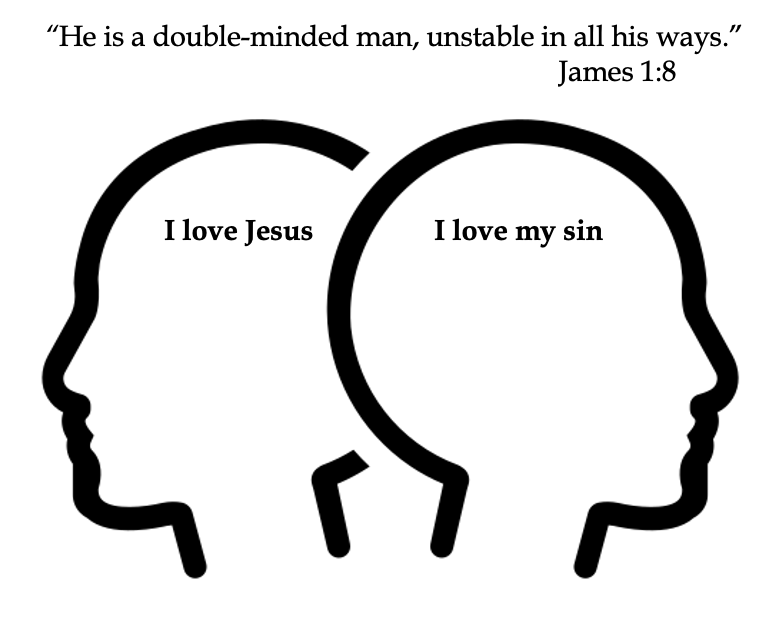
The first way Satan tries to control our minds is through what James calls being double-minded: “6 But let him ask in faith, with no doubting, for he who doubts is like a wave of the sea driven and tossed by the wind. 7 For let not that man suppose that he will receive anything from the Lord; 8 he is a double-minded man, unstable in all his ways.” (Jas. 1:6-8). Satan will do his best to make a Christian a spiritual schizophrenic with two minds. With our mind we want to love and serve the Lord, but also with our mind many times we want to toy with the things that are not of God. Instead of relying solely on God’s wisdom (Jas. 1:5), the double-minded believer wants to rely on human wisdom. He wants to act independently of God. James warns us that this is an “unstable” existence.
A divided mind is a very serious emotional state; but it is even more serious spiritually. We need to pray like King David prayed, “Unite my heart to fear Your name.” (Psa. 86:11b). David wanted God to bring a unity or single-mindedness to his heart, so the Lord was the center of everything in his life.
A second way the Devil attempts to control our minds is through a carnal mind. A carnal mind is an enemy of God. The apostle Paul tells us this in Romans 8. “For those who live according to the flesh set their minds on the things of the flesh, but those who live according to the Spirit, the things of the Spirit.” (Rom. 8:5). When Paul speaks of the carnally minded here (“set their minds on the things of the flesh”), he is referring to a believer who places himself under the law to try to become holy as Paul had tried to do only to experience spiritual defeat (cf. Rom. 7:4-25).
“While striving for holiness under the law, Paul had focused on the commands (e.g., ‘lust’) so that his mind-set was fleshly: ‘I must steer clear of all lust.’ This fleshly orientation doomed him to commit the very sin he sought to avoid.
“Simply put, if one lives with a fleshly orientation—even if it is the result of a vigorous effort to keep the law—he is going to fail because he has the wrong mind-set.” [12] [emphasis added]
“6 For to be carnally minded is death, but to be spiritually minded is life and peace. 7 Because the carnal mind is enmity against God; for it is not subject to the law of God, nor indeed can be.” (Rom. 8:6-7). These two mind-sets, “to be carnally minded,” or “to be spiritually minded,” are polar opposites. The first mind-set is in the sphere of “death” and results in “death.” But the “spiritually minded” believer experiences “life and peace.”
“The trap into which a Christian falls when he is principally concerned with the law itself is that he cannot escape a preoccupation with the spiritual deadness within and around him. The mind-set of the Spirit, however, lifts his preoccupations to the level of supernatural life and peace.” [13][emphasis added]
Carnal mindedness is described in Galatians by Paul when he writes, “19 Now the works of the flesh are evident, which are: adultery, fornication, uncleanness, lewdness, 20 idolatry, sorcery, hatred, contentions, jealousies, outbursts of wrath, selfish ambitions, dissensions, heresies, 21 envy, murders, drunkenness, revelries, and the like…” (Gal. 5:19-21). Carnal mindedness focuses on the fleshly desires of our sinful nature. The longer a Christian sets his mind on his sinful flesh, the more likely his fleshly mind becomes a demonically dictated thought process. Satan uses this carnal mindedness to control a believer’s thoughts.
The third way Satan will attempt to control our thoughts is through his version of “God-is-our-enemy–thoughts.” The Devil enjoys putting thoughts in our mind that say, “God is your enemy.” “God is not playing fair with you.” “He could make it different, but He is not.” “You ought to get angry with God.“ “If God truly loved you, He wouldn’t let you go through so much pain and suffering.” When we have thoughts like that, do we know where they are coming from?
God cannot be anything but good (Psa. 106:1), gracious (Psa. 111:4), holy (Isa. 6:3), just (Isa. 45:21), kind (Joel 2:13), loving (I John 4:8b), merciful (Ps. 103:8), and righteous (Psa. 11:7). Regardless of what we are experiencing, God is Who He is because He cannot be anything but that.
But Satan will come along when life is not what we hoped it would be, and he tries to rule our mind with wicked thoughts about God being our enemy. And these thoughts can easily make us angry toward the Lord.
Fourth, the Devil can also try to rule our minds through deceiving, lying thoughts. Such was the case with Ananias and Sapphira. Satan filled their hearts to lie to the Holy Spirit and keep back part of the price of the land they sold for themselves (Acts 5:4, 8-9). It cost both of them their lives.
Whenever we are tempted to lie, we can be assured that Satan is involved in that temptation. Jesus said the devil “is a liar and the father of it” (John 8:44).
Fifth, Satan will also try to control our minds through fearful thoughts. The Bible tells us the that our “adversary the devil walks about like a roaring lion, seeking whom he may devour” (I Pet. 5:8b).
“Do you know how a lion uses his fearsome roar to frighten his prey? I’m told that the old male in a lion pride goes upwind of a herd of gazelles or whatever and lets out a roar. The terrified animals take off in the opposite direction, where the rest of the pride is waiting to gobble them up.
“If we were to hear a lion roar, most of us would run. If he roared again, we would run again. Pretty soon we’re being directed by fear.” [14] [emphasis added]
In the verse prior to I Peter 5:8, Peter writes, “…casting all your care upon Him, for He cares for you.” (I Pet. 5:7). We can cast all our cares or concerns upon God because “He cares for you.” This phrase can be translated, “You are a matter of concern to God.” [15]
Christians who are engaged in intense spiritual warfare, especially those who facing Satanic frontal attacks, may conclude, “God doesn’t really care about me. If He did, He wouldn’t let me languish in this terrible bondage.”[16] [emphasis added]
If we believe God doesn’t care about us, we will be plagued by all kinds of fear. Satan loves to put us in bondage to fear. He will even use violent fear and panic to immobilize us.
But at the moment we feel that panic and fear, is the moment to use our helmet of salvation and pray, “In the mighty name of the Lord Jesus Christ and by the power of His blood, I command the wicked power of fear to leave my presence and go where the Lord Jesus Christ sends you.” God does not give us a spirit of fear, but of power and love and a sound mind (2 Tim. 1:7). The helmet of salvation enables our thoughts to be our own and to be like those of Christ.
Thoughts that are projected into our minds by the enemy need to be recognized quickly and decisively! We need to understand this. We don’t have to accept those thoughts from Satan as our own.
For example, one Christian young man was deeply troubled. Every time he began to pray to God, thoughts would enter his mind that said, “Pray to Satan…Pray to Satan… Pray to Satan.” He was tormented by these thoughts so much so that he became convinced he was going crazy. But once he understood where these thoughts were coming from, and resisted them, he was totally set free from those intruding thoughts. [17]
The Person of Salvation
This fifth piece of armor is called “the helmet of salvation.” What is salvation? The Bible informs us that salvation is a Person. David wrote, “The Lord is my light and my salvation.” (Psa. 27:1). The Hebrew word translated “salvation” is yeshu’ah. Yeshu’ah is the Old Testament word for “salvation,” and its basic meaning is “deliverance.” The English word Jesus, which means “God is salvation,” is also derived from this Hebrew word. Hence, David is saying, “The Lord [Yahweh] is my light and my Jesus [Yeshu’ah].” (Psa. 27:1). Salvation is a Person.
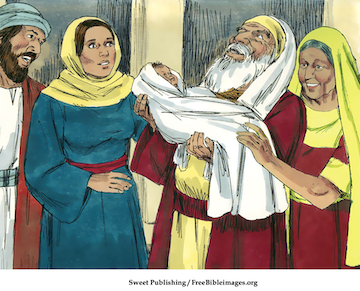
This is why Simeon prayed in the temple as he held the Baby Jesus in his hands, “Lord, now You are letting Your servant depart in peace, according to Your word; for my eyes have seen Your salvation…” (Luke 2:29-30). Christ is our salvation. He is a Person.
Thus, when we put on our helmet of salvation, we are putting on the Lord Jesus Christ to protect our mindsfrom the intruding thoughts of Satan and also to fill our minds with His thoughts. [18]
The Lord Jesus is much greater than the Devil. Christ is seated at the right hand of God the Father in the heavenly places, “far above all principality and power and might and dominion,” including Satan and his demonic armies (Eph. 1:20-21). Jesus sits in a position of authority and power that is far greater than the kingdom of darkness and we are seated next to Him (Eph. 2:5-6).
The apostle John tells us that this same Jesus indwells us: “You are of God, little children, and have overcome them, because He who is in you [Jesus through the indwelling Holy Spirit] is greater than he who is in the world [Satan].” (I John 4:4; cf. Gal. 2:20). Hence, we do not need to fear nor succumb to Satan’s attacks because Jesus in us is far greater than the Devil and his demonic armies who are in the world.
The Greek word translated “salvation” (sōtēria) in the New Testament basically means “deliverance.”[19] The apostle Paul refers to this helmet as “the hope of salvation,” that is, the hope of deliverance (I Thess. 5:8b). Why? Because Satan wants to convince us that our situation is hopeless. If we conclude that our situation is hopeless, that we are trapped in our bondage and there is nothing we can do, then we only have two choices: We can either abandon ourselves to the sin or get ready to check out of this life. [20]
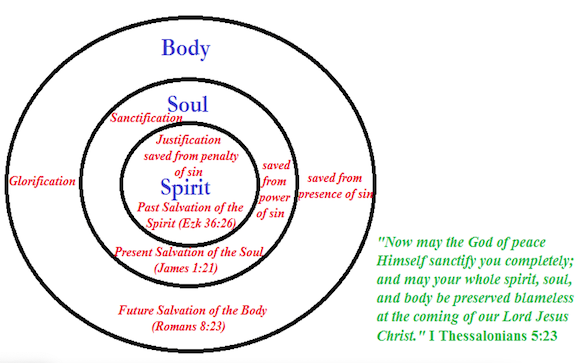
The type of deliverance Jesus provides is determined by the context. As our “Salvation” (Psa. 27:1), the Lord Jesus provides three types of deliverances as they relate to our spirit, soul, and body (I Thess. 5:23).
Our Past Salvation
The first type of salvation is our past salvation (a.k.a. justification) whereby our spirit is delivered from the penalty of sin forever when we believed in Jesus for His gift of salvation (Acts 16:31; Eph. 2:8-9). When we were born again by believing in Jesus (John 3:3-18), we received “a new spirit” (Ezek. 36:26) that “was created according to God, in true righteousness and holiness” (Eph. 4:23-24) and was “perfected forever” (Heb. 10:14). Our spirit “cannot sin because” it “has been born of God” (I John 3:9).
Satan wants to steal the assurance of our past salvation. Since he knows we cannot lose eternal life (John 3:16; 5:24; 6:35-40; 10:28-29; 11:25-26; et al.), he tries to rob us of our assurance that we are God’s child. He may put hideous thoughts in our minds and then accuse us, saying, “No true Christian would never entertain such wicked thoughts.”
Satan will use false teachers to try to steal our assurance of eternal life. The apostle John addresses this in his first epistle. John’s readers were being told by the antichrists (false teachers) that Jesus was not the Christ Who guarantees a future resurrection and never-ending life to all who believe in Him. But John refutes this by saying, “And this is the promise that He has promised us—eternal life.” (I John 2:25). Instead of listening to the falsehoods of the antichrists, John redirects his readers to the unchanging “promise” of God which guarantees “eternal life” to all who believe in Jesus (cf. I John 5:1, 13; John 3:15-16, 36; 5:24; 6:35-40, 47; 11:25-27; 20:31). This is the message they heard from the beginning of their Christian experience. This is how they began a personal relationship with God. Assurance of eternal life is found in God’s promises, not in the lies of false teachers which denied that eternal life is through simple faith in Jesus.
There is much confusion today about assurance of salvation. Some insist that assurance of going to heaven is based on our performance and whether we measure up to certain tests concerning the quality of our Christian experience. [21] But if we look to our performance or experience, we will never be certain we have eternal life because we always fall short of God’s glory (Rom. 3:23; I John 1:8, 10). Whenever we take our focus off Christ and His finished work on the cross (John 19:30), we are more likely to doubt our salvation. Even on our best day, we still fall short of God’s glory.
John wants his readers to look to the unchanging promises of God for the assurance of their salvation.“God’s promises don’t change. That’s why the promises of God are the foundation for our assurance of salvation. People who want to teach that 1 John is a book of tests to determine whether you are a Christian or not have gone completely against what John himself uses as his source of assurance: the promises of God.”[22]
Why does John remind his readers of their secure relationship with Jesus? “These things I have written to you concerning those who try to deceive you.” (I John 2:26). John did not want his readers to be deceived by the false teachers who tried to undermine their assurance of salvation. Knowing they have eternal life simply be believing in Jesus for it would enable them to effectively resist these antichrists who taught John’s readers they were not genuinely saved because they lacked a secret knowledge which only the false teachers could give them to have eternal life. John understood if a Christian doubts his or her salvation they are more vulnerable to losing their fellowship with God and the apostles. Hence, I believe John would agree with the apostle Paul, that Christians must take up the helmet of salvation, so they do not lose the hope of their past salvation.
Our Present Salvation
The second type of salvation is our present salvation (a.k.a. sanctification) whereby our soul is being delivered from the power of sin as we hear the word and do what it says (Phil. 2:12; Jas. 1:21-22). Just as we were justified and reconciled to God through faith in Jesus’ death, so now we are to be saved from the power of sin (God’s present-day wrath – Rom. 1:18-32) through faith in Jesus’ resurrection life (Rom. 5:9-10). This is a lifelong process called discipleship which begins at conversion and ends when we go to be with Jesus in His heaven (John 8:31-32; 13:34-35; 14:1-3; 15:1-8).
Reimer writes, “To really understand your identity, you have to properly divide soul and spirit. Your spirit has been made new. You are a new creation in Christ. You have received a new spirit and a new heart (Ezek. 36:26). Your spirit has been perfected in Christ. You have received every spiritual blessing you need in the heavenly realms (Eph. 1:3). You are adopted into the family of God (Eph. 1:5; Rom. 8:15). You are heirs of God…
“These are all the claims of Scripture for who you are in Christ. Your spirit has been purified, purged, renewed, born again, and transformed. But your soul… well, that can still be a bit of a mess.
“Your soul can have hurts and bitterness. Your soul can still have sin and demonic strongholds. Your soul can have fears and faulty beliefs about who you are. Your soul can still feel condemnation and shame.
”Sanctification, or the process of becoming like Jesus is simply becoming who you already are. You have to work out in the realm of the soul what has already taken place in the heavenly realms through the work of Christ in your spirit.
“Your soul is where your mind, your will, and your emotions still hold sway over the reality of your daily existence. For example, you may know cognitively that you are loved, but because you grew up in an abusive home, or because of your own sinful behaviors, you don’t feel loved. You don’t act as if you are deeply loved. Your soul still feels shame, you may even feel unlovable, and you feel distant from God. Until you deal with the issues of your soul, you will not experience the fullness of God nor the intimacy with Him for which your heart longs.
“Working out your identity is learning to become who you already are. This battle for your identity is a critical part to your spiritual maturity.”[23] [emphasis added]
Satan wants to deceive us into thinking that the power of sin has not been broken in our lives. That we are still slaves to sin. He loves to whisper lies that say, “You can never change.” “This isn’t that bad.” “God gave you this desire, so use it.” “Everyone else is doing it.” “You deserve to feel pleasure.” “You cannot cope with your pain without doing this.” “God doesn’t want you to experience this because He knows you will become more like Him knowing good and evil, etc.”
The Bible describes the victory Jesus has already won for us, “Having disarmed principalities and powers, He made a public spectacle of them, triumphing over them in it.” (Col. 2:15).
“It is more natural to view the principalities and powers here as the defeated foes, driven in front of the triumphal chariot as involuntary and impotent witnesses to their conqueror’s superior might.” [24][emphasis added]
“The picture, quite familiar in the Roman world, is that of a triumphant general leading a parade of victory…. To the casual observer the cross appears to be only an instrument of death, the symbol of Christ’s defeat; Paul represents it as Christ’s chariot of victory.” [25] [emphasis added]
The death of Jesus did three things to the spiritual rulers of darkness. It disarmed them, displayed them, and dethroned them.
How did Jesus do this? [26] Jesus “wiped out the handwriting of requirements that was against us, which was contrary to us. And He has taken it out of the way, having nailed it to the cross.” (Col. 2:14). When a person was executed under Roman law, the sentence was attached to the accused’s cross (see John 19:19). But Jesus took our sentence away, effectively nailing our certificates of debt to His cross. He paid our penalty in full (John 19:30); He died for our guilt and shame. God “made Him who knew no sin to be sin for us, that we might become the righteousness of God in Him.” (2 Cor. 5:21).
Satan now has no legitimate grounds to accuse us of wrongdoing before God because Jesus already paid our sin debt to God in full. That is why Paul writes, “Having disarmed principalities and powers, He made a public spectacle of them, triumphing over them in it.” (Col. 2:15). A fallen angel is no match for the Son of God, Who took away Satan’s power. Satan is the accuser of Christian brothers and sisters (Rev. 12:10). He accused Job (cf. Job 1:9-11; 2:4-5) and Joshua the high priest (Zech. 3:1). But in light of the all-sufficient sacrifice of Jesus’ atoning sacrifice, Satan’s accusations are empty now.
If somebody has a gun pointed at you, whether or not it’s loaded is a huge deal. The devil doesn’t want us to know that his gun has been emptied by the cross of Christ. Now, if we don’t know that, we are still going to cower and run, living in fear and shame. But we don’t have to listen to the devil any longer. Though he is right about our sin, our sin debt has been paid by Christ in full. We are free to live for God now. Satan still has power, but he no longer possesses final authority in our Christian lives.
Thus, when the devil tempts us to sin, we can respond by saying,“Jesus has already broken the power of that sin through His death and resurrection (Rom. 6:10-11). Therefore, it has no power over me.”
Our Future Salvation
Our third type of salvation is our future salvation (a.k.a. glorification) whereby our physical body is delivered from the presence of sin when Jesus comes back for His church (I Thess. 1:10; 4:13-18; 5:8b-10; I John 3:2-3). The apostle Paul writes, “And to wait for His Son from heaven, whom He raised from the dead, even Jesus who delivers us from the wrath to come.” (I Thess. 1:10). The Greek verb translated “delivers” [ruomenon] means to “rescue from danger.”[27] This deliverance or rescue is from the Tribulation “wrath to come” on earth (cf. Rev. 6:1-18:24) which is the theme of this epistle [28] (cf. I Thess. 2:19; 3:13; 4:13-5:11, 23). How does Jesus deliver Christians from this coming Tribulation wrath on earth?
Paul explains in First Thessalonians 4:13-18. The apostle does not want his readers, including us, to be ignorant concerning believers who have died lest we “sorrow as others who have no hope.” (I Thess. 4:13). Paul understands that an ignorant believer can easily become a hopeless believer. [29] He then provides the order of events in the Rapture or sudden removal of the church from the earth.
First, we see the return of Christ in the air with Christians who have died. “For if [or since] we believe that Jesus died and rose again, even so God will bring with Him those who sleep in Jesus.” (I Thess. 4:14). The rapture of the church is just as certain as the death and resurrection of Jesus Christ. At one point in time the death and resurrection of Christ were prophecy. But now they are history. We can believe the Rapture with equal certainty.
When Paul refers to “those who sleep in Jesus,” he is talking about Christians who have died (cf. John 11:11-12). What happens when a Christian dies (see pic)? His spirit goes immediately to heaven, but his body “sleeps” in the grave. “We are confident, yes, well pleased rather to be absent from the body and to be present with the Lord.” (2 Cor. 5:8). To be absent from the body in death is to be present with the Lord Jesus in heaven.
The second event is the resurrection of the bodies of Christians who have died. “For this we say to you by the word of the Lord, that we who are alive and remain until the coming of the Lord will by no means precede those who are asleep.” (I Thess. 4:15). The bodies of Christians who have died will be resurrected first by Jesus, so that their spirits, which are now with Christ, can re-enter their bodies permanently in resurrection. Notice that Paul included himself in these verses – “we who are alive and remain…” He expected to be “alive” when Jesus returned. He believed the Rapture could take place at any time and so should we.
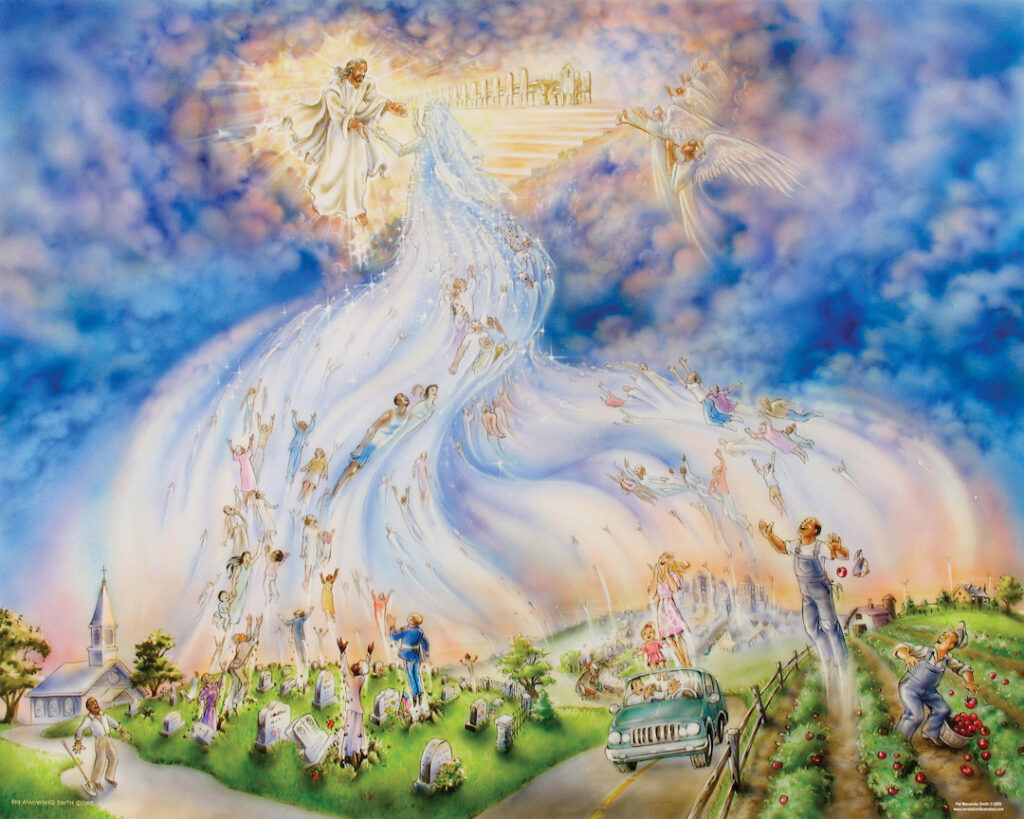
“For the Lord Himself will descend from heaven with a shout, with the voice of an archangel, and with the trumpet of God. And the dead in Christ will rise first.” (I Thess. 4:16). In the Rapture, it is the Lord Jesus Himself that is coming, not the Holy Spirit or God’s angels. There will be a magnificent sound much like a shout, like the voice of an archangel and like the sound of a trumpet all in one, and only those who have placed their trust in Christ as their Savior will hear it. For the Bible says, “The dead in Christ will rise first.” Only those who are “in Christ” through believing in Jesus, will respond to this sound. Those who have not believed in Jesus Christ will be left behind.
Notice that Christians who have died will return with Jesus (I Thess. 4:14b) and receive a glorified resurrection body (“the dead in Christ will rise first” – I Thess. 4:16b) that is incorruptible (sinless) and imperishable (eternal), like the resurrection body of the Lord Jesus Christ (cf. I Cor. 15:35-51; Phil 3:20).
Next is the removal of living Christians. “Then we who are alive and remain shall be caught up together with them in the clouds to meet the Lord in the air. And thus, we shall always be with the Lord.” (I Thess. 4:17a). The words “caught up” are from the Greek word haparzō which means “to snatch up or take away suddenly.” [30] Paul describes it like this: “In a moment, in the twinkling of an eye, at the last trumpet… the dead will be raised incorruptible, and we shall be changed.” (I Cor. 15:52). In the time it takes you to blink your eye, the Lord will snatch all believers in Jesus off the earth to meet Him in the air – not one will remain behind.
Finally, we see the reunion of both living and dead believers with the Lord in the air. “Then we who are alive and remain shall be caught up together with them in the clouds to meet the Lord in the air. And thus, we shall always be with the Lord.” (I Thess. 4:17). This sudden removal of all Christians from the earth is intended to comfort believers in Jesus. That’s why Paul writes, “Therefore comfort one another with these words.” (I Thess. 4:18.) If the rapture is at the middle or end of the seven-year Tribulation period of intense and unusual suffering on earth, there would be little comfort and encouragement in this. But the prospect of Christ coming at any moment is a much greater comfort.
Paul alludes to putting on “as a helmet the hope of salvation” (I Thess. 5:8c). The Greek word translated “salvation” (sōtērias) in First Thessalonians is not deliverance from everlasting punishment in hell, but deliverance from the Tribulation wrath on earth. “9 For God did not appoint us to wrath, but to obtain salvation through our Lord Jesus Christ, 10 who died for us, that whether we wake or sleep, we should live together with Him.” (I Thess. 5:9-10). Christians will not go through the Tribulation because “God did not appoint us to wrath.” Thus, this “salvation” is deliverance from God’s Tribulation wrath on the earth via the Rapture of the church “through our Lord Jesus Christ.”
Our precious Lord’s death (“Christ, who died for us”) guarantees that all Christians will be caught up to be with Jesus, “whether we wake or sleep,” spiritually (I Thess. 5:10; cf. I Thess. 5:4-7). Knowing and believing this truth acts as a protective helmet against Satan’s attacks. The Devil wants us to doubt that we will be delivered from God’s coming wrath through the Rapture of the Church. He has convinced many Christians that they will go through the Tribulation period. Some believers think we are now in the Tribulation.
Satan wants us to conclude that Jesus is not coming back in our lifetime because he understands that we will then be more likely to live his way instead of God’s way. Jesus warned of this faulty conclusion when He told the parable of the faithful servant who became an evil servant (Matt. 24:45-51). Christ spoke of “a faithful and wise servant, whom his master made ruler over his household” (Matt. 24:45). If that servant remains faithful in light of his master’s soon return, his master “will make him ruler over all his goods” when he comes back (Matt. 24:46-47).
But Jesus warns, “If that evil servant says in his heart, ‘My master is delaying his coming,’” he will be in danger of mistreating “his fellow servants” and living a self-indulgent life (“eat and drink with the drunkards”), resulting in a severe rebuke (“the master of that servant… will cut him in two,” cf. Heb. 4:12-13) and intense grief (“weeping and gnashing of teeth”) over the loss of eternal rewards at the Judgment Seat of Christ (Matt. 24:48-51; cf. Matt. 25:30; I Cor. 3:15; I John 2:28). [31]
Even though it has been nearly twenty centuries since Jesus ascended to heaven, no Christian should dare to conclude that Jesus “is delaying His coming” for His church. That is what Satan wants us to do. He knows that if we lose sight of the nearness of Christ’s return, we will also lose hope.
The helmet of salvation provides hope for the believer. The hope that one day all the projected thoughts from the powers of darkness will be removed forever when the Christian is given a new resurrection body which will no longer be subject to sin and death.
The promise that Jesus Christ could return for His church at any moment is one of the greatest reasons for us to live for Jesus now. Focusing on Christ’s any-time-return “purifies” us inwardly so we can have confidence and not be ashamed before Him when He appears (I John 2:28; 3:2-3).
Conclusion
Satan does not want us to put on the helmet of salvation because…
He wants us to live in the past filled with our sin and shame. But when we put on the helmet of salvation, the Lord Jesus instructs us to learn from the past, not live in the past because He has delivered our spirit from the penalty of sin forever the moment we believed in Him for His gift of salvation (Acts 16:31; Eph. 2:8-9; 4:23-24; cf. Ezek. 36:26).
He wants us to believe that we are still slaves to sin who can never change. But when we put on the helmet of salvation, Christ tells us that we can change because our soul is being saved from the power of sin which was broken through Jesus’ death and resurrection (Rom. 6:10-11). We must simply hear and do what Christ tells us (Jas. 1:21-22).
He wants us to doubt Jesus will return for His church in our lifetime so we will lose hope and live under his control instead of God’s. However, when the helmet of salvation is put on, we become watchful for Jesus’ soon return for His church when our physical bodies will be saved from the presence of sin forever (I Thess. 1:10; 4:13-5:11; I John 3:2-3). Focusing on Christ’s any-time-return “purifies” us inwardly so we can have confidence and not be ashamed before Him when He appears (I John 2:28; 3:2-3).
As with the other pieces of armor, we put on the helmet of salvation through prayer (Eph. 6:18).
Prayer: Father God, I recognize that my mind is a particular target of Satan’s deceiving ways. Thus, I cover my mind with the powerful helmet of salvation which protects and directs my thoughts, so my life is filled with hope. Thank You for the assurance that my spirit is saved from the penalty of sin forever when I put my faith in the Lord Jesus alone for His gift of salvation. I praise you for Jesus’ death and resurrection which broke the power of sin. By Your grace I pray for my soul to be saved from the power of sin as I yield to the Holy Spirit’s power to obey what Your Word says. And thank You Lord for the hope that my physical body will be saved from the presence of sin when Jesus gives me a new glorified resurrection body when He comes back for His church. Please show me any thoughts I am entertaining right now that are from the enemy. In the authority of the Lord Jesus Christ and by the power of His blood, I come against the power of darkness that just put that wicked thought in my mind. And I command you to leave me and go where the Lord Jesus Christ sends you.
FOOTNOTES:
[1] Adapted from David R. Anderson, Position and Condition: An Exposition of the Book of Ephesians (Grace Theological Press, 2017 Kindle Edition), pp. 369-370.
[3] Tony Evans, The Tony Evans Bible Commentary, 2019 Kindle Edition, pg. 2665.
[4] The first three verbs in Greek (perizōsamenoi… endysamenoi… hypodēsamenoi… ) are aorist middle participles which means they have already been put on by the soldier or Christian.
[5] Evans, The Tony Evans Bible Commentary, 2019 Kindle Edition, pg. 2665.
[6] The Greek verb translated “taking…” (analabontes) is an aorist active participle, meaning the Christian is taking the shield of faith as needed and the last Greek verb translated “take…” (dexasthe) is an aorist middle imperative which is used of the last two pieces of armor and means for oneself to take them up as needed.
[7] Retrieved on March 5, 2025, from an article entitled, “Motorcycle Helmet Laws and Safety Statistics 2024,” at lawtigers.com. The article states that “in states with universal helmet laws, 55 percent of motorcyclists killed in 2021 were not wearing helmets, compared to 9 percent in states with universal helmet laws.”
[8] The following lengthy discussion about the use of a helmet in American football is adapted from Tony Evan’s video message entitled, “The Helmet of Salvation,” on youtube.com.
[9] Many of the following paragraphs are adapted from Mark Bubeck’s video message entitled “9. Head First Into Battle… Ephesians 6 Series,” on BRMinistry app, unless otherwise noted.
[10] For a more detailed treatment of Matthew 16:21-23, see “Spiritual Warfare – Part 2” in Ropp Update & Reflections (July 2024).
[11] Much of this section is adapted from Mark Bubeck’s video message entitled “9. Head First Into Battle… Ephesians 6 Series,” on BRMinistry app, unless otherwise noted.
[12] Zane C. Hodges, “Romans,” The Grace New Testament Commentary: Revised Edition, 2019 Kindle Edition, pg. 1045.
[17] Adapted from Mark Bubeck’s video message entitled “9. Head First Into Battle… Ephesians 6 Series,” on BRMinistry app.
[18] The first three paragraphs of this section are adapted from Mark Bubeck’s video message entitled “9. Head First Into Battle… Ephesians 6 Series,” on the BRMinistry app.
[19] Walter Bauer, A Greek-English Lexicon of the New Testament and Other Early Christian Literature: Third Edition, 2000 Kindle Edition, pp. 985-986.
[21] Anderson, Maximum Joy: I John – Relationship or Fellowship? 2013 Kindle Edition, pg. 15 cites John MacArthur, Jr., Saved without a Doubt (Colorado Springs: Cook Communications, 1992), pp. 67-91; Tom Constable, Notes on I John, 2022 Edition, pg. 46 cites James Montgomery Boice, The Epistles of John (Grand Rapids: Zondervan Publishing House, 1979); John F. MacArthur Jr., The Gospel according to Jesus (Grand Rapids: Zondervan Publishing House, 1988); John R. W. Stott, Basic Introduction to the New Testament, 1st American ed. (Grand Rapids: Wm. B. Eerdmans Publishing Co., 1964); and Warren W. Wiersbe, The Bible Exposition Commentary, 2 vols. (Wheaton: Scripture Press Publications, Victor Books, 1989).
[22] Anderson, Maximum Joy: I John – Relationship or Fellowship? 2013 Kindle Edition, pg. 128.
[23] Dr. Rob Reimer, Soul Care: Seven Transformational Principles For A Healthy Soul (Carpenter’s Son Publishing, 2016), pp. 37-38.
[24] Tom Constable, Dr. Constable’s Notes on Colossians, 2023 Edition, pg. 61 cites F. F. Bruce, “Colossians Problems,” Bibliotheca Sacra 563 (July- September 1984):198-199.
[25] Ibid., cites Curtis Vaughan, In Ephesians-Philemon. Vol. 11 of The Expositor’s Bible Commentary, 12 vols. Edited by Frank E. Gaebelein and J. D. Douglas (Grand Rapids: Zondervan Publishing House, 1978), pg. 202.
[26] The following three paragraphs are adapted from Tony Evans, The Tony Evans Bible Commentary, 2019 Kindle Edition, pp. 2701-2702.
[27] Bauer, A Greek-English Lexicon of the New Testament and Other Early Christian Literature: Third Edition, 2000 Kindle Edition, pg. 907.
[28] Robert Wilkin, “I Thessalonians,” The Grace New Testament Commentary: Revised Edition, 2019 Kindle Edition, pg. 1463.
[29] Evans, The Tony Evans Bible Commentary, 2019 Kindle Edition, pg. 2727.
[30] Bauer, A Greek-English Lexicon of the New Testament and Other Early Christian Literature: Third Edition, 2000 Kindle Edition, pg. 134.
[31] Hal Haller Jr., “Matthew,” The Grace New Testament Commentary: Revised Edition, 2019 Kindle Edition, pp. 179-182.
On my bike ride last Monday (April 8, 2024) while I was stopped at a stoplight, a woman walking her dog asked me if I was waiting for the eclipse. I said the coming of Christ is more important to me than the coming of a solar eclipse. [1] She agreed, but then she asked if the solar eclipse was a sign that Christ’s coming is near, citing Jesus’ words from His Olivet Discourse, “Immediately after the tribulation of those days the sun will be darkened, and the moon will not give its light…” (Matt. 24:29) prior to Christ’s return to earth (Matt. 24:30-31). About three weeks ago while I was driving my wheelchair van at work, a client’s caregiver said her church taught that this solar eclipse was the last chance for people to get right with God because Jesus was coming back to earth at that time.
Is this solar eclipse one of the signs that Jesus spoke of regarding His coming to earth? Well, the solar eclipse has come and gone, but Jesus did not return to earth. Should this surprise us? No. Why do I say this?
Because there are no prophetic signs that must take place before Jesus comes back for His church. Those who conclude that Jesus’ reference to the darkening of the sun prior to His return to earth refers to this recent solar eclipse are confusing two different aspects of Jesus’ Second Coming which Christ alludes to in Matthew 24.
When His disciples ask, “When will these things be? And what will be the sign of Your coming, and of the end of the age?” (Matt. 24:3), Christ answers the second question (“And what will be the sign of Your coming, and of the end of the age?”) first in Matt. 24:4-35 which describes the seven-year Tribulation period that will contain many “signs” of the nearness of Jesus return to earth. This is designated by the words “the sign” (to semeion) used only in verses 3 and 30. Jesus begins with a survey of the entire seven years (Matt. 24:4-14) followed by a closer look at the last half of the seven-year Tribulation (Matt. 24:15-28).
Then in verse 29 Jesus uses the phrase, “Immediately after the tribulation of those days…” to introduce His description of His Second Coming described in Matthews 24:30-31. Christ explains in Matthew 24:32-35 how the events of the seven-year Tribulation He just described (Matt. 24:5-31) are like the springtime budding of the fig tree. Just as the budding of the fig tree in the spring signals the nearness of summer, so the events that take place during the Tribulation provide clear evidence of the nearness of Christ’s Second Coming. Throughout Matthew 24:5-31 there are many observable “signs” or “warnings” that signal Christ’s future return to earth. In Matthew 24:32-35 Jesus commands His disciples to “learn this parable from the fig tree” and “When you see all these things, know that it [His return to earth] is near.”
But when we come to Matthew 24:36, Jesus says, “But of that day and hour no one knows.” Now Jesus is talking about His coming without any preceding observable signs that signal His return. Jesus is talking about two different aspects of His Second Coming – one that involves observable signs(Matt. 24:4-31) and one that involves no observable signs (Matt. 24:36-44). (see chart)
The Greek phrase “But of” (peri de) that Jesus uses in Matthew 24:36 at the beginning of the sentence marks a new section of thought that looks back to the previous material to answer an unanswered question. Hence, Jesus answers the disciples’ first question (“When will these things be?”) in verse 3 about when the end-time events will begin. Because of this major transitional marker (peri de), “the coming of the Son of Man” (Matt. 24:37) is referring to a different phase of the Lord’s return.
The peri de (“But of”) of verse 36 is followed by the phrase “that day and hour.” In Matthew 24, only the phrase “those days” (plural) had been used (24:19, 22, 29). But in verse 36, Jesus changes to “that day” (singular). Why? Because He is transitioning to talk about the Old Testament “day of the Lord” which was considered an imminent event – it could take place at any moment (Ezek. 30:3, 9; Joel 3:14, 18; Zeph. 1:7-15). The apostle Paul also uses “day” for the imminent day of the Lord in I Thessalonians 5:4 where he is speaking of the sudden removal of the church prior to the wrath of God during the Tribulation period (I Thess. 4:13-5:11; cf. 1:10). Both the pretribulational rapture and day of the Lord are illustrated by the thief in the night imagery which is an imminent event (cf. Matt. 24:43; Luke 12:39-40; I Thess. 5:2; 2 Pet. 3:10).
After Jesus looked at the events of Daniel’s 70th week of years as a whole (Matt. 24:4-35), He now talks about the beginning of that week (Matt 24:36-44) which will catch everyone by surprise. Jesus explains that the coming of “that day and hour” will be like “the days of Noah” in which people “were eating and drinking, marrying and giving in marriage, until the day that Noah entered the ark, and did not know until the flood came and took them all away, so also will the coming of the Son of Man be” (Matt.24:38-39; cf. Luke 17:27-28 where a similar description of the days of Lot is given). The lifestyles described in the days of Noah and Lot have existed in every generation since the early days of human history. These lifestyles are ones of normalcy and indifference.
In Matthew 24:41-42, two men are working in a field and two women are grinding at the mill which also focuses on normal, unsuspecting lifestyles. Jesus’ point in Matthew 24:37-39 is that just as normal and unsuspecting lifestyles existed prior to the great worldwide judgment of the flood in Noah’s day, so too normal and unsuspecting lifestyles will exist prior to the sudden beginning of the day-of-the-Lord judgments which begin after the Rapture of the church. The people of Noah’s day “did not know” about the coming worldwide flood “until the flood came and took them all away” (Matt. 24:39). Is it likely that the world will not know about the devastating judgments that have been inflicting it during the past seven-year Tribulation (Matt. 24:5-31; cf. Rev. 6:6-17)? Not likely. It is much better to understand Jesus’ Noah illustration corresponding to the time of the sudden arrival of the day of the Lord and the pretribulation rapture.
The word “taken” in Matthew 24:40-41 refers to believers being taken in the rapture before the Tribulation. While Jesus uses the word airo (“took…away”) in Matthew 24:37 to refer to unbelievers being taken in judgment by the Flood, He uses a different word for “taken” (paralambano) in Matthew 24:40-41. This Greek word, paralambano, has the meaning of “take into close association, take (to oneself), takewith/along.[2] It conveys the idea of personal accompaniment. In other words, believers will be taken to be with Christ forever at the rapture of the church (cf. I Thess. 4:15-17). Two days after His teaching in Matthew 24, Jesus used the word paralambano in John 14:3 to describe the taking of believers in a pretribulational rapture – “And if I go and prepare a place for you, I will come again and receive [paralambano] you to Myself; that where I am, there you may be also” (John 14:3).
This understanding is substantiated further by the word for “left” (aphiemi) in Matthew 24:40-41 which has the idea of “abandon” when its object is a person (cf. Matt. 4:11, 22; 8:15; 13:36; 19:29; 22:22, 25; 26:56, etc.). God will never abandon believers (Heb. 13:5). Two days after Jesus’ teaching in Matthew 24, He used aphiemi in John 14:18 when He said, “I will not leave [aphiemi] you as orphans; I will come to you” (John 14:18). Rather than referring to unbelievers being taken to judgment and believers being abandoned by the Lord in Matthew 24:40-41, Christ is referring to believers being taken to be with Jesus forever at the rapture of the church and unbelievers being abandoned to face God’s wrath during the seven-year tribulation period on the earth. The judgments of the day of the Lord will come on unbelievers and they will not escape (I Thess. 5:3).
Jesus employs “the thief” imagery in Matthew 24:42-44 to encourage His disciples to “watch” and “be ready” for His any-moment coming for them. This thief imagery is also used in several other prophetic passages dealing with the rapture and day of the Lord, most importantly I Thess. 5:2-4 and 2 Peter 3:10. A thief depends upon the element of surprise. He does not give any forewarning of his coming. Hence, the thief imagery used in Matthew 24:42-44 must refer to the pretribulational rapture of the church which has no observable signs prior to it (Matt. 24:36-44). But the Second Coming of Christ to earth at the end of the tribulation has many observable signs (Matt. 24:5-31).
The use of the word “watch” (gregoreo) in Matthew 24:42-43 in connection with the thief imagery conveys the idea of imminency – it could happen at any moment. Gregoreo occurs several times in prophetic passages taught by Jesus (Matt. 24:42, 43; 25:13; Mark 13:34, 35, 37; Luke 12:37) and the apostles Paul ( I Thess. 5:6, 10) and John (Rev. 3:2, 3; 16:15). Eight of the twelve uses of gregoreo in prophecy take place with the thief imagery (Matt. 24:42-43; Luke 12:37-39; I Thess. 5:2-10; Rev. 3:2-3; Rev. 16:15). Even in non-prophetic passages, imminency is connected to the use of the verb “to watch” (cf. Matt. 26:45; Acts 20:31; I Pet. 5:8). It is most appropriate to understand Jesus’ command to “watch” or be “alert” (gregoreo) in connection with the thief imagery in Matthew 24:42-44, to refer to an imminent, pretribulational return of Christ prior to the tribulation period. Hence, we can be confident that the apostle Paul’s use of the verb “to watch” in I Thessalonians 5:6 and 10 in the context of an imminent pretribulational rapture was derived from Jesus’ use of the same word in Matthew 24:42-44 where He stressed watchfulness in the context of His imminent pretribulational rapture.
Hence, when people mistakenly refer to the recent solar eclipse as a sign of the nearness of Christ’s return to earth, they are confusing the second aspect of Christ’scoming which will be preceded by observable signs (i.e. the sun darkening, etc.) with the first aspect (i.e. the rapture or removal of the church) which will not be preceded by observable signs (see chart).
Before I left the woman who asked me about the solar eclipse being a sign of the nearness of Christ’s coming, I told her that Jesus’ coming for His church could happen at any moment. There are no prophetic signs that must take place before He comes for those who are His. The key is to be ready for His return.
If you are not certain you have the gift of eternal life from Jesus and that you will go to heaven when Christ comes for His church at any moment, you can receive His gift right now. Jesus said, “He who believes in Me has everlasting life.” (John 6:47). Are you persuaded that Jesus was speaking the truth when He said this, and He is therefore worthy of your trust? If so, then Christ guarantees you now have everlasting life, and you will enter His heaven in the future whether you die first (2 Cor. 5:6-8; Phil. 1:21-23) or He comes back while you are alive (I Thess. 4:15-17).
If you do know you have everlasting life as a result of believing in Jesus (I John 5:13), it is important not to let anything eclipse the light of the Son in your life. The recent solar eclipse occurred when the Moon passed between the Earth and the Sun and blotted out all or some of the Sun’s light, depending on where you live. When we permit someone or something to come between us and the Son that blocks His light from reaching us, we experience broken fellowship with Jesus. The key is for us to remain open and honest before the Son, Who is light (I John 1:5-7). When God reveals sin in our lives, we simply confess that sin to Him, and He is faithful and just to forgive that sin and cleanse us of all our unknown sins or unrighteousness (I John 1:9).
FOOTONOTES:
[1] According to NASA there has been an average of 2-3 solar eclipses of all kinds each year every 1,000 years and about 2 total solar eclipses every 3 years (retrieved on April 12, 2024, from https://science.nasa.gov/eclipses/future-eclipses/eclipse-2024/faq/).
[2] Walter Bauer, A Greek-English Lexicon of the New Testament and Other Early Christian Literature, 2000 Kindle Edition, pg. 767.
“’Behold, the virgin shall be with child, and bear a Son, and they shall call His name Immanuel,’ which is translated, ‘God with us.’” Matthew 1:23
I never grow tired of hearing the Bible’s perspective about the birth of Jesus Christ. It truly is good news! In the gospel of Matthew, we learn of the humanity of Jesus as proven by the fact that He is a legal Descendant of King David (Matt. 1:1-17; 2 Sam. 7:16). But Jesus is also God as proven by His names and manner of conception (Matt. 1:16, 18, 20-21, 23, 25). 1
When Joseph discovered Mary became pregnant while engaged to him, he assumed the worst and sought to put her away to avoid public disgrace for them both (Matt. 1:18-19). Before Joseph could act, God showed up to him and addressed him as a descendant of David (“son of David”) through whom the Messianic King would come, telling him not to be afraid because Mary’s pregnancy was supernaturally produced by God the Holy Spirit (Matt. 1:20). This Son Whom Mary would bear was to be named “Jesus” (Yahweh is Savior) “for He will save His people,” Israel, “from” the physical (Zech. 9:9-10) and spiritual (Acts 10:43; 16:31) consequences of “their sins” (Matt. 1:21). 2
Jesus’ virgin birth fulfilled Isaiah’s prophecy (Isaiah 7:14) that a virgin shall be with child – a supernatural sign that would indicate an unusual “Child” was to be born because of His divine nature and presence (Matt. 1:22-23a). A virgin birth through the Holy Spirit explains Jesus’ sinless nature (2 Cor. 5:21; Heb. 4:15). The sin nature is passed on through the human father. Romans 5:12 states, “Therefore, just as through one man sin entered the world, and death through sin, and thus death spread to all men, because all sinned” (cf. Rom. 5:18).Although Eve sinned first in the Garden of Eden (Gen. 3:1-6), Adam is held accountable for sin’s entrance into the world.
The Bible also teaches that God visits “the iniquity of the fathers upon the children to the third and fourth generations” (Exod. 20:5; cf. Deut. 5:9). Generational sins are passed on through the fathers, not the mothers.This implies that the sin nature is transmitted through the fathers, not the mothers or both parents.
“Humans have 23 pairs of chromosomes: one member of each pair inherited from the mother and the other from the father. This suggests that when the Holy Spirit overshadowed Mary (Luke 1:35), and Jesus was conceived in His mother, God miraculously supplied the other 23 chromosomes to make the matched pair with Mary’s. These would normally have come from a human father.”3
“And the angel said to her, ‘The Holy Spirit will come upon you, and the power of the Highest will overshadow you; therefore, also, that Holy One who is to be born will be called the Son of God.’” (Luke 1:35). Since God the Holy Spirit took the place of the human father and brought about the conception of Jesus, His 23 chromosomes “overshadowed”Mary’s, causing Christ to be the only human being ever to be conceived since the fall of Adam and Eve without a sin nature. The Greek word translated “overshadowed” (episkiazo) occurs in all three accounts of the Transfiguration where the cloud overshadowed those present (Matt. 17:5; Mark 9:7; Luke 9:34). 4 The Holy Spirit “overshadowed” Mary with His presence to bring about this supernatural conception.
“This delicate expression rules out crude ideas of a ‘mating’ of the Holy Spirit with Mary.”5
“The deity and preexistence of the Son of God required a miraculous conception. His virgin birth resulted in His assuming a human nature, without giving up His divine nature.”6
The virgin birth qualifies this infinite Person (Jesus) to bear an infinite number of sins for all humanity on the cross 7 (cf. John 1:29; I John 2:1-2). Only a perfect sacrifice could remove the sins of all humanity forever. In the Old Testament, emphasis is given to “perfect” animal sacrifices “without blemish” (Exod. 12:5; 29:1; Lev. 1:3, 10; 3:1, 6; 4:3, 23, 28, 32; 5:15, 18; 6:6; 9:2-3; 14:10; 22:19, 21; et al.) as foreshadows of the perfect Lamb of God Whose shed blood on the cross would perfect forever those who believe in Him (John 1:29; 3:14-18; Rom. 4:5; 8:31-39; 2 Cor. 5:21; Heb. 9:1-10:18; I Pet. 3:18)!
Since Jesus is fully human (John 1:14; I Tim. 2:5), He can empathize with our human struggles (Heb. 4:15). And since He is fully God (John 1:1, 18; Titus 2:13; I John 5:20), He can heal our brokenness (Exod. 15:26b; Psalm 147:3). Jesus is “Immanuel” which means “God with us” (Matt. 1:23b). We often focus on this verse to emphasize that Jesus is “God,” but in so doing we can easily skip over the word “with.” The Greek word translated “with” (meta) refers to God being “among” or “inthe company of” someone in a supportive way. 8
Jesus Christ is not “God against us,” “God condemning us,” “God judging us,” “God punishing us,” “God pushing us,” “God shaming us,” or “God shoulding us.” The God of the universe is saying, “I am God WITH you.” The Lord is with us in our pain and struggles. He moves toward us with compassion and love so we can feel safe from being criticized, judged, or shamed. This can help us relax and let Jesus heal the deep wounds that we have buried deep within our souls to protect us from rejection and ridicule.
Jesus is “God WITH us.” He is“God HELPS us.”9 He moves toward broken humanity with compassion, not against them with condemnation (Matt. 11:28-30; 12:20; John 3:17).
Unfortunately, Christians may not experience Christ in this way when it comes to their “church” experience. When they struggle with anxiety, depression, loneliness, rejection, sadness, or suicidal thoughts, well-meaning Christians may move against them by saying, “You shouldn’t feel that way. Just trust God.” Then they quote a Bible verse to support their should’s. What this communicates to the struggling believer is that it is not okay to feel that way. It also reinforces the lie that says, “Good Christians don’t have negative emotions.”
I believe when a hurting believer gets exhorted by other Christians with should’s, it is often because the exhorting believer is uncomfortable with their own feelings that are activated when they hear someone else talk about negative emotions. But instead of facing their own feelings, the exhorting believer focuses on the feelings of the hurting person in a critical or judgmental way to get them to stop talking.
The result is the struggling Christian learns that it is not safe to talk about their negative emotions in a church setting. So, they work extra hard to know the Bible and have all the right answers. They faithfully attend prayer meetings, volunteer to teach Sunday School and Vacation Bible School, and go on mission trips so they don’t upset God and other believers. It is not wrong to do these things per se. But when we do these things out of fear instead of love, it causes more isolation and pain. We can do all these right things without any close connection with God and others.
You probably realize that I am speaking from my own experience. I have been on both sides of this equation. I have been the exhorting Christian who moves against the hurting believer with should’s and lots of Bible verses. And I have also been the hurting believer who has been the recipient of many Bible verses and should’s from well meaning believers who unknowingly moved against me.
This serves as a reminder that all people, including Christians, need Jesus Christ. Only Jesus can move toward us with perfect love and compassion regardless of our condition. Perhaps you are struggling with anxiety, depression, loneliness, rejection, sadness, self-doubts, stress, or suicidal thoughts. You can draw near to Jesus this Christmas season with confidence that He will help you and heal you. He wants all people to experience “God with us” both now (Matt. 28:20) and forever (Rev. 21:3)!!!
How can you experience God’s loving presence in your life if you are not a Christian? Jesus wants you to understand your need for Him. The Bible tells us that “all have sinned and fall short of the glory of God” (Rom. 3:23). All people (except Jesus) are born with a sin nature that desires to live our own way instead of God’s way. All of us are like sheep who “have gone astray; we have turned, everyone, to his own way.” (Isaiah 53:6a). All people have rebelled against God and disobeyed His laws.
Since God is absolutely holy and righteous, He cannot be around our sin. Therefore, the Bible says, “The wages of sin is death.” (Rom. 6:23b). The word “death” means separation. Our sins separate us from God. Jesus tells us that the final punishment for our sins is death in hell or the lake of fire forever (Mark 9:43-48; cf. Rev. 20:15). I think you will agree this is bad news.
But Isaiah’s prophecy also has good news! “And the Lord has laid on Him theiniquity of us all.” (Isaiah 53:6b). Hundreds of years before Jesus came to earth, the prophet Isaiah tells us that Christ would be punished for all the sins of the world through crucifixion (“pierced through for our transgressions” – Isaiah 53:5).
God loved you and me so much He gave His only Son, Jesus Christ, to die in our place on the cross and rise from the dead over two thousand years ago (John 3:16a; I Cor. 15:1-6). Jesus is alive today and He invites you to come to Him on His terms when He says, “that whoever believes in Him should not perish but have everlasting life.” (John 3:16b). What are Jesus’ terms? He says, “whoever believes in Him.” He does not say, “whoever lives a good life… prays… has religion… turns from sin… meditates… loves God… surrenders… gives his or her life to God… is baptized with water, etc.” Christ says simply to “believe in Him.”
To “believe in” (pisteuōn eis) Jesus means to be persuaded that He is speaking the truth and is therefore worthy of your trust. 10 Are you convinced Jesus was speaking the truth when He said, “Whoever believes in Him should not perish but have everlasting life”? If you are, then believe or trust in Him alone to give you His gift of everlasting life so you will not perish in hell.
If you believed Christ’s promise, He wants you to know with absolute certainty that you now have eternal life (I John 5:13)! Jesus now lives inside you forever through His Holy Spirit (John 7:37-39; Gal. 2:20) and He promises never to leave you nor forsake you (Heb. 13:5). You can now experience “God with us” every day of your life as you learn to talk to Him in prayer (John 15:7) and obey His Word (John 15:4-5; I John 3:24).
The best part is we will experience God dwelling with us in perfect harmony on the new earth in the eternal state where there will be no more barriers to fellowship with Him (Rev. 21:3-4). Anything associated with the fallen world will “have passed away,” never to return (Rev. 21:4). The sin that caused tears, pain, and death will be forever removed! We can enjoy uninterrupted fellowship with God and with His people for all eternity.
Prayer: Hallelujah Lord God Almighty! Thank You for giving us Immanuel that first Christmas season so we can experience God with us both now and forever the moment we believe in Jesus for everlasting life. Thank You Jesus for moving toward us with compassion and love so we can feel safe from criticism, judgment, rejection, and shame. Use us to move toward other broken sinners with the same love and compassion You have moved toward us so they can discover You alone are the Giver of eternal life. In the mighty name of Jesus Christ, we pray. Amen.
ENDNOTES:
1. Hal Haller, Jr., Robert Wilkin; J. Bond; Gary Derickson; Brad Doskocil; Zane Hodges; Dwight Hunt; Shawn Leach; The Grace New Testament Commentary: Revised Edition (Grace Evangelical Society, Kindle Edition, 2019), pp. 14-15.
2. Ibid., pg. 15.
3. Randy Alcorn’s and Julia (Stager) Mayo’s August 26, 2013, article entitled, “Did Jesus Have a Sin Nature?” at eternal perspective ministries (https://www.epm.org).
4. Tom Constable, Dr. Constable’sNotes on Luke, 2022 Edition, pg. 46.
5. Ibid., cites Leon Morris, The Gospel According to St. Luke, Tyndale New Testament Commentaries series (Grand Rapids: Wm. B. Eerdmans Publishing Co., 1974), pg. 73.
6. Ibid., pp. 46-47 cites Erwin W. Lutzer, Christ among Other gods (Chicago: Moody Press, 1994), pp. 64-74.
7. Haller, pg. 15.
8. When meta (“with”) occurs with the genitive (hēmōn – “us”), it expresses supportiveness as in “God with us,”“God stands by us,” or “God helps us.” See Walter Bauer, A Greek-English Lexicon of the New Testament and Other Early Christian Literature: Third Edition (BDAG) revised and edited by Frederick William Danker (Chicago: University of Chicago Press, 2000 Kindle Edition), pg. 636.
9. Archibald Thomas Robertson, A. T. Robertson’s Word Pictures in the New Testament (with Bible and Strong’s Numbers Added!), 6 Volumes (E4 Group, 2017 Kindle Edition), Kindle Location 567.
“The grace of our Lord Jesus Christ be with you all. Amen.” Revelation 22:21
Pastor and author J. Vernon McGee observed that the Old Testament concluded with a curse (Malachi 4:4-6), but the New Testament ends with an extension of God’s grace to “all” who read the book of Revelation (Revelation 22:21). 1 This blessing of grace is in high demand today in a world that is spiraling downward into the darkness of sin and shame.
People desperately need to hear this message of grace today. As the brokenness of the world dips deeper into the degradation of sin, the need for God’s grace to rescue and restore people has increased exponentially. However, many people do not know about God’s grace because churches are not clearly communicating it to them. Instead of hearing that God offers eternal life and complete forgiveness freely to those who believe in Christ, people are being told they must clean up their livesfirst or turn from their sin before they can become eligible for this grace. Or they may hear about God’s grace from the pulpit on Sunday mornings, but they do not experience that grace in their relationships with those who espouse it.
The apostle John has written twenty-two chapters of Revelation given to him by the ascended and glorified Lord Jesus Christ through His angel (1:1). This may come as a surprise to many of us, but I will risk saying it any way: Christ entrusted John with this disclosure of future events so people who read this book may experience God’s grace. This may seem strange to us when we consider the many dire predictions of judgment recorded in the book of Revelation, but the Lord wants His grace to have the last word! 2
The final verse of the Bible says, “The grace of our Lord Jesus Christ be with you all. Amen.” (Revelation 22:21). The Greek word translated “grace” (charis) in this context refers to “Christ, who gives undeserved gifts to people.”3 Grace means getting what we do not deserve. We do not deserve eternal life nor forgiveness from God. We do not deserve to be rescued from the coming wrath of God during the Tribulation period (Revelation 6:1-19:21) nor from the eternal wrath of God in the lake of fire (Revelation 20:11-15). Yet “our Lord Jesus Christ” offers it “freely” to anyone who believes in Him (22:17; cf. John 3:15-18, 36; 4:10-14; 5:24; 6:35-40, 47; 7:37-39; 11:25-26; 20:31; Romans 3:23-4:5; 6:23b; 11:6; Galatians 2:16; Ephesians 1:13-14; 2:8-9; I Thessalonians 1:9-10; 4:13-5:11; I Timothy 1:16; I John 5:1, 13; Revelation 21:6; et al.).
This “grace” can only be found in “our Lord Jesus Christ.” You cannot obtain this “grace” from your church, your parents, your peers, your pastor, your priest, your imam, your religion, or your own performance. This grace can only be found in the Person of Jesus Christ. The apostle John tells us in his gospel, “And the Word became flesh and dwelt among us, and we beheld His glory, the glory as of the only begotten of the Father, full of grace and truth.” (John 1:14). The “glory” that John and the other apostles “beheld” in Christ was “full of grace and truth.”
Christ was full of grace and truth. He has the perfect ability to tell us the awful truth about ourselves, while holding us up by His grace. Because He is full of truth, He was the perfect sacrifice to pay the penalty for our sin (2 Corinthians 5:21; I Peter 3:18). Because He is full of grace, you can come to Him just as you are, without having to clean up your life first. And because He is full of truth, you can come in complete confidence knowing that He will keep His promise to forgive you and grant you eternal life the moment you believe in Him. Jesus promised, “He who believes in Me has everlasting life” (John 6:47).
Please notice, however, that John does not mention Jesus’ truth at the end of Revelation. Instead, He focuses on “the grace of our Lord Jesus Christ.” God knew that as the world races toward the future events recorded in the book of Revelation that what “all” of us would need the most is His grace. He knew about the global pandemic and the conflict between Ukraine and Russia. He knew about the increase in political, racial, and religious tensions. He knew our society would become more sexualized and temptations would abound. He foresaw the devaluation of human life and the Satanic assault on His design for marriage and family. He understood the world would turn away from Him and spiral downward into the consequences of sin. Yet God still extends His grace to “all” of us.
For the nonbeliever, this grace invites them to come to Christ in “faith” to be forever saved from the penalty of his or her sins. The Bible says, “8 For by grace you have been saved through faith, and that not of yourselves; it is the gift of God, 9 not of works, lest anyone should boast.” (Ephesians 2:8-9). Being “saved” from hell is “by grace … through faith… not of works.” “Grace” precedes “faith.” God’s undeserved favor (grace) draws the non-Christian to place his or her faith in Christ alone. This salvation is “not of yourselves.” It is not based on your determination or dedication because it is “the gift of God.”
When you receive a Christmas or birthday gift, do you have to pay for it? No, of course not. Why? Because it is a gift. It has already been paid for so there is nothing left for you to pay. If you offered a gift to someone and they insisted on paying for it, how would you feel? If you are like me, you would probably feel hurt or offended because they are telling you that you did not finish paying for that gift.
Think about how God feels when we refuse to receive His gift of salvation on His terms (faith alone in Christ alone). God can offer salvation from hell freely because Jesus Christ paid for it all when He died in our place on the cross and rose from the dead (John 19:30; I Corinthians 15:3-6). God the Father accepted Jesus’ perfect sacrifice as the full payment for the sins of the world. Since God was forever satisfied with Jesus’ payment for all our sins (Isaiah 53:11; John 19:30; I John 2:1-2), we must also be satisfied with what satisfies God. God cannot accept anything we do as payment for our sins because He has already accepted His Son’s payment for all our sins when He died in our place on the cross.
But when people trust their works or faith plus their works to receive Christ’s gift of salvation, they are insulting God by telling Him that His Son, Jesus Christ, did not get the job done, so they must help Jesus finish paying all their sin debt back to God. God says to those who are not satisfied with what satisfied Him, “I never knew you, depart from Me you who practice lawlessness.” (Matthew 7:23). Jesus will reject those who confess Him as “Lord” while relying on their own good works (“prophesied in Your name, cast out demons in Your name, and done many wonders in Your name” (Matthew 7:21-23) because they failed to do “the will of” His “Father in heaven” (Matthew 7:21) which is to believe in Jesus alone for everlasting life (John 6:40; cf. John 3:5-16; Matthew 18:3, 6; 21:32; 27:42). God is telling us if people will not believe Jesus paid their sin debt in full, then He will let them pay their entire sin debt to Him in the lake of fire forever because they have rejected God’s terms for receiving salvation from hell (John 3:18, 36; Revelation 20:15).
This blessing of grace at the end of Revelation is also intended for Christians. God’s grace invites them to continually come to His heavenly throne in prayer to receive mercy and grace in their time of need no matter how much they have struggled with failure because Christ understands and sympathizes with them: “15 For we do not have a High Priest who cannot sympathize with our weaknesses, but was in all points tempted as we are, yet without sin. 16 Let us therefore come boldly to the throne of grace, that we may obtain mercy and find grace to help in time of need.” (Hebrews 4:15-16).
This grace also teaches believers how to persevere in godliness until Christ returns for them: “11 For the grace of God that brings salvation has appeared to all men, 12 teaching us that, denying ungodliness and worldly lusts, we should live soberly, righteously, and godly in the present age, 13 looking for the blessed hope and glorious appearing of our great God and Savior Jesus Christ, 14 who gave Himself for us, that He might redeem us from every lawless deed and purify for Himself His own special people, zealous for good works.” (Titus 2:11-14).
While the New Testament ends with God’s grace (Revelation 22:21), we also see that it begins with this same amazing grace. Starting with “the genealogy of Jesus Christ,” we see several examples of the Lord’s grace (Matthew 1:1-17). The Lord God orchestrated the coming of His Son to earth through imperfect people such as Abraham, Isaac, and Jacob who were deceivers and liars (1:1-2; cf. Genesis 12; 20; 26; 27; et al.); Tamar who posed as a prostitute to commit incest with her father-in-law Judah (1:3; cf. Genesis 38), Rahab, a prostitute (1:5a; cf. Joshua 2; 6; Hebrews 11:31); Ruth, a Gentile from Moab outside the covenant of Israel whose people worshiped idols (1:5b; cf. Ruth 1:1-4); King David who committed adultery and murder (1:6b; cf. 2 Samuel 11); Solomon who had many wives and concubines, and whose life ended as an idolator (1:7a; cf. I Kings 11); and Manasseh, one of Israel’s most wicked kings (1:10a; cf. 2 Kings 21), to name a few. Would we have chosen these people to be the ancestors of the Messiah-God? Probably not.
It is humbling to realize that God’s grace still uses imperfect sinners to bring His Son to others through the preaching of the gospel. The Lord takes unlikely people and uses them greatly to accomplish His purposes regardless of their circumstances or character. Truly, God’s grace is unlike anything we could ever create.
Although the book of Revelation speaks primarily of future events, it points believers and nonbelievers to God’s grace to help them prepare for what is coming. May His amazing “grace” be with us all!!!
Prayer: Gracious Lord Jesus, thank You for extending Your amazing grace to us during this church age prior to the outpouring of Your wrath on the earth. Your grace not only saves us from Your eternal wrath in the lake of fire the moment we believe in You, but it will also save us from Your temporal wrath during the Tribulation period through the sudden removal of Your church from the earth at any moment. As the world rapidly moves toward end-time events, we desperately need Your grace to enable us to persevere in godliness and communicate Your love to the lost with our words and actions. Please lead us by Your Spirit to those You have prepared to hear and believe the gospel so they may come to faith in You alone for eternal life and enjoy eternity with You on the new earth in the New Jerusalem. Hallelujah Lord Jesus for Your Revelation! May all honor and glory and power and dominion be Yours both now and forever! Amen.
ENDNOTES:
1. Charles Swindoll, Insights on Revelation (Swindoll’s Living Insights New Testament Commentary Book 15, Tyndale House Publishers, Inc., 2014 Kindle Edition), pg. 404 cites J. Vernon McGee, Thru the Bible with J. Vernon McGee, Vol. 5, I Corinthians – Revelation (Nashville: Thomas Nelson, 1981), 1080.
2. Tom Constable, Notes on Revelation, 2017 Edition, pg. 259 cites George Raymond Beasley-Murray, The Book of Revelation, New Century Bible Commentary series, revised ed., (London: Morgan & Scott, 1974; reprint ed., Grand Rapids: Wm. B. Eerdmans Publishing Co., and London: Marshall, Morgan & Scott, 1983), pg. 350.
“He who testifies to these things says, ‘Surely I am coming quickly.’ Amen. Even so, come, Lord Jesus!” Revelation 22:20
Chuck Swindoll writes, “The book of Revelation was written during a difficult time in Christian history. The emperor Domitian, having declared himself to be ‘lord and god,’ tried to force Rome’s traditional religious practices on everyone – especially the Christians. This involved persecuting the Christian ‘atheists,’ who worshiped a God who couldn’t be seen. How difficult it was for Christians to hang on to their faith, their hope, and their love in the midst of such persecution! How tempting it would be to succumb to fear, to deny the source of eternal life in exchange for temporal living. How encouraging the prophecies and promises of Revelation must have been to those first-century Christians whose faith was hanging by a thread!
“Today, in a world increasingly antagonistic toward biblical truth and the claims of Christ, Revelation’s vivid, striking images and dire predictions of doom offer a strangely satisfying form of comfort to us as well. In effect, the persecuted righteous still hear the righteous Judge say, ‘Don’t lost heart; remain faithful; I will vindicate your suffering soon.’” 1
Following Jesus’ previous testimony (22:12-19), Christ once again promises to come quickly: “He who testifies to these things says, ‘Surely I am coming quickly.’ Amen. Even so, come, Lord Jesus!” (Revelation 22:20). Jesus is the One “who testifies to these things” previously mentioned about His soon coming to reward people, both saved and unsaved (22:12-15), the divine origin of the book of Revelation (22:16), the free offer of eternal life (22:17), and the warning not to alter the book of Revelation (22:18-19).
Even though many Christians avoid the book of Revelation because of its symbolism, there are certain truths of which they can be certain. The first is Jesus is coming soon. Christ promises, “Surely I am coming quickly.” The Greek word translated “quickly” (tachy) means “soon, in a short time.” 2 The words “quickly”and “soon” both convey God’s perspective about His return for His church. His coming is always “soon” from “the standpoint of the saints’ foreview of the future, and when it occurs, it will come suddenly or quickly.”3 This is the third time in this chapter that Christ makes this promise (22:7, 12, 20; cf. 3:11; 16:15).
Jesus’ promise to come soon (22:20) is in response to the prayers of “the Spirit,” the church (“the bride”), and anyone who “hears,” to “come” (22:17). 4 The implication of these words of Jesus for first-century Christians was that His coming could take place at any day or hour or moment in their lifetime. 5 This is also true for us today. The next event on God’s prophetic calendar is the return of Christ for His church (Revelation 4:1-4; cf. John 14:1-3; I Corinthians 15:51-58; I Thessalonians 1:10; 4:13-5:11).
We can understand that the Lord Jesus is coming soon even if the details of the Rapture, Tribulation, the Second Coming of Christ, the Millennium, and New Heaven and New Earth are not clear to us. 6 This is one reason why Christ repeats this promise three times in the last chapter of the Bible. He wants us to look for His coming at any moment.
The second truth Christians can be certain of from this verse (and the entire book of Revelation) is seen in the apostle John’s response: “Amen. Even so, come, Lord Jesus!” The word “Amen” (Amēn) “comes from a Hebrew exclamation based on a verb that means ‘to confirm, support, uphold… to be certain.’”7 Literally this word means, “So be it!” 8 John’s “Amen” expresses a worshipful affirmation of what Jesus just promised. John then prays, “Even so, come, Lord Jesus!” There is enough clear teaching in the book of Revelation for you and me to look forward to the soon coming of our Lord Jesus Christ. If reading this book makes you a better worshiper of Christ, then it has achieved its goal. 9
The soon return of Christ depicted in the book of Revelation is intended to motivate apathetic or indifferent people to wake up because their present choices will have eternal consequences connected to Jesus’ coming. For the Christian, they will have to stand before Jesus at His Judgment Seat to determine what, if any, eternal rewards they will receive for the way they lived their lives on earth since being saved (I Corinthians 3:8-15; 2 Corinthians 5:10; Revelation 22:12). Since Christ could return at any moment or we could lose our lives today, we cannot afford to neglect our walk with Jesus for one moment. 10
For the non-Christian, the soon return of Christ at any moment is intended to encourage them to receive Jesus’ free offer of eternal life simply by believing in Him (22:17; cf. John 4:10-14; 6:40, 47; 11:25-26). God does not promise you tomorrow on the earth, so today could be your last opportunity to get right with Him. Jesus said to a religious leader who thought the way to heaven was by doing good works, “Most assuredly, I say to you, unless one is born of water and the Spirit, he cannot enter the kingdom of God.” (John 3:5). Entering God’s eternal kingdom on the new earth is not by your behavior, but by your births.
According to Jesus, you need two birthdays to enter His eternal kingdom. The first birthday is your physical birth (“born of water … that which is born of the flesh is flesh” – John 3:5a, 6a). Since you are reading this article, you already have this birth. But you also need a second birth which is spiritual (“born of… the Spirit… that which is born of the Spirit is spirit” – John 3:5b, 6b).
Jesus explains that the way to be born of the Spirit is to believe in Him for eternal life: “Even so must the Son of Man be lifted up, that whoever believes in Him should not perish but have eternal life.” (John 3:14b-15). Christ was “lifted up” on the cross to pay the full penalty for all our sins (John 19:30) so “whoever believes in Him should not perish” in the lake of fire “but have eternal life” both now and forever in the world to come. At the moment of faith in Christ, God’s Spirit baptizes or places us into the family of God (I Corinthians 12:13; Galatians 3:26-27). We are NOT born of the Spirit by being baptized with water, taking communion, speaking in tongues, casting out demons, or performing miracles. We are born of the Spirit by believing in Christ alone for His free gift of eternal life.
If you have never understood and believed this before, but now you do, you can tell God this through prayer. But praying this prayer does not get you to heaven. Only believing in Jesus for His gift of eternal life gets you to heaven. This prayer is a way of telling God you are now believing in His Son.
Prayer: Dear Lord Jesus, thank You so much for bringing to my attention that You could return for Your church today. I want to be part of that wonderful event. I am coming to You now as a sinner who cannot save him or herself from sin. I believe You died in my place for all my sins and rose from the dead, and You are alive today. As best as I know how, I am believing or trusting in You alone to give me the gift of eternal life. Thank You for the eternal life I just received and for my spiritual birth into Your family today. Thank You also for the future home I will have in Your eternal kingdom. Please help me learn how to follow You and share with others how they can enter Your eternal kingdom. In Your mighty name I pray, Lord Jesus. Amen.
ENDNOTES:
1. Charles Swindoll, Insights on Revelation (Swindoll’s Living Insights New Testament Commentary Book 15, Tyndale House Publishers, Inc., 2014 Kindle Edition), pg. 405.
2. Walter Bauer, A Greek-English Lexicon of the New Testament and Other Early Christian Literature: Third Edition (BDAG) revised and edited by Frederick William Danker (Chicago: University of Chicago Press, 2000 Kindle Edition), pg. 993.
3. John F. Walvoord, The Bible Knowledge Commentary Epistles and Prophecy, Editors John F. Walvoord and Roy B. Zuck (David C. Cook, 2018 Kindle Edition), Kindle Location 6654.
4. Tom Constable, Notes on Revelation, 2017 Edition, pg. 258.
5. Ibid., cites Joseph A. Seiss, The Apocalypse (Charles C. Cook, 1900; reprint ed. Grand Rapids: Zondervan Publishing House, 1973), pg. 523.
6. Tony Evans, CSB Bible by Holman, The Tony Evans Study Commentary (B & H Publishing Group, Kindle Edition 2019), pg. 2425.
7. Swindoll, pg. 404 cites R. Laird Harris, Gleason L. Archer, Jr., and Bruce K. Waltke, eds., Theological Wordbook of the Old Testament (Chicago: Moody Press, 1980), Vol. 1, pg. 51.
“18 For I testify to everyone who hears the words of the prophecy of this book: If anyone adds to these things, God may add to him the plagues that are written in this book: 19 and if anyone takes away from the words of the book of this prophecy, God may take away his part from the tree of life, from the holy city, and from the things which are written in this book.” Revelation 22:18-19
After the Lord Jesus offered eternal life freely to those who thirst for it (22:17), the exalted Lord Jesus Christ 1 offers a stern warning to anyone who wants to add or subtract from the book of Revelation, “For I testify to everyone who hears the words of the prophecy of this book: If anyone adds to these things, God may add to him the plagues that are written in this book.” (Revelation 22:18). Christ is warning “everyone,” saved or unsaved, who “hears the words of the prophecy of this book.” The word “everyone” includes the seven churches of Asia Minor (Revelation 2-3) and all churches to the present. It also includes any non-Christians who are exposed to the message of the book of Revelation since the time of its writing. This would include copyists, translators, and teachers of the book who intentionally distort or pervert the written message of the book of Revelation. 2
“He is not concerned about possible mechanical errors in transmission or mistakes of judgment in interpreting his message, but in deliberate distortions and perversions of it.”3
God does not want anyone to alter or distort the final book of the Bible because its message is vitally important to future generations. This warning from the Lord Jesus has two parts: first He warns against adding to the book of Revelation. Anyone who does this Christ warns, “God may add to him the plagues that are written in this book.” The majority of Greek manuscripts include “God may add to him…” instead of “God will add to him…”
Second, the Lord warns against subtracting from the book of Revelation: “If anyone takes away from the words of the book of this prophecy, God may take away his part from the tree of life, from the holy city, and from the things which are written in this book.” The majority of Greek manuscripts include “God may take away…” instead of “God will take away…”
Vacendak explains, “This is not so much a prediction as it is an imprecation (a wish of judgment and difficulty on another). This is an expression of holy desire that the seriousness of these acts be met with severe divine judgment. John is not making an exact prediction about what will happen to people who add or subtract from the Book of Revelation; the imprecations express judgments John believes such people deserve. He wants the retribution to be commensurate with the guilt. Throughout history, God has sent plagues on people who were disobedient to Him that resemble the plagues of the Tribulation (e.g., the plagues of Egypt). And as He sees fit, He can still bring similar troubles, diseases, and so forth, on those who deliberately revise Scripture today. He can ‘add to’ and ‘take away’ from them as He desires (including eternal rewards like the tree of life).”4
For example, in the context, one of the most important truths in the book of Revelation is that eternal life (“the water of life”) is “freely” offered by Jesus Christ to whoever “thirsts” for it (22:17; cf. 21:6). Jesus is warning that anyone – saved or unsaved – who “adds” to this by saying eternal life is freely offered by Jesus and other religions such as Islam, Hinduism, Mormonism, Jehovah Witnesses, etc., may be subject to the plagues found in the book of Revelation. Nowhere does the book of Revelation (nor the rest of the Bible) say that eternal life can be freely received outside of Jesus Christ.
For the believer who adds to this truth, this could mean they will have more troubles, diseases, and other calamities mentioned in the book. For the non-believer, in addition to receiving the aforementioned temporal plagues is a far worse eternal plague – greater punishment in the lake of fire forever (20:11-15). Since they led people away from faith alone in Jesus Christ alone for eternal life, they will receive greater condemnation in the lake of fire (cf. Matthew 10:15; 23:14; Mark 12:40; 2 Peter 2:1-17; Jude 1:1-13).
For the believer who “takes away” from Jesus’ free offer of eternal life by removing the word “freely” and then saying eternal life must be earned by good works or faith plus good works, that believer will have eternal rewards taken away from him or her such as access to the “tree of life” (22:19; cf. 2:7), the loss of special honor and privileges in the “holy city” (New Jerusalem), or the loss of other “things” (rewards) mentioned in the book of Revelation (22:19) such as wearing special white garments (3:4-5), ruling with Christ (2:26-27; 3:21), eating hidden manna (2:17), receiving a white stone engraved with your own special name that only the Lord and you will know (2:17), and receiving a special entrance into the New Jerusalem (22:14).
For the unbeliever who takes away from the book of Revelation, he or she will have no “part” of anything on the new earth because they will be confined forever to the lake of fire (20:11-15). His or her degree of punishment in the lake of fire will be greater than those nonbelievers who did not take away from this book.
Walvoord writes, “How great will be the judgment of those who despise this book and relegate it to the mystical experiences of an old man, thereby denying that it is the inspired Word of God. Rejecting the Word of God is rejecting God Himself. And those who deny His promises of blessing and subtract from His truths will receive His judgment.” 5
Chuck Swindoll describes some subtle ways a believer could “add” or “take away” from the prophetic words of the book of Revelation:
“Disobeying – willfully rebelling against clear commands of Scripture
“Disregarding – intentionally ignoring what is written
“Distorting – purposely twisting the true meaning of God’s Word to accommodate our opinions
“Diluting – adding other traditions, texts, or teachers as authoritative ‘truth’” 6
“Some well-meaning theologians argue that certain versions or paraphrases of the Bible violatethe parameters given in Revelation 22:18-19. Still others argue that accidental errors made by well-meaning students of Scriptures constitute ‘adding to’ or ‘taking from’ God’s Word. Correctly handling Holy Scripture is vital to the health of the church, but the warning of 22:18 addresses those who would intentionally, maliciously, and deceptively disobey, disregard, distort, or dilute God’s authoritative Word. We keep the words of God by hearing them, accepting them, internalizing them, and applying them to our daily lives.” 7
All of us – Christian or non-Christian – can be guilty of adding or taking away from the book of Revelation. May God increase our sensitivity to Him and grant us humility to place ourselves under His authoritative Word. Instead of us changing His Word, may His Word change us to be more like His Son.
Prayer: Lord Jesus, thank You for preserving Your Word which is truth. When You warned us not to add or take away from the words of the book of Revelation, we are reminded that Your Word is unchangeable and unchanging. May each of us approach Your Word with humility and openness to let Your Word change us instead of us trying to change Your Word. Please enable us to know Your Word so well that we are not deceived by those who deliberately alter Your Word to mislead people away from freely receiving eternal life by believing in You. In Your precious name we pray, Lord Jesus. Amen.
ENDNOTES:
1. Tom Constable, Notes on Revelation, 2017 Edition, pg. 257. Evidence for Jesus speaking here includes the preceding context (22:16) and especially verse 20: “He who testifies to these things says, ‘Surely I am coming quickly.” (22:20). Those who think the apostle John is speaking here include Bob Vacendak; Robert Wilkin; J. Bond; Gary Derickson; Brad Doskocil; Zane Hodges; Dwight Hunt; Shawn Leach; The Grace New Testament Commentary: Revised Edition (Grace Evangelical Society, Kindle Edition, 2019), pg. 1591; Charles Swindoll, Insights on Revelation (Swindoll’s Living Insights New Testament Commentary Book 15, Tyndale House Publishers, Inc., 2014 Kindle Edition), pg. 403; Tony Evans, CSB Bible by Holman, The Tony Evans Study Commentary (B & H Publishing Group, Kindle Edition 2019), pg. 2425.
2. Constable, pg. 257.
3. Ibid., cites George Eldon Ladd, A Commentary on the Revelation of John, 1972 reprint ed. (Grand Rapids: Wm. B. Eerdmans Publishing C., 1985), pg. 295; cf. Henry Barclay Swete, The Apocalypse of St. John, 2nd ed. (London: Macmillan and Co., Ltd., 1907), pg. 313.
4. Vacendak, pg. 1591.
5. John F. Walvoord, The Bible Knowledge Commentary Epistles and Prophecy, Editors John F. Walvoord and Roy B. Zuck (David C. Cook, 2018 Kindle Edition), Kindle Location 6701.
“And the Spirit and the bride say, ‘Come!’ And let him who hears say, ‘Come!’ And let him who thirsts come. Whoever desires, let him take the water of life freely.” Revelation 22:17
After the ascended Lord Jesus Christ promised to give obedient believers eternal rewards (22:12-15), Christ then makes plain the divine origin and intended readership of the book of Revelation when He says, “I, Jesus, have sent My angel to testify to you these things in the churches. I am the Root and the Offspring of David, the Bright and Morning Star.” (Revelation 22:16). The combination, “I, Jesus” is used nowhere else in the New Testament and signifies the unique role that Jesus has in producing this book, and in this way bolsters its authority. 1
Christ “sent” His “angel to testify to” the apostle John “these things” in the book of Revelation about His soon return and rewards “in the churches” so His readers will know the message has come from God Himself and is therefore trustworthy. 2 The book of Revelation was written about the future specifically for “churches” not only in the first century (Revelation 2-3), but for all churches to the present day. 3
The message of Revelation is as reliable as its Source. Jesus is the Ancestor (“the Root”) and Descendant (“Offspring”) “of David” and therefore fulfills all the prophecies concerning David’s family. 4 Historically Christ comes from King David (Matthew 1:1; cf. Isaiah 11:11; Revelation 5:5) 5 who established the old Jerusalem as the capital city of Israel, but David’s greatest Descendant will establish the glorious New Jerusalem on the new earth forever! 6
Prophetically Christ’s coming is like “the Bright and Morning Star” heralding the dawn of a new day in history. 7 The phrase “Bright and Morning Star” is “another way of referring to the sun. In the daytime, it is the one star sufficiently luminous and powerful to light the entire earth. Spiritually speaking, Jesus is ‘the bright morning star’ because He is the most powerful source of spiritual illumination and is the sole source of eternal life.” 8
Jesus “is the brightest of all personal stars, just as the morning star is the brightest physical star in the sky. He is the ‘Star’ that, in fulfillment of Balaam’s prophecy, would ‘come forth from Jacob’ (Numbers 24:17).”9
“The ‘Root’ is buried in the ground where no one can see it, but the ‘Star’ is in the heavens where everyone can see it.”10
“Like a king affixing a royal seal to an official document, Jesus ties His reputation as Son of David and Son of God to the prophecies of the book.”11
The last five verses of the last book of the Bible are very telling (22:17-21). It has been said that last words are lasting words.
“They represent the last God-breathed words we have before the return of Christ. In a few lines, the Spirit of God expresses the underlying purpose and message of the entire book of Revelation.”12
“A person’s last words often provide a glimpse into his or her character, sometimes revealing what that individual values most. Some parting comments are thoughtful; others are spontaneous and sometimes surprising.” 13
The Lord Jesus continues to speak to John. “And the Spirit and the bride say, ‘Come!’And let him who hears say, ‘Come!’ And let him who thirsts come. Whoever desires, let him take the water of life freely.” (Revelation 22:17). The first thing on God’s heart at the end of the Bible is an invitation for unsaved people to receive eternal life freely. God has revealed future events in the book of Revelation to draw people to Himself.
God’s Holy “Spirit and the bride” of Christ, the church (cf. Revelation 3:14, 20; 19:7-9; 21:2, 9; 22:17; 2 Corinthians 11:2; Ephesians 5:25-32), “say, ‘Come!’” When churches walk in step with God’s Spirit, they will invite people to come to Christ for His free gift because they understand the heart of Jesus Christ. Christ has sent the church to preach the gospel to the whole world and to every individual in that world (Mark 16:5; Acts 1:8). We are not to wait for lost people to come to us. We must go where the lost people are. If we wait for lost people to come to us, we may wait the rest of our Christian lives. Instead, we must go to the unsaved people of this world. Why?
Because Jesus Christ came to earth the first time to seek and to save those who were lost (Luke 19:10). Christ loves all people (John 3:16; Romans 5:8). He desires that all people be saved (I Timothy 2:3-4). He died on the cross to pay the sins of all people (I Timothy 2:5; I John 2:1-2). If we know and love Jesus Christ, we will love the lost people for whom He died and rose from the dead. Instead of avoiding them, we will love them and go to them.
Oh, if only this was on the heart of churches today! So often Christians fight over the meaning of Revelation instead of letting it motivate them to share the gospel with a lost world! Recently, my wife and I attended a church that announced they will be installing a pastor of evangelism this coming Sunday. What a joy to hear this! How many churches have evangelistic pastors on staff today? This is rarely the case because evangelism is not a priority among today’s churches. But this is the first priority of God’s Spirit in the final verses of the Bible.
God has given gifted leaders to prepare His people to serve. God has not only given “pastors and teachers” to equip His people for “the work of the ministry,” but He has also given the church “evangelists” (Ephesians 4:11-12). Evangelists not only make the gospel of Christ known to the unsaved, but they also build up the faith of Christians. 14“11 And He Himself gave some to be… evangelists… 12 for the equipping of the saints for the work of ministry, for the edifying of the body of Christ.” (Ephesians 4:11-12). The responsibility of evangelists is to train and “equip” Christians to share the gospel with the unsaved. One of the reasons the church has failed to reach the world for Christ with the gospel is because it has failed to make evangelism a top priority. If more churches had evangelists on staff in addition to pastors and teachers, more churches would be equipped for doing the work of an evangelist within their spheres of influence (2 Timothy 4:5).
Jesus then says, “And let him who hears say, ‘Come!’” Those who read or hear the book of Revelation are to invite the lost to “come” to the Lamb of God, Jesus Christ, for salvation. No one else in the universe can wash away our sins. Only Jesus Christ can do this because He is fully God and fully Man (John 1:1, 14) Who died in our place on the cross to pay the full penalty for all our sins (John 1:29; 19:30; I Corinthians 15:3-6; I Timothy 2:3-5; I John 2:1-2; Revelation 1:5; 5:6, 12; 7:10, 14 12:11; 13:8). He then rose from the dead proving His claims to be God are true (Romans 1:3-4).
God never intended for believers to keep the good news of Jesus to themselves. He has saved us so we can take the message of salvation to our unsaved family, friends, co-workers, neighbors, and acquaintances. God wants to use our voices to invite the lost to “come” to Jesus Christ in faith for His gift of eternal life.
During His earthy ministry Jesus explained why nonbelievers did not have eternal life. 15 He said, “You are not willing to come to Me that you may have life” (John 5:40). It was not because they had never heard the truth about Jesus. It wasn’t because they had no Scripture. It wasn’t because they lacked reasonable evidence about Jesus’ identity. It wasn’t because of the pain and suffering they had endured. It wasn’t because of the hypocrisy of believers in Jesus. They lacked eternal life because they were not willing to come to Jesus in faith. God will not force a person to come to Him against his or her will. God lovingly invites all people to receive His gift of eternal life.
Next Christ invites everyone who “thirsts” and “desires… the water of life” to “come” (22:17b). The “water of life” refers to eternal life in John’s writings (John 4:10, 13-14; 7:37-39; Revelation 7:17; 21:6; 22:17). Eternal life is not something we can earn or work for because Jesus offers it “freely” (dōrean) or “without payment”16 or cost to “him who thirsts” or “desires” (21:17; cf. John 4:10-14; Romans 3:24; 6:23b; Ephesians 2:8-9). Eternal life is free to us because it has already been paid for by Jesus Who “washed us from our sins in His own blood” when He died in our place on the cross and rose from the dead (Revelation 1:5; cf. 7:14; Romans 3:24; I Corinthians 15:3-6; John 19:30). Everyone who believes in Jesus Christ alone for “the water of life” (eternal life) acquires it the moment they believe (cf. John 3:15-16, 36; 4:13-14; 5:24; 6:40, 47; 11:25-26; et al.).
No act of obedience, preceding or following faith in the Lord Jesus Christ, such as commitment to obey, sorrow for sin, turning from one’s sin, water baptism, prayer, persevering in good works, or submission to the Lordship of Christ, may be added to, or considered as a part of, faith as a condition for receiving eternal life (Romans 4:5; Galatians 2:16; Titus 3:5). This saving transaction between God and the sinner is simply the giving and receiving of a free gift (John 3:14-18; 4:10-14; 6:47; Romans 6:23; Ephesians 2:8-9; Revelation 22:17).
If you are not certain you have eternal life, would you like to receive this absolutely free gift from the Lord Jesus Christ right now so you can live with Jesus forever in the New Jerusalem on the new earth with other believers in Him? Simply take Jesus at His Word when He said, “He who believes in Me has everlasting life.” (John 6:47). To “believe in” (pisteuōn eis) Jesus means to be persuaded that He is speaking the truth and is therefore worthy of your trust. 17
If you are convinced Jesus is telling the truth in John 6:47 and is therefore worthy of your trust, then believe or trust Christ alone (not your good life, prayers, or religion) to give you His gift of everlasting life. When you believe in Christ for His free gift of eternal life, you can be just as certain of heaven as the people who are already there. Knowing we are going to heaven is not a guess; it is a guarantee from Jesus Christ (John 14:1-3). 18 If you now believe this, you can tell God in a simple prayer:
Prayer: Dear Lord Jesus, thank You for this last invitation in the Bible to come to You just as I am. Thank You for Your patience in giving me this opportunity to get right with You. I have tried to live life without You only to discover that the penalty of my sin is death or separation from You. Nothing I am or do makes me deserve to go to heaven. I believe You loved me so much You took my punishment when You died on the cross and rose from the dead. I am now believing or trusting in You alone Jesus (not my good life, my prayers, or my religion), to give me everlasting life and a future home in Your heaven. Thank You for the gift of eternal life I just received and for the future home I will have in Your heaven. Please use me now to tell others how they can know for sure they will live with You forever. I ask You God Almighty to renew Your church’s love for You and the lost people for whom You died. In Your mighty name I pray, Lord Jesus. Amen.
ENDNOTES:
1. Tom Constable, Notes on Revelation, 2017 Edition, pg. 265.
2. Bob Vacendak; Robert Wilkin; J. Bond; Gary Derickson; Brad Doskocil; Zane Hodges; Dwight Hunt; Shawn Leach; The Grace New Testament Commentary: Revised Edition (Grace Evangelical Society, Kindle Edition, 2019), pg. 1590.
3. Tony Evans, CSB Bible by Holman, The Tony Evans Study Commentary (B & H Publishing Group, Kindle Edition 2019), pp. 2424-2425; Constable, pg. 256.
4. Constable, pg. 256.
5. John F. Walvoord, The Bible Knowledge Commentary Epistles and Prophecy, Editors John F. Walvoord and Roy B. Zuck (David C. Cook, 2018 Kindle Edition), Kindle Location 6687.
10. Ibid., cites Warren W. Wiersbe, The Bible Exposition Commentary, Vol. 2. (Wheaton: Victor Books, Scripture Press, (1989), pg. 625.
11. Charles Swindoll, Insights on Revelation (Swindoll’s Living Insights New Testament Commentary Book 15, Tyndale House Publishers, Inc., 2014 Kindle Edition), pg. 401.
12. Ibid., pg. 402.
13. Ibid., pg. 401.
14. EvanTell’s The Evangelism Study Bible (Grand Rapids: Kregel Publications, 2014), pg. 1387), pg. 1299.
15. Vacendak, pg. 1590.
16. Walter Bauer, A Greek-English Lexicon of the New Testament and Other Early Christian Literature: Third Edition (BDAG) revised and edited by Frederick William Danker (Chicago: University of Chicago Press, 2000 Kindle Edition), pg. 266.
17. Ibid., pg. 816.
18. R. Larry Moyer, Show Me How To Illustrate Evangelistic Sermons (Grand Rapids: Kregel Publications, 2012), pg. 265.
“Blessed are those who do His commandments, that they may have the right to the tree of life, and may enter through the gates into the city.” Revelation 22:14
In our verse-by-verse study of the book of Revelation, we discovered an important connection between the worship of God and eternal rewards. John explained that we can enhance our worship of God (22:10) throughout eternity by earning eternal rewards during our time on earth (22:12-14).
Right after promising to return soon and reward His people according to their work (22:12), the Lord Jesus then provides assurance that He can be trusted to fulfill those promises based on Who He is. Christ said, “I am the Alpha and the Omega, the First and the Last, the Beginning and the End.” (Revelation 22:13). Jesus shares titles to remind us He is more than able to fulfill His promises in verse 12. “The Alpha and Omega” are the first and last letters of the Greek alphabet. Bible teacher John MacArthur states, “An alphabet is an ingenious way to store and communicate knowledge. The 26 letters in the English alphabet, arranged in almost endless combinations, can hold and convey all knowledge. Christ is the supreme, sovereign alphabet.” 1 No one is more qualified than Jesus Christ to judge and reward people according to their work. He is the source of all truth, and He knows everything about us including our thoughts, words, actions, and motives. He knows best what rewards will motivate us to live for Him.
As “the First and the Last,” Jesus is the cause and goal of history. 2 Christ is the eternal God Who is in control of our past, present, and future. His comprehensive control over all things – including the time of His return and the giving of rewards (22:12; cf. 21:6) – makes it possible for Him to fulfill His promises in verse 12. His eternal nature guarantees He will continue to exist after the present creation is destroyed 3 by fire (cf. 22:1; 2 Peter 3:10-13) so that His promises of eternal rewards can be trusted.
The Lord Jesus is the Originator (“the Beginning”) and Terminator (“the End”) of all things, 4 and therefore He can be trusted to finish what He starts. 5
Christ then shares two eternal rewards that are reserved for overcoming believers. “Blessed are those who do His commandments, that they may have the right to the tree of life, and may enter through the gates into the city.” (Revelation 22:14). The majority of Greek manuscripts contain the phrase “do His commandments” in place of the phrase, “wash their robes.”
Only those believers whose lives are characterized by obedience to Christ to the end of their lives (cf. 2:10, 25-27) will “have the right to the tree of life, and may enter through” one of the main “gates into the city.”
“There is a connection between the ‘tree of life’ and man’s rule over the earth. Adam in hisunfallen state had access to this ‘tree,’ but when he fell, God kept him from it (Genesis 1:26-28; 3:22).”6 The tree of life will be “in the midst of the Paradise of God” in the New Jerusalem (cf. 2:7; 22:2, 14a).
“This reward is reminiscent of the original paradise in Genesis 1–2 where Adam and Eve were allowed to eat from any tree in the Garden, including the tree of life. At the end of the Book of Revelation, the tree of life is described as bearing twelve kinds of fruit, one for each month, with leaves that bring healing to the nations (22:2). Not everyone has the right to eat from the tree of life (22:14). A person can forfeit the right to eat from the tree by adding to or taking away from the words of Revelation (22:19). Aside from this, little is known about the tree of life, but its vagueness makes this reward even more tantalizing and motivating.”7
People love to eat! I enjoy eating food every chance I get! “From the beginning God intended people to enjoy food. If Adam and Eve had not sinned, mankind would have forever eaten from the foods God provided. While many of us don’t think of food in the life to come, we should.
“At the Last Supper the Lord Jesus indicated He wouldn’t drink of the fruit of the vine with His disciples again until He came in His kingdom. That means, of course, that He and they will enjoy drinking wine together in the kingdom.
“After the Lord rose from the dead, He ate some fish and honey in the presence of His disciples (Luke 24:41-43). He also prepared fish for them and possibly shared that meal as well (John 21:9-15). Food will not be foreign to saints with glorified bodies. Surely all will eat, but some will enjoy special delicacies reserved only for persevering saints.”8
The Lord Jesus knows us better than we know ourselves. He knows what will motivate us to live faithfully for Him till the end of our Christian lives on earth. Christ promises the faithful believer access to “the tree of life” in the New Jerusalem in the future (22:14a; cf. 2:7). Eating the fruit from the tree of life may give faithful believers the resources to rule more effectively on the new earth (Revelation 2:7, 25-27).
Only those believers “who do His commandments” in this lifewill be able to “enter through the” main “gates into the city” of the New Jerusalem in the life to come (22:14b). The emphasis of verse 14 is not on entering the city, but on entering by “the gates” into the city. Every believer can enter the city (Revelation 21:27b), but only faithful believers will “have the honor and privilege of entering the New Jerusalem through the main gates (surely there will be other, possibly smaller, gates through which the others will enter).” 9
This is emphatic in the Greek text which literally says, “and by the gates they may enter into the city” (kai tois pylōsin eiselthōsineis tēn polin).The apostle John is emphasizing the way of entrance, that is, by the gates, and not the fact of entrance. 10
“Gates of ancient cities were for defense or honor or both. To be known ‘in the gates’ was to sit among the ‘elders of the land’ and have a position of high honor and authority (Proverbs 31:23, cf. ISBE 2:408). Since defense is not a function of these ‘gates’ into the heavenly city; they are to be regarded as places of honor and authority. The overcomer was promised ‘authority’ over the nations (Revelation 2:26). John describes them elsewhere, as memorials to the twelve tribes of Israel (21:12, 14). We are reminded of the Roman victory arches which sat astride the main thoroughfares entering into Rome. There were thousands of entry ways into Rome, but Caesar entered by these gates, by the victory arch. Through these gates, according to John, ‘the honor and glory of the nations’ will enter (Revelation 21:25-26).”11 “As Lange has suggested, to enter by the gates means to enter ‘as conquerors in triumphal procession.’”12
What Jesus may have had in mind when He spoke of faithful believers entering the New Jerusalem through “the gates” (22:14), are “the victory arches that towered over the main thoroughfares entering into Rome. Through these gates the triumphant Roman generals and their soldiers would march.”13
For example, “the Arch of Titus near the Forum in Rome… was constructed after his victory over Jerusalem in AD 70.
“Engravings on it show Roman soldiers bringing back treasures from the temple in Jerusalem. Similarly, those Christians [believers] who remain faithful to their King will enter the city in victory and will be likewise honored.” 14
Wilkins writes, “When my friend Al visited the Middle East, an Israeli tour guide told him about a VIP entrance into a Middle Eastern city which only special dignitaries were permitted to use. The New Jerusalem will have twelve such entrances.
“It is quite probable that there will be more ways to enter the New Jerusalem than through its twelve gates of pearl. While all believers will be able to enter the city, only select believers will enter by the gates.
“In the Old Testament to be ‘in the gates’ was a privilege reserved for the elders of the city. Citizens would come there to ask the elders for their judgment in matters (see Ruth 4:9-10).
“To enter the New Jerusalem through one of its twelve gates will be a great honor reserved only for those believers who overcame in this life.” 15
If you are the kind of person who enjoys receiving recognition and appreciation, this eternal reward may appeal most to you. Each time you enter one of the main gates of the New Jerusalem, you will be given special honor perhaps before the angel at that gate (21:12). Jesus promised, “Also I say to you, whoever confesses Me before men, him the Son of Man also will confess before the angels of God.” (Luke 12:8). It may be when an overcoming believer who faithfully “confessed” Christ “before men” especially in hostile contexts (Luke 12:1-12; cf. Matthew 10:16-42) during his Christian life on earth, enters one of the main gates into the New Jerusalem in the life to come, the Lord Jesus will give a good confession (special recognition) about that believer to the angel of God at that gate. Jesus wants us to know that if we testify of Him in the face of hostile persecution during our Christian lives on earth, He will testify about us before the angels of God and God the Father in the life to come on the new earth (Luke 12:8; Matthew 10:32).
This confession by Christ may include the declaration that this faithful believer is fit to rule with Him because he or she endured opposition when speaking up for Christ throughout their entire Christian lives (cf. 2 Timothy 2:12; Matthew 10:16-32). 16 Believers on the inside of the city at that gate will stop what they are doing to welcome this overcomer into the city. Since overcomers will rule with Christ in His eternal kingdom (Revelation 2:25-27; 3:21), they will be honored as royalty each time they enter the New Jerusalem.
Those believers who do not faithfully confess Christ before hostile people in this life will still be on the new earth because the only condition for that is to believe in Christ for His gift of eternal life apart from any works, including confessing Him before men (cf. John 3:5-16; Ephesians 2:8-9; Revelation 21:27b). However, Jesus will “deny” giving them a good confession before God the Father and the angels of God because they refused to testify of Him in the face of opposition during their Christian lives on earth (Luke 12:9; Matthew 10:33). Hence, they will still be on the new earth, but they will not have the honor and privilege of entering through one of the main gates into the New Jerusalem. Christ has informed us now of this reward to motivate us to speak up for Him even though the cost may include losing our lives for Him.
After talking about those who may enter the New Jerusalem through the main gates, the Lord Jesus then describes those who will not be able to enter the city at all. “Outside are dogs and sorcerers and sexually immoral and murderers and idolaters, and whoever loves and practices a lie.” (Revelation 22:15). All those who refused to believe in Jesus for eternal life during their time on earth will be “outside” the New Jerusalem forever, confined to the lake of fire (Revelation 20:15).
Jesus describes these nonbelievers as “dogs” (kynes). This unusual term referred to male prostitutes in the Old Testament (Deuteronomy 23:18) which were common among Canaanite religious cults. Jesus and the apostles in New Testament times used this term to refer to enemies of God’s Word (cf. Matthew 7:6; Mark 7:27; Philippians 3:2). 17 In John’s day, “dogs” were wild, aggressive scavengers and considered unclean by the Jews. 18 These human “dogs” were spiritual predators who fed off others.
Imagine being on the new earth in the New Jerusalem and not having to deal with people who take away or add to God’s Word!?! No more legalists who keep declaring that you must obey the law and believe in Jesus to enter God’s heaven. No more false teachers who say all religions lead to heaven. No more false religions that try to mislead us away from the one true God and eternal life, Jesus Christ (I John 5:20). No more false prophets who deny Jesus is God and reject His death and resurrection. All these human “dogs” will be cast into the lake of fire forever.
Christ also refers to unbelieving sinners who are “sorcerers and sexually immoral and murderers and idolaters, and whoever loves and practices a lie.” All of them will be consigned to the lake of fire because of their unbelief toward Christ (cf. John 3:18; Revelation 20:15; 21:27). This verse is saying nothing about born again believers in Jesus who have committed such sins because they have been washed in the blood of Jesus Christ and are totally forgiven before God (Revelation 1:5; 7:14; cf. Acts 10:43; Colossians 2:13-14). 19
Remember, King David was “sexually immoral” and a “murderer” (2 Samuel 11:14-27), yet the Bible refers to David as an example of those who are justified (declared totally righteous before God) by faith alone in Christ alone apart from any works (Romans 4:5-8; cf. Psalm 32:1-2). So, when a person in the Old Testament or in the New Testament believes in the coming Messiah, Jesus Christ, he, or she is covered with the righteousness of Jesus Christ so that God no longer sees their sin, He sees the perfect righteousness of His Son (Genesis 15:6; Romans 3:21-4:25; 2 Corinthians 5:21) and permits that person to enter His heaven.
Another example of God’s grace toward sinning believers is seen in I Corinthians. The Christians at Corinth were “sexually immoral” by having immoral relations with temple prostitutes (I Corinthians 6:12-7:5). They even tolerated sexual immorality among their church members (I Corinthians 5:1-13), yet the apostle Paul refers to these immoral believers “at Corinth” as “those who are sanctified [set apart positionally from their sin] in Christ Jesus” (I Corinthians 1:2a). He addresses them as “saints” positionally even though their practice was far from saintly (I Corinthians 1:2b).
Paul addresses them as “saints” so they will begin to live like the saints they are in Christ. The more believers see themselves as saints in Christ, the more they will live like saints. Nowhere in I Corinthians does Paul doubt or question the salvation of the Corinthian believers. What he does question is their understanding of who they are in Christ. For example, in I Corinthians 6:19, he writes, “Or do you not know that your body is the temple of the Holy Spirit who is in you, whom you have from God, and you are not your own?” The more they understood and believed their new identity in Christ, the more they would live the way God created them to live in Christ.
When professing believers do not go on to grow toward Christlike maturity, it is important that church leaders do not automatically assume that they are unsaved. It is possible they are not saved, but not because they lack a changed life. What makes a person unsaved is their unbelief toward Christ (John 3:18, 36). Many believers lack spiritual growth in their Christian lives because they have not been discipled by older believers. Discipleship involves helping believers to see who they are in Christ, so they can begin to live like the person God created them in Christ Jesus to be (cf. Ephesians 2:10).
Only by God’s grace will all believers who have failed Him (and we all have) be on the new earth and/or New Jerusalem because God does not fail them (2 Timothy 2:13). He remains faithful to His promise of eternal life to all who believe in Jesus (John 3:15-16, 36; et al.). However, only those believers who faithfully endure in their obedience to Christ (overcome) to the end will have the special honor and privilege of accessing the tree of life and entering through the main gates of the New Jerusalem (Revelation 2:7, 25-27; 22:14). Such splendid eternal rewards are intended to motivate us to live faithfully for Christ now.
Prayer: Holy Lord Jesus, thank You for Your amazing love which led You to die in our place on the cross for all our sins and rise from the dead so whoever believes in You has everlasting life and a future home on the new earth no matter how much they have failed You in the past. Thank You, Lord Jesus, for disclosing to us the incredible eternal rewards that await us if we faithfully obey You till the end of our lives on earth. As the Alpha and Omega, You have complete knowledge of us, including what will motivate us to live for You during our time on earth. Thank You for giving us different persevering rewards that appeal to our different likes and preferences. Some of us love to eat food more than anything else, so we are more motivated to live for You so we can enjoy special delicacies throughout eternity such as eating the hidden manna and the fruit from the tree of life. Others of us received little recognition or attention growing up, so we especially like the prospect of receiving special honor and recognition from You by entering through the main gates of the New Jerusalem on the new earth. Precious Lord Jesus, thank You for knowing us so thoroughly and yet loving us so deeply. Such amazing love motivates us to live for You more than anyone or anything else. In Your majestic name we pray, Lord Jesus. Amen.
ENDNOTES:
1. Charles Swindoll, Insights on Revelation (Swindoll’s Living Insights New Testament Commentary Book 15, Tyndale House Publishers, Inc., 2014 Kindle Edition), pg. 400 cites John MacArthur, Jr., The MacArthur Bible Commentary (Nashville: Thomas Nelson, 2005), 1993.
2. Tom Constable, Notes on Revelation, 2017 Edition, pg. 255.
3. John F. Walvoord, The Bible Knowledge Commentary Epistles and Prophecy, Editors John F. Walvoord and Roy B. Zuck, (David C Cook, 2018 Kindle Edition), Kindle Location 6675.
4. Constable, pg. 238.
5. Ibid., pg. 255 cites Philip Edgcumbe Hughes, The Book of Revelation (Grand Rapids: Wm. B. Eerdmans Publishing Co., 1990), pg. 238.
6. Ibid., pg. 33.
7. Bob Vacendak; Robert Wilkin; J. Bond; Gary Derickson; Brad Doskocil; Zane Hodges; Dwight Hunt; Shawn Leach; The Grace New Testament Commentary: Revised Edition (Grace Evangelical Society, Kindle Edition, 2019), pg. 1504.
8. Robert N. Wilkin, The Road to Reward: A Biblical Theology of Eternal Rewards Second Edition (Grace Evangelical Society, 2014 Kindle Edition), pg. 46.
9. Vacendak, pg. 1590.
10. Joseph Dillow, Final Destiny: The Future Reign of The Servant Kings: Fourth Revised Edition (Grace Theology Press, 2018 Kindle Edition), pp. 974-975.
11. Ibid., pg. 975.
12. Ibid., cites John Peter Lange, “The Revelation of John,” in A Commentary on the Holy Scriptures, ed. John Peter Lange, et al. (Bellingham, WA: Logos Bible Software, 2008), 12:446.
13. Dillow, pg. 975.
14. Ibid.
15. Wilkin, pg. 47.
16. Hal Haller, Jr., Robert Wilkin; J. Bond; Gary Derickson; Brad Doskocil; Zane Hodges; Dwight Hunt; Shawn Leach; The Grace New Testament Commentary: Revised Edition (Grace Evangelical Society, Kindle Edition, 2019), pg. 58.
17. Vacendak, pg. 1590.
18. Constable, pg. 255 cites Archibald Thomas Robertson, Word Pictures in the New Testament, Vol. 6 (Nashville: Broadman Press, 1931), pg. 485; and Alan Johnson, “Revelation,” in Hebrews-Revelation, Vol. 12 of The Expositor’s Bible Commentary, Edited by Frank E. Gaebelein (Grand Rapids: Zondervan Publishing House, 1981), pg. 602.
“And behold, I am coming quickly, and My reward is with Me, to give to every one according to his work.” Revelation 22:12
After the angel encouraged the apostle John to get the message of Revelation out to all people even though not everyone would respond positively to that message (22:10-11), the Lord Jesus Himself then said, “And behold, I am coming quickly, and My reward is with Me, to give to everyone according to his work.” (Revelation 22:12). When the Lord Jesus says, “Behold…” He is telling us to stop what we are doing and pay attention to what He is about to say because it is extremely important. Jesus then announces, “I am coming quickly!” The Greek word translated “quickly” (tachy) means “soon, in a short time.” 1 The words “quickly” and “soon” both convey God’s perspective about His return for His church. Christ has already stated this promise earlier in the book (3:11; 22:7; cf. 22:20).
Christ is returning soon to “reward” each believer at the Judgment Seat of Christ (cf. I Corinthians 3:8-15; Romans 14:10-12) “according to his work” whether it be good or bad (22:12; cf. 2 Corinthians 5:10). The word “work” (to ergon) is singular, and therefore refers to a Christian’s life on earth (22:12; cf. I Corinthians 3:12-15). 2
If you are a Christian, the day is coming when the Jesus Who saved you eternally from the lake of fire will be your Judge to determine the degree of reward you will receive in His eternal kingdom (Revelation 22:12). But those who never believed in Jesus will be judged by Him at the Great White Throne Judgment after the Millennial Kingdom of Christ to determine the degree of their punishment in the lake of fire (Revelation 20:11-15; cf. Matthew 10:15; 23:14; Mark 12:40).
Every born-again Christian from the Church Age will stand before the Judgment Seat of Christ to give an account of how he lived or did not live his life for Christ on earth (I Corinthians 3:8-15; 2 Corinthians 5:10). This does not determine their entrance into Christ’s heaven because that was already settled the moment they received His gift of salvation through faith alone in Christ alone (Ephesians 2:8-9). God has saved us to work for Him, not for salvation (Ephesians 2:10). Christ wants to know how much we appreciate His gift of salvation. The Judgment Seat of Christ determines this. We were saved to live for Christ out of gratitude for what He has done for us.
To illustrate this, think of what it would be like to pay for your child to study and learn at college. You are paying for him or her to get a degree, not to party all the time. Given the cost of a college education, you do not want your child to waste that payment you made by partying all the time and failing their classes. As a parent, you want to know that your child is grateful for the price you paid for them to get a college education.
Likewise, Jesus wants to know how much we appreciated the free gift of salvation that He paid for when He died in our place on the cross and rose from the dead (cf. 2 Corinthians 5:15). Did we value His gift of salvation by the way we lived on earth? Did we live for Him or ourselves? The Judgment Seat of Christ shows how grateful we are for what Jesus did for us.
On Father’s Day, let’s say you take your dad to an expensive restaurant to show him how much you appreciate him. But at this restaurant they serve you leftovers and yet they charge you the full price for them. This would be an insult to you, wouldn’t it!?! No one wants to pay full price for leftovers.
Jesus Christ paid the full price for our salvation (John 19:30), yet some Christians are simply giving Him their leftovers by the way they are living on earth. This is an insult to Jesus Christ. Believers who give Christ their leftovers will suffer the loss of reward at the Judgment Seat of Christ (I Corinthians 3:15).
You may say to yourself, “Well, I just won’t show up for the Judgment Seat of Christ, so I don’t have to risk losing my reward.” That is not an option. The Bible says, “For we must all appear before the judgment seat of Christ, that each one may receive the things done in the body, according to what he has done, whether good or bad.” (2 Corinthians 5:10). Notice God says, “We must all appear.” There is no choice. This appearance is mandatory, not optional. My appearance is required, not requested. “Each one” must individually attend the Judgment Seat. No one else can do this for us.
The word “appear” (phanerōthēnai) means “to expose, to become visible, to show or reveal oneself.”3 There will be no secrets at the Judgment Seat of Christ. Nothing that is hidden in our lives now will be overlooked by Jesus. He will fully expose every part of our lives, good or bad (cf. I Corinthians 4:5).
Christians from the Church Age will “receive” Jesus’ evaluation of their Christian life, whether that life is “good or bad.” The Greek word for “good” (agathos) “pertains to meeting a high standard of quality that is useful, beneficial, and worthy of merit.”4 The Greek word for “bad” (phaulos) “pertains to being low-grade or morally substandard, base”5 or “evil.”6 This will be a very comprehensive analysis of our Christian lives on earth. Christ will look at our thoughts, words, actions, and motives to determine what, if any rewards, we will receive from Him (cf. I Corinthians 3:13; Romans 2:16; Luke 12:2; Matthew 12:36-37; I Corinthians 4:2; Hebrews 4:12-13).
Believers who are recompensed for the “good” in their lives will be recompensed with praise (Matthew 25:21-23), joy (Matthew 25:21-23), and authority and privilege (Matthew 8:11; 24:45-47; 25:21-23; Luke 19:17-18). But believers who are recompensed for the “bad” in their lives (Matthew 22:10) will experience the loss of authority and privilege (Matthew 25:28-29; Luke 19:24-26), pain (Matthew 24:51a; I Corinthians 3:15), rebuke (Matthew 25:26; Luke 19:22), sadness (Matthew 8:12; 22:13; 24:51b; 25:30), and shame (I John 2:28) at the Judgment Seat of Christ. They will still be in heaven because of their faith in Christ, but their experience in heaven will be not as rich as faithful believers’.
Knowing that every “good or bad” thing we have done during our Christian lives on earth will be repaid at the Judgment Seat of Christ, how do we want to live the remaining days allotted to us on earth? I pray we will live faithfully for our Lord Jesus to the very end.
Recently I realized an important connection between Revelation 22:10 and 22:12-14. The angel told John to “worship God” (22:10). John then explains how we can enhance our worship of God throughout eternity. We do this by earning eternal rewards during our time on earth (22:12-14).
As we have observed worship taking place in the book of Revelation, we have seen the inhabitants of heaven (“twenty-four elders” representing the church) worshiping God by casting “crowns” before God’s throne throughout eternity (4:10). Christ had honored them with these “crowns” at the Judgment Seat of Christ for their faithful service to Him (cf. Revelation 4:1-4; cf. I Corinthians 9:25; 1 Thessalonians 2:19; 2 Timothy 4:8: James 1:12; I Peter 5:4). These crowns are not meant to be worn throughout eternity, drawing attention to ourselves. “Instead, they provide us with tokens of worship, symbols of relinquishment of all personal honor, which we can lay at His feet in gratitude, submission, and reverence.”6
It is not selfish to pursue eternal rewards because Christ approves this and even encourages it (cf. Matthew 6:19-21). “There is no ‘spiritual commercialism’ or selfishness involved in the pursuit of honor, opportunities for ministry, and the desire for maximum intimacy with Christ. These are noble and inspiring goals, fully approved by Christ and His apostles. They focus ultimately on Him, not ourselves.” 7
Throughout eternity, we can lay our crowns, these tokens of worship, at the feet of the Lord Jesus Christ, expressing our extreme gratitude and appreciation for the ultimate price He paid for our salvation. Each time the rewarded believer approaches God’s throne in heaven, he will remove his or her crown, lay it at the feet of Jesus, and worship. Each time the rewarded believer casts his crown at Jesus’ feet, he is in essence saying, “Thank You, Lord Jesus, for taking my place on the cross and dying for me.” Each crown is a beautiful token of our gratefulness for the ultimate price Jesus paid for our salvation.8 Hence, the primary motivation for obtaining eternal rewards is found in the desire to bring more honor to Jesus as we worship Him throughout eternity! 9
Prayer: Gracious Lord Jesus Christ, thank You for drawing our attention to the fact that You are coming soon to reward every Christian from the Church Age according to the work they have done on earth, whether good or bad. While our entrance into Your heaven is based on believing in You and Your finished work on the cross, our rewards at the Judgment Seat of Christ are based on the works we have done during our lives on earth. Thank You for revealing to us that the primary motivation for obtaining eternal rewards is found in the desire to bring more honor to You as we worship You throughout eternity. Please keep this motivation at the front of our minds now so we will seek You and Your approval instead of the approval of people. In Your glorious name we pray, Lord Jesus. Amen
ENDNOTES:
1. Walter Bauer, A Greek-English Lexicon of the New Testament and Other Early Christian Literature: Third Edition (BDAG) revised and edited by Frederick William Danker (Chicago: University of Chicago Press, 2000 Kindle Edition), pg. 993.
2. Bob Vacendak; Robert Wilkin; J. Bond; Gary Derickson; Brad Doskocil; Zane Hodges; Dwight Hunt; Shawn Leach; The Grace New Testament Commentary: Revised Edition (Grace Evangelical Society, Kindle Edition, 2019), pg. 1589.
3. Walter Bauer, A Greek-English Lexicon of the New Testament and Other Early Christian Literature: Third Edition (BDAG) revised and edited by Frederick William Danker (Chicago: University of Chicago Press, 2000 Kindle Edition), pg. 1048.
4. Ibid., pp. 3-4.
5. Ibid., pg. 1050.
6. Joseph Dillow, Final Destiny: The Future Reign of The Servant Kings: Fourth Revised Edition (Grace Theology Press, 2018 Kindle Edition), pp. 1015-1016.