Introduction
The last few weeks have been filled with disturbing reports about the dismantling of the United States so that our country is no longer a superpower. These reports are not addressing an enemy that is outside of the U.S. They are speaking of an enemy that is here on U.S. soil. Reports indicate that thousands of Chinese military-aged males, Iranians, and Iranian-backed terrorists such as Hezbollah, have entered our country through its porous borders during the previous presidential administration. [1]
Following the bombing of Iran’s nuclear facilities by the U.S. military on June 22, 2025, there is a growing concern that terrorist sleeper cells here in the U.S. will seek revenge against Americans. [2] Now with 4th of July celebrations coming up this week across the country, U.S. law enforcement is on high alert for Iranian retaliation. [3]
There are some analysts who believe that Islam is also seeking to cause America to collapse from within. We have over 2,700 mosques throughout the U.S. [4] What are these mosques teaching? Their sacred writing is called the Qur’an which they understand to be divine and unchanging. These mosques teach Jihad [5] and want there to be a movement towards Sharia Law [6] which is contrary to American Law.
It is naïve for Americans to believe that Islam is a peaceful religion. It is not. The ultimate goal of Islam is to convert the world to its religion (Qur’an 8:39). Allah (the god of Islam) [7] instructs his followers to kill the infidels – those who refuse to convert to Islam (Qur’an 5:72-76; 9:5; 47:4). However, Allah instructs his followers to treat infidels peacefully and not involve them in war only when the infidels have more might and larger numbers (Qur’an 47:35), much like their prophet Mohammed said as when he was weak in Mecca. Then when Mohammed became strong, he went to war with them and took over the city of Mecca by the edge of the sword. [8]
When Muslims are outnumbered by non-Muslims (infidels), instead of overtaking them with violence, they seek to overtake them through non-violent means. Some examples written by a Christian Arab American years ago, include: [9] [brackets added]
1. Terminate America’s freedom of speech by replacing it with statewide and nationwide hate-crime bills.
2. Wage a war of words using black leaders like Louis Farrakhan, Rev. Jesse Jackson and other visible religious personalities who promote Islam as the religion of African Americans while insisting Christianity is for whites only. What they fail to tell African Americans is that it was Arab Muslims who captured them and sold them as slaves. In fact, the Arabic word for black and slave is the same, “Abed.”
3. Engage the American public in dialogues, discussions, debates in colleges, universities, public libraries, radio, TV, churches and mosques on the virtues of Islam. Proclaim how it is historically another religion like Judaism and Christianity with the same monotheistic faith.
4. Nominate Muslim sympathizers to political office to bring about favorable legislation toward Islam and support potential sympathizers by block voting.
5. Take control of as much of Hollywood, the press, TV, radio and the Internet as possible by buying the related corporations or a controlling stock.
6. Yield to the fear of the imminent shut-off of the lifeblood of America – black gold. America’s economy depends on oil and 41 percent of it comes from the Middle East.
7. Yell “foul, out-of-context, personal interpretation, hate crime, Zionist, un- American, inaccurate interpretation of the Qur’an” anytime Islam is criticized, or the Qur’an is analyzed in the public arena.
8. Encourage Muslims to penetrate the White House, specifically with Islamists who can articulate a marvelous and peaceful picture of Islam [President Obama welcomed the Muslim Brotherhood to the White House during his administration. [10]]…
9. Accelerate Islamic demographic growth via:
• Massive immigration (100,000 annually since 1961).
• Use no birth control whatsoever – every baby of Muslim parents is automatically a Muslim and cannot choose another religion later.
• Muslim men must marry American women and Islamize them (10,000 annually). Then divorce them and remarry every five years – since one can’t legally marry four at one time. This is a legal solution in America.
• Convert angry, alienated black inmates and turn them into militants (so far 2,000 released inmates have joined al-Qaida worldwide). Only a few ”sleeper cells” have been captured in Afghanistan and on American soil.
10. Reading, writing, arithmetic and research through the American educational system, mosques and student centers (now 1,500) should be sprinkled with dislike of Jews, evangelical Christians and democracy…
When you read through this plan, every point has been unfolding since the time of its writing years ago. Its author wrote, “Will Americans continue to sleep through this invasion as they did when we were attacked on 9/11?“
Here in the U.S., our largest city has a Muslim democratic mayoral candidate who recently defeated the former Democratic governor of New York in the primary elections. [11] This mayoral candidate states that Israel has no right to exist as a Jewish state. [12] I wonder how this will play out if Mamdani is elected mayor of New York City, especially among its Jewish and Christian residents there?
What I am describing in this introduction is warfare that is up close, not “out there” somewhere in another country. We are facing a complex battle on our own soil.
The apostle Paul reminds us that our battle is not against “flesh and blood, but against principalities, against powers, against the rulers of the darkness of this age, against spiritual hosts of wickedness in the heavenly places.” (Eph. 6:12). Paul discusses four groupings of demonic spirits in this verse. You can read more details about these groupings in the third of these articles in this Spiritual Warfare series. But the main thing to understand is that our primary battle is not with people – not with Iranians, the Chinese, or Islamists. Our primary battle is with the Devil and his entire kingdom of darkness consisting of various demonic spirits under different levels of authority, all of which are under Satan, who is “the prince” (Eph. 2:2) of this kingdom, “the god of this age” (2 Cor. 4:4), and “the ruler of this world” (John 12:31; 14:30; 16:11; cf. Matt. 4:8-9).
The Whole Armor of God
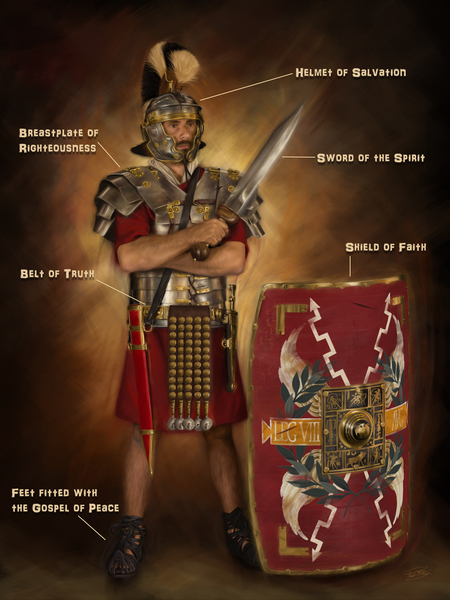
God wants every Christian to wear “the whole armor of God” so we may stand against the “wiles” or trickery of the Devil (Eph. 6:11). The first three pieces of armor we have with us all of the time [13] (“having girded… put on… shod…” – Eph. 6:14-15). [14] This is the state we are always in. But the last three pieces of armor we are called to take and use as needed [15] (“taking … take…” Eph. 6:16-17), [16] especially “in the evil day” (Eph. 6:13b) when all hell breaks loose and seeks to steal, kill, and destroy us (John 10:10a).
Paul describes the armor that Roman infantrymen wore in the order they would put it on. The soldier first puts on his belt which represents the Christian’s belt of truth (Eph. 6:14a). Since Satan is the father of lies (John 8:44), this first piece of armor is essential to protecting us from Satan’s deceptions and lies. We learned that truth is God’s viewpoint on a subject. It is the absolute standard by which reality is measured in its original form. [17]Truth points us in the direction that God wants to lead us.
After putting on his belt, the soldier then puts on his breastplate which protects his vital organs in his chest region. “The breastplate” (Eph. 6:14b) we are to put on is “righteousness” (dikaiosunē) which refers to the quality of “being right.” [18]God’s truth is the informational base that tells us the right thing to do. The truth points our heart in the direction of God’s righteousness. The breastplate of righteousness is our response to God’s truth or viewpoint on a matter.
When God’s truth and righteousness are operative in our lives, it will lead to the next piece of armor which is feet shod with the gospel of peace (Eph. 6:15). We are often faced with a myriad of choices and decisions in life, but how do we know we have made the right choices or decisions? How do we know we are moving in the right direction? How do we know we have the right perspective on a matter? God’s peace will confirm it. The Lord will give us a deep-seated calm to move forward (“feet” suggest movement) with a decision even though hell may be breaking loose in our lives.
As we experience God’s peace as a result of His truth and righteousness being operative in our lives, we can then see our faith in God renewed and strengthened. This leads to the fourth piece of armor which is “the shield of faith” (Eph. 6:16) which can protect us from the flaming arrows of the evil one that he uses to cause us to doubt our Christian faith.
The next piece of armor we are to take up is the “helmet of salvation” (Eph. 6:17a). This powerful piece of spiritual armor protects and directs our thoughts, so our lives are filled with hope. Satan wants us to lose hope about our past salvation from the penalty of sin (Acts 16:31), our present salvation from the power of sin (Jas. 1:21-22), and our future salvation from the presence of sin (I Thess. 1:10; 4:13-5:11; I John 3:2-3).
Up to this point Paul has been focusing on our defensive armor. But the sixth piece of armor is “the sword of the Spirit, which is the word of God.” (Eph. 6:17b). This is the only offensive piece of spiritual armor God has given us. Why would God give us only one offensive piece of armor to use against the kingdom of darkness? Because this one piece of armor is sufficient to overcome our enemy. Notice that it is a “sword” that belongs to “the Spirit.” This is the tool the Spirit of God uses to address the spiritual attacks we are facing.
Two Types of Swords
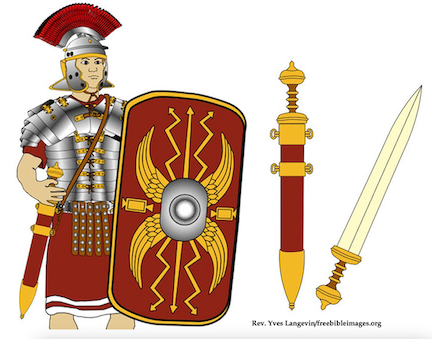
The New Testament uses two different Greek words for “sword.” One of those words (rhomphaia) refers to “a large and broad sword” [19] that was used for defending oneself from somewhat of a distance (cf. Luke 2:35; 21:24; Rev. 2:12, 16; 6:8). This word is used figuratively to describe the powerful word that proceeds from the mouth of King Jesus to decimate His enemies when He returns to earth at the end of the seven-year Tribulation (Rev. 19:15, 21). But this is not the word Paul uses in Ephesians 6:17b.
The other Greek word used for “sword” (machaira) was used of a shorter and very sharp sword like a dagger. [20]It was approximately eighteen inches long. This is what Peter used to cut off the ear of the high priest’s servant in his attempt to protect Jesus in the Garden of Gethsemane (cf. Matt. 26:51; Mark 14:47; Luke 22:49-50; John 18:10-11). This sword was used in hand-to-hand combat when the enemy was up close and in your face. This is the word Paul uses in Ephesians 6:17b
“The sword of the Spirit” is the tool that the Holy Spirit uses in the spiritual realm. [21] The Spirit uses this sword when the enemy confronts you up close in “the evil day.” When Satan or his demonic spirits are attacking you up close and there is no escape because they have encompassed you, you must get to the enemy quickly, definitively, and decisively. This is the sword the Holy Spirit (not us) uses to stab the enemy and give him a death blow to his attempts to defeat us.
This is the only offensive weapon the Spirit uses in the spiritual realm. He uses the sword of the Spirit to address the spiritual conflict in the invisible world which is being manifested up close in our visible world. This is the piece of armor that the Spirit uses to deal with what is causing us distress in the world in which we live. If we don’t believe the source of our battle stems from the spiritual world, we won’t use this piece of armor.
If we don’t use this spiritual weapon God has given us, we will be like Moses and Peter. When Moses tried to deliver Israel, he killed the Egyptian who was mistreating a Hebrew slave (Exod. 2:11-15). When Peter wanted to deliver Jesus in Gethsemane, he took out his sword and cut off the ear of the high priest’s servant (Matt. 26:51; John 18:10). Jesus, the God of the Old and New Testaments, told both of these men that He did not need their human methodologies or perspectives to fight a spiritual battle (Exod. 3:2-10; Matt. 26:52-54; John 18:11).
Many of us may be losing our spiritual battle because our default response to spiritual attack is to turn to human approaches or perspectives instead of God’s approach and perspective. We may be quick to seek human wisdom instead of God’s wisdom. When we choose to use a man-made method for a spiritual battle, we will have no assistance from God in our war against the kingdom of darkness.
For example, this is why God’s Word says, “For the wrath of man does not produce the righteousness of God.” (Jas. 1:20b). My human anger will not produce the righteousness of God. When I get cut off in traffic during rush hour, it is easy for me to be quick to anger toward that inconsiderate driver. My thoughts and words at that time do not express the righteousness of God. But God says, “Let Me handle this, Jeff.” (Rom. 12:17-19).
What is the Sword?

Paul informs us that “the sword of the Spirit” is “the word of God.” (Eph. 6:17b). There are three Greek words that are translated “word” in the New Testament. The first is graphē and it refers to the “writings or a piece of writing.” [22] Scripture is called the graphē (2 Tim. 3:16). The Bible you hold in your hand is the graphē. Those sixty-six books in written form are the graphē. But Paul is not talking about carrying your Bible around to defeat the devil on the evil day. Some people treat the Bible as a lucky charm and take it with them everywhere they go. That is not what Paul is talking about here.
The second Greek word is logos.The apostle John referred to Jesus as the Logos (John 1:1). Logos refers to a “message.” [23] Jesus was God’s messenger to the world. He presented God to humanity (John 1:18). Logos is also the content of the Bible (graphē). For example, when you hear a sermon at church, you are hearing the logos or message of the Bible which brings clarity to your understanding so you can apply it more effectively to your Christian life. Logos is very powerful. But this is not the word Paul uses for the sword of the Spirit.
The Greek word that Paul uses for “word” is the Greek word rhēma. This word means “utterance” or “words spoken and declared.” [24]Paul did not say, “the sword of the Spirit, which is the graphē of God.” Nor did he say, “the sword of the Spirit, which is the logos of God.” No, Paul says, “the sword of the Spirit, which is the rhēma of God.”
Evans explains it like this: “The rhēma is the declaration of the logos that you got from the graphē… The sword that the Spirit uses is the rhēma of God. The graphē, the book, gives you the logos, the message. But it is the rhēma that plunges in and draws blood. It is the rhēma that the Spirit uses. So many of us are not seeing the power of the Spirit because we have not graduated to the rhēma. We are either stuck at graphē… Others of us… come to understand the logos, the message. We want to understand the sermon… the truth… We may be inspired by it or educated by it… But when it comes to spiritual warfare… you need more than graphē and logos. You need rhēma – the logos from the graphē uttered.” [25]
The Intrinsic Nature of the Logos [26]
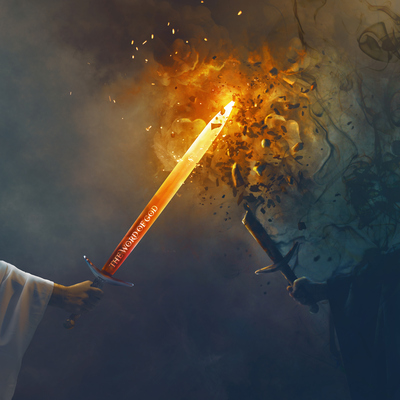
We want to utter or declare (rhēma) the logos (message) because of its intrinsic nature. Regarding the logos, the Bible says, “For the word (logos) of God is living and powerful, and sharper than any two-edged sword, piercing even to the division of soul and spirit, and of joints and marrow, and is a discerner of the thoughts and intents of the heart.” (Heb. 4:12). When we get the message (logos) it is “living and powerful.” It has supernatural energy behind it. It is “sharper than any two-edged sword.” It can cut either way you swing it because on both sides of its blade it is razor sharp.
How sharp is the logos of God? It is so sharp, it can pierce “to the division of soul and spirit.” The “word”(logos) that God uses is able to penetrate the invisible world (“soul and spirit”). The spiritual world consists of our “soul” (psyches) which is being saved from the power of sin (sanctification) as we hear and do what God says (Phil. 2:12; Jas. 1:21-22) and our “spirit” (pneumatos) which was saved forever from the penalty of sin (justification) when we believed in Jesus for His gift of salvation (cf. Ezek. 36:26; Acts 16:21; Eph. 4:23-24; Heb. 10:14).
The author of Hebrews is telling us that “the word” (logos) is so sharp it can slice into the spiritual realm and separate what is “spirit” and what is “soul” (Heb. 4:12). Why does God want to use the message or logos to separate our “soul and spirit”? Because our “soul” can get in the way of our “spirit.” Our “soul” has been distorted by sin and it can hinder us from expressing our “spirit” which is who we truly are in Christ. Our personality, how we were raised, educated, and the perspective we have can all get in the way of our “spirit” which is our true identity in Christ.
Our “spirit” and “soul” can be so intertwined that we need the logos to separate the two so He can remove our soul-driven life and enable the “spirit” to express God’s presence in our lives. Remember, our “spirit” was created “according to God, in true righteousness and holiness” (Eph. 4:23-24) and was “perfected forever” (Heb. 10:14) when we were born again through faith in Jesus. Our spirit “cannot sin because” it “has been born of God” (I John 3:9). When the soul is removed from our decision making, then our “spirit” can express the character of Jesus in our lives. But the only thing that can get our “soul” out of the way is the logos of God.
For example, when you hear a sermon online or in person, the message (logos) of the Bible (graphē) is used by God to reveal that what you thought (“soul”) about a matter and what God thought (“spirit”) about it are not the same. The logos is revealing that the perspective your parents or peers or a politician or a professor or a post on social media taught you is not the same as what God is teaching you. You are realizing that what God thinks about that particular matter is not the same as what you thought. When that happens, you are getting sliced and diced by the word (logos).
But the “word” (logos) not only exposes what we do, but it also reveals what we think. It “is a discerner of the thoughts and intents of the heart.” (Heb. 4:12b). The logos not only discerns our thoughts but the intentions behind them. The goal of logos is to expose. The logos is God’s MRI or Xray machine.
When we come to church and read our Bibles, all we have done is open up graphē, the written word.But when the truth pierces our heart, we have encountered logos because the message is given. When we receive the message (logos) and accept it, we now have understanding and clarity about what God is saying. But in an up-close spiritual battle, the Spirit of God wants to use not just the graphē and the logos when you listen to Bible teaching on radio broadcasts or podcasts, He wants to use the rhēma of God, i.e., the spoken or declared word of God (Eph. 6:17b).
The Rhēma of God [27]
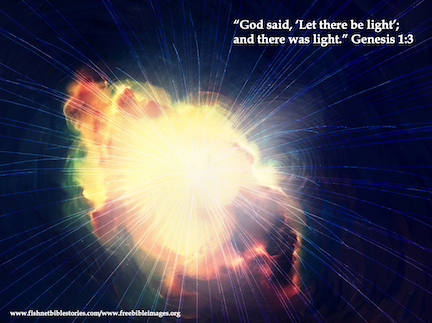
In the beginning when God created the heavens and the earth, “God said, ‘Let there be light’; and there was light.” (Gen. 1:3). God spoke, and it was so. The spoken word had the power within it to do what the spoken word declared would be done. God spoke it, and it happened exactly like He said it. Notice that there was no light until God spoke it into existence. God did not just think it into existence. He declared it and then there was light. There was power in the word spoken, not just in the word that is known. God used what He knew. The spoken word had the power within it to produce what the spoken word called for.
This is what the Spirit of God used to create light. How do we know this is what the Spirit used? The Bible tells us that when God was ready to create, “the Spirit of God was hovering over the face of the waters.” (Gen. 1:2b). The Spirit of God was ready to move when He heard the spoken word of Jesus. But the word of God had to be spoken before the Spirit could use it.
The same is true for us when we are in a spiritual battle. God’s Spirit wants to use the spoken word of God to defeat our enemy. It is not enough to know the Word. We must declare it to the enemy. This is what Jesus did when He was tempted in the wilderness by the devil. More on that after this next section.
Satan’s Strategy [28]
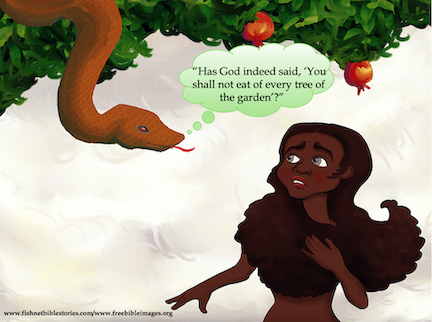
Satan’s strategy is to knock the Sword of the Spirit out of our hands. Imagine you are a Roman soldier in a battle and an enemy soldier is coming at you. He is fully armed. He has his big rectangular shield that protects his entire body. All you can see is that big shield coming at you along with the top of his helmet … and … a … sword. If you are going to overcome this soldier, what is the first thing you will have to do? That’s right. You will have to knock the sword out of his hand. That is the only offensive weapon he has. If you go for his shield or even his helmet, he may stab you through with his sword. You have to get the sword out of his hand.
The “wiles” of the devil seek to knock the sword of the Spirit out of our hands. The best way for Satan to overcome the Christian is to knock the sword out of his hand. And, according to Ephesians 6:17b, the sword is the spoken (rhēma) word of God. If the devil can knock the spoken word of God out of the hand of the Christian, he can easily defeat the unarmed soldier for Christ. So, let’s look more closely at the wiles or methods of deception that Satan uses.
When Adam and Eve sinned in the Garden of Eden, the devil cast doubt on the spoken word of God. He said, “Had God indeed said, ‘You shall not eat of every tree of the garden’?” (Gen. 3:1b). The enemy got Eve to begin to doubt God’s spoken word. [29] Here the serpent turns Eve’s eye away from the freedom she has (“of every tree of the garden you may freely eat” – Gen. 2:16) and onto the single prohibition (“but of the tree of the knowledge of good and evil you shall not eat” – Gen. 2:17). Eve said to the serpent, “2 We may eat the fruit of the trees of the garden; 3 but of the fruit of the tree which is in the midst of the garden, God has said, ‘You shall not eat it, nor shall you touch it, lest you die.’” (Gen. 3:2-3). This turns her into a legalist in that she forgot the word “every” (she limited her freedom) and added the words “nor shall you touch it” (she increased her limitation). She begins to doubt the love and goodness of God.
Next Satan denies God’s spoken word. “Then the serpent said to the woman, ‘You will not surely die.’” (Gen. 3:4). This is an outright claim that God’s Word is not true; it cannot be trusted.
Finally, Satan distorts God’s spoken word when he says to Eve, “For God knows that in the day you eat of it your eyes will be opened, and you will be like God, knowing good and evil.” (Gen. 3:5). The serpent distorts the truth by claiming God limited Adam and Eve because He (God) did not want them to be like He was, knowing good from evil. Of course, when Eve and Adam ate of the fruit, they did learn the difference between good and evil, but not the way God knows the difference.
God’s knowledge was intuitive; Eve’s knowledge was experiential. Adam and Eve tasted sin for the first time and felt its effects, the effects of the fall. They experienced sin. Up until this point, God has known about sin intuitively. Not until the cross will He know it experientially. He knows about sin the way a heart doctor knows about heart attacks. The man with the heart attack knows about heart attacks in a way the surgeon does not. This new knowledge doesn’t get Eve to first base in the realm of knowledge when compared to an omniscient Being. She got duped. Nevertheless, the serpent has done his work: three blows to the mid-section of Eve. Now he hops out of the ring and tags his partner, the world.
The world leaps into the ring in round two in order to knock Eve out. “So, when the woman saw that the tree was good for food, that it was pleasant to the eyes, and a tree desirable to make one wise, she took of its fruit and ate. She also gave to her husband with her, and he ate.” (Gen. 3:6). The world is made up of “the lust of the flesh, the lust of the eyes, and the pride of life” (I John 2:16). The fruit “was good for food” (lust of the flesh), “pleasant to the eyes” (lust of the eyes), “desirable to make one wise” (pride of life). The world scores an uppercut, a chop to the chin, and a haymaker to the temple. Down goes Eve, down goes Eve, down goes Eve. Her husband wasn’t far behind.
Satan has been using these same simple boxing moves ever since. But notice, in round one the serpent is knocking the sword out of Eve’s hand (Gen. 3:1-5). The entire round is an attack on the spoken Word of God. Once the Word of God is no longer in the hand of the believer, he or she has lost the only offensive weapon they have. In leading Adam and Eve to sin, the serpent enjoys a two-round knockout. He is present only in round one. He uses the three punches mentioned above to undermine Eve’s faith in God’s Word. He tried to do the same thing with Jesus.
Using the word of God [30]
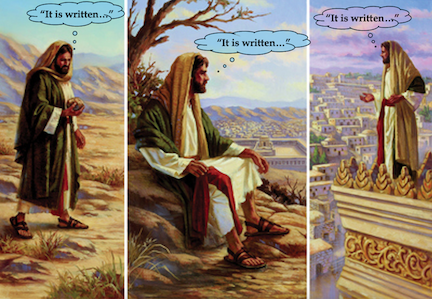
Remember when the Holy Spirit led Jesus into the wilderness to be tempted by the devil (Matt. 4:1-11)? Satan tried to use the same three punches on Jesus that he used on Eve in the Garden of Eden. First, the devil uses the lust of the flesh when he says to Jesus, “If You are the Son of God, command that these stones become bread.” (Matt. 4:3). The phrase, “If You are the Son of God” is a first-class condition in the Greek language which assumes the condition is true, [31] and would therefore be translated, “Since You are the Son of God…” Satan is so crafty. He had been watching Jesus go without food for ”forty days and forty nights,” and of course “afterward He was hungry” (Matt. 4:2). So, the devil attacks Jesus at the point of His vulnerability.
And you know what? Satan and his demons are watching us and taking notes. They keep a scouting report on each of us. They know when we are vulnerable to temptation, and they act accordingly. [32]
So, Satan shows up at a specific time to address a legitimate need that Jesus has. He is telling Jesus, “Look, You are the Son of God. You can do whatever You want to do. So, You might as well command these stones to become bread.” “In this situation, Satan questioned the provision of God: Jesus was hungry. God hadn’t fed him. Why shouldn’t Jesus just make what was needed?” [33]
How does Jesus respond? He says, “It is written…” (Matt. 4:4a). Then Jesus quotes a verse from a chapter in the Old Testament, “Man shall not live by bread alone, but by every word that proceeds from the mouth of God.” (Deut. 8:3). If the living Word (Jesus) needed to use the written Word to deal with the enemy of the Word, how much more must you and I who have written no word, need to use that same Word against the enemy of the Word?! Christ did not respond to the devil based on what He thought, and He had perfect thinking.
Jesus says, “Let Me tell you what the graphē says.” Christ tells Satan what the graphē says based on the logos. Christ doesn’t quote just any verse. He goes back to the Old Testament to a passage that deals with what He is facing in the New Testament. Christ was hungry. So, what does He do? He goes to Deuteronomy 8 where Moses explained to Israel how they survived through the wilderness when they were hungry. They survived by God’s provision. They didn’t survive merely because of the manna, but because of the One Who provided it through supernatural means. Was Jesus hungry? Yes. But He was willing to trust His Father to provide for Him supernaturally instead of acting independently of Him. [34]
Jesus had a legitimate need (hunger), and Satan was offering to meet that need in an illegitimate way – by having Jesus act independently of God. But God was offering to meet Christ’s legitimate need His way. The issue is not whether your need is legitimate; the issue is who is giving you the advice to address it? God or Satan?
Christ runs to Deuteronomy 8 and says to the devil, “Let Me tell You what God said about this situation.” “It is written: ‘Man shall not live by bread alone, but by every word that proceeds from the mouth of God.’” (Deut. 8:3). Man doesn’t live by bread alone, but by where it came from, “by every word that proceeds from the mouth of God.” When Satan heard what was written, he couldn’t handle that anymore, so he went to another subject.
Satan’s next temptation uses the pride of life. “ 5 Then the devil took Him up into the holy city, set Him on the pinnacle of the temple, 6 and said to Him, ‘If You are the Son of God, throw Yourself down. For it is written: ‘He shall give His angels charge over you,’ and, ‘In their hands they shall bear you up, lest you dash your foot against a stone.’” (Matt. 4:5-6). Challenging Jesus to jump to His death doesn’t sound like much of a temptation. But notice that the devil supported his appeal by quoting God’s promise of angelic protection in Psalm 91:11-12. Jesus, then, had an opportunity to demonstrate that He was the promised Messiah for all of Jerusalem to see. The problem with Satan’s plan was it ignored God’s plan. If Jesus did what Satan advised Him to do, it would bypass the cross which was contrary to God’s will. [35]
Notice that Satan knows the Bible and he uses it. If the devil can’t convince you to act independently of God, he’ll work through your religion. But God doesn’t need Satan’s help to get you where He wants you to go.
Christ responds to Satan, by quoting Deuteronomy 6:16, “It is written again, ‘You shall not tempt the Lord your God.’” (Matt. 4:7). We are never to use disobedience to back God into a corner to force Him to fulfill His plan. [36]Satan was telling Jesus to test God. And Christ says to the devil, “God told Me in His Word not to test Him.” Notice that Satan does not argue with Jesus when He responds with the rhēma of God.
Instead, the devil uses the lust of the eyes to tempt Jesus. “8 Again, the devil took Him up on an exceedingly high mountain, and showed Him all the kingdoms of the world and their glory. 9 And he said to Him, ‘All these things I will give You if You will fall down and worship me.’” (Matt. 4:8-9). Did you catch that? “The devil took Him…” Sometimes God lets the devil take us to tempt us. Ultimately Satan wanted Christ to worship him. So, he offers Jesus the entire kingdoms of the world and their glory if Jesus would take a knee before him. Satan wants our worship too. He will make incredible offers to us to get us to bow down to him.
How does Jesus respond? “Then Jesus said to him, ‘Get behind Me, Satan!” (Matt. 4:10a). This command displays Jesus’ absolute authority over the devil. Then Christ quotes, Deuteronomy 6:13, “For it is written, ‘You shall worship the Lord your God, and Him only you shall serve.’” (Matt. 4:10b). Worship is reserved for the one true God and Him only. Too often we may come to worship God on Sunday and then serve lesser agendas and gods the rest of the week. But if Jesus is the ultimate authority in the universe, He deserves our exclusive worship and service. [37]
In responding to each of Satan’s temptations, Jesus did not just study the Bible and know what it said. He opened His mouth and uttered what it said. He said to the devil, “Let Me tell You what God just said about what you are telling Me.” And when Jesus told Satan what God said, “Then the devil left Him, and behold, angels came and ministered to Him.” (Matt. 4:11). The devil failed to knock the sword of the Spirit out of Jesus’ hands. He could not handle hearing the rhēma of God three times, so he left Jesus alone. When the fallen angel left, the faithful angels came and ministered to Jesus.
We may ask, “Why doesn’t the devil leave me alone?” Could it be because he knows we will never say, “It is written…”? He knows we will never bring that up. Instead, he knows we will talk about our families, our jobs, our education, our reading, our favorite sports, TV programs, and politicians, etc. He knows that we will never say, “It is written…” and if we do study the Word, he knows we are never going to use it and speak it to him. Thus, the devil does not fear us because we are not wielding “the sword of the Spirit, the word (rhēma) of God.” (Eph. 6:17b).
A Personal Example of the Rhēma of God
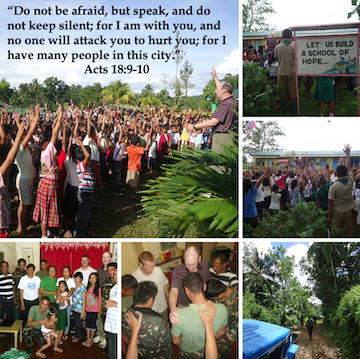
During a short-term mission trip in the Philippines with an evangelistic association in the summer of 2013, I was scheduled to go with three other American men to a predominantly Muslim area in the southern Philippines to preach the gospel in public schools. Two nights before we were to go there, the Filipino director and other Filipino staff who lived in or near that province began to brief me about the mission there and the high risk of going. Two countries recently issued an alert not to go into this area due to militant Muslim activity. I was told we would have to keep a low profile and have military escorts at all times. We would stay in our hotel when we were not preaching in schools.
The Filipinos then asked me a series of questions. They asked me, “What will you do if you are kidnapped?” “I would preach Jesus to them.” They asked, “But they will move you from militant camp to militant camp to make it difficult to find you. Then what?” “Then more Muslims will hear the gospel,” I said. They asked, “What about Pat and the girls if you are killed?” “God is their Father and He will take much better care of them than I ever could.” The staff then asked me, “What about how it would affect our evangelistic association if you were kidnapped or killed?” To which I said, “Good question. I will consider the implications.” But I thought to myself, Christ will be magnified in life or death. I knew I was called to go.
The pastors and I prayed and then I went to talk to the American founder and director of the association. He said no one should go if they are afraid because Muslims sense fear and try to bully those who are afraid. He said they don’t know how to handle fearless Christians. They can’t bully them. I told him I believed the Lord wanted me to go. I then went to tell the three other Americans of this new information to see if they were still led to go to the area. We talked and prayed a lot and the short of it is only two of us went.
I talked and prayed with Pat and the girls as well. They had obvious concerns, but I could not deny that the Lord Jesus wanted me to go. I shared with them verses God was bringing to my attention. “And the Lord, He is the One who goes before you. He will be with you, He will not leave you nor forsake you; do not fear nor be dismayed.” (Deut. 31:8). I asked, “Is there anywhere we can go where God has not already gone before us?” “No.” “Is there anywhere we can go where God will not be with us?” “No.” “Is there any place we can go where God will abandon us?” “No.” “Then what is there to fear?” “Nothing.” “Why be discouraged or dismayed?” “No reason.” We claimed Psalm 31:14-15, “But as for me, I trust in You, O Lord; I say, ‘You are my God. My times are in Your hand.’” My family was very concerned, but they knew the Lord was calling me to go.
I also shared with Pat and the girls how God had been speaking to me all week long leading up to this trip. I was having my devotions in the Book of Acts, and I would fall asleep thinking about what I had read and then dream about it at night and how God delivered the apostles from opposition and plots to kill them. When Stephen was being stoned, he saw Jesus standing in heaven as if to applaud his sacrifice for the gospel.
Satan’s attacks during the two nights before the trip were very intense. I felt an intense evil presence and intense fear gripped me. I had intrusive thoughts of being kidnapped, tortured, and dying a slow death. God led me to pull out the sword of the Spirit to confront the enemy. Two verses that especially ministered to me said, “9 Now the Lord spoke to Paul in the night by a vision, ‘Do not be afraid, but speak, and do not keep silent; 10 for I am with you, and no one will attack you to hurt you; for I have many people in this city.’” (Acts 18:9-10). It wasn’t enough to read these verses (graphē) or understand their significance (logos). I needed to declare their message to the powers of darkness, “It is written: ‘9 Now the Lord spoke to Paul in the night by a vision, ‘Do not be afraid, but speak, and do not keep silent; 10 for I am with you, and no one will attack you to hurt you; for I have many people in this city.’” (Acts 18:9-10). The Holy Spirit calmed my heart and encouraged me, assuring me of His presence, His protection, and His people to watch out for us. By God’s grace, I was prepared to die but planning to return to my family.
When our team of Filipino pastors/translators and myself and another American arrived in the province we were to evangelize, we went to the Filipino military battalion to meet with them and share our intentions to preach the Gospel of peace in that area. Their commander was a very gracious and kind man who informed our Filipino staff that it was too dangerous for Americans to go alone, and they would provide 24/7 military escorts for us. Honestly, with Jesus with us I did not believe it was necessary to have military escorts, but God had a higher purpose than our own safety.
We learned additional information about the criticalness of the area a day or two later. A month before our arrival, the Filipino military had captured the Militant Muslims’ commander and now the Militants were threatening to kill our military escorts (3 of the 4 were already believers and the 4th became a believer during the week with us) and kidnap a teacher since we were preaching in elementary and high schools. We had a choice to make at this point: Do we pull out or press on and preach the Gospel to these needy souls?
We pressed on because God is much greater than the lies of Militant Muslims and their threats. The Lord went before us and we preached the gospel of grace in eighty-five schools, two-thirds of which were 90% Muslim. Our military escorts had agents in the jungle giving them updates on the position of the Militants. I learned from our Filipino team leader that the militants had 60-70 men who could have overpowered our military escorts at any time, but God protected us from them. We also would be an easy target for a sniper as we preached outdoors at school assemblies, but the Lord was our rock and refuge.
The most memorable experience for me was when we went to an elementary school composed of mostly Muslim students. When we arrived, we saw a crowd of adults meeting around a stage. Classes were cancelled due to a PTA meeting. The president of the PTA permitted us to interrupt their meeting so we could share the gospel with over 220 adults, most of whom were devoted Muslims as shown by the head garments they were wearing and their veils over the faces of the women.
I began by saying, “The God who made this universe, the God of Abraham loves you very much.” My translator boldly and clearly translated for me which emboldened me even more. I then proceeded to talk about sin, death, and deserving to die forever in hell where the fire never stops burning to which all the Muslims and a few Catholics nodded in agreement when they heard these truths. I then asked, “How many of you want to live forever in hell?”, raise your hands. None of them did.
Then God led me to say, “How many of you believe Jesus Christ was a prophet from God?” They all shook their heads “Yes.” Then I asked, “How many of you believe a prophet of God can lie?” They all shook their heads “No.” Then the Lord led me to say, “Jesus Christ said, ‘I am the way, the truth, and the life. No one comes to the Father, except through me. The only way to heaven, the only way to the God of Abraham is through Jesus Christ.”
As I said this, the devoted Muslims began to form a circle with each other in front of the stage, looking at me with eyes of anger and/or curiosity. I silently asked God to increase my love for them and my boldness. God enabled me to look each one in the eye through the remainder of the presentation as I shared about Jesus, Who was fully God and fully man. He loved them so much that He took their punishment for all of their sins and rose from the dead so that He is not alive to offer everlasting life as a free gift and peace with God to all who believe or trust in Him alone for His gift of everlasting life. After explaining the gospel, I invited them to take Jesus at His Word when He said, “Whoever believes in Him should not perish [in hell], but have everlasting life [in heaven]” (John 3:16b).
After leading them in a prayer to tell God they were now trusting in His Son, Jesus, for a home in heaven, I asked them, “How many of you just trusted in Jesus to give you a home in heaven? Raise your hands.” My heart leaped for joy as all of the people raised their hands, including the devoted Muslims whose faces turned from hate and confusion to hope and peace. We had to leave quickly for security reasons, but I praise the Lord Jesus for His faithfulness to seek and to save the lost.
God truly went before us on this trip as nearly twenty-seven thousand people heard the gospel in five days, and over twenty-four thousand said they trusted in Jesus for His gift of salvation. According to my figures, 96% of the people I shared with all publicly indicated they trusted in Jesus for a home in heaven. For the Muslims, this was more of an act of discipleship to publicly identify with Jesus Christ.
God also had believers in almost every school and/or village to fellowship with and feed us. In fact, every evening we met in the home of our team leader’s mother-in-law to feast and fellowship. Our last night in this province, we had a celebration dinner there. Afterward, we spent time in worship of our Savior Who is mighty to save.
Then each person shared a highlight from the trip, including the four soldiers who were with us 24/7. One of them said this, “Until the very last drop of our blood, we will protect you.”This was so humbling to hear. These soldiers were willing to take a bullet for us as were our translators. Their courage rubbed off on us. I experienced more peace in the militant area than I have experienced anywhere else. When I returned to the States, I learned that two Australian missionaries were shot and killed in the areas where we were either the week before we arrived or the week after.
As with all the pieces of armor, we take up the sword of the Spirit through prayer (Eph. 6:18-19).
Prayer: Gracious heavenly Father, thank You so much for the sword of the Spirit, the spoken word of God which has the power in Itself to do what it declares. It is with great joy that I lift the sword of Spirit and choose to abide in its truth and power. Holy Spirit, please open my eyes to see wonderful things in Your Word! Please enable me to use Your Word to defend myself from Satan, and also to wield the sword well on the battlefield when the Devil attacks me, so his lies and deceptions are exposed, and he is pushed back and defeated. I pray the power of the Holy Spirit is ignited in my life, so that Jesus may live His victorious life through me today and every day. In the mighty name of the Lord Jesus Christ, I pray. Amen.
FOOTNOTES:
[1] Colonel Rob Maness Live with David Pyne, President of the Task Force on National & Homeland Security on June 23, 2025, “The U.S. Enters War with Iran – More War Monday,” at www.worldviewtube.com; Brannon Howse Live with Shahram Hadian on June 20, 2025 – “Iran-Backed Terror Threats Inside the U.S. as FBI Increases Efforts to Monitor Them” at www.worldviewtube.com; Sophia Compton’s June 19, 2025, Fox News article entitled, “Border Patrol agents shut down massive drug smuggling tunnel between Tijuana and San Diego,” at www.foxnews.com.
[2] Madison Colombo’s June 25, 2025, article entitled, “Obama’s former DHS secretary sounds alarm on Iranian sleeper cells, calls it concern of ‘highest magnitude’” at www.foxnews.com. Brannon Howse, June 24, 2025, “Rising Threat of Terror Cells in US,” at www.worldviewtube.com; Adam Goldman and Devlin Barrett’s June 23, 2025, article entitled, “F.B.I. Warns of Possible Retaliation by Iran After Bombing of Nuclear Sites,” atwww.nytimes.com; Tara Suter’s June 22, 2025, article entitled, “Threat of sleeper cells in US has ‘never been higher’: CBP,” at www.thehill.com.
[3] Bill Hutchinson’s June 25, 2025, article entitled, “With July 4 just days away, US law enforcement on high alert for Iran retaliation,” at www.abcnews.go.com; Brooke Shafer’s article, entitled, “US cities ramp up security ahead of Fourth of July celebrations,” at www.newsnationnow.com.
[4] See March 12, 2024, article entitled, “Mosques: A fixture of America’s cultural landscape,”
at www.archive-share.america.gov.
[5] Jihad refers to a holy war. In the Bible, people were killed because of their sin in the Old Testament. In the New Testament, Jesus Christ was killed for the sin of the world. But in Islam, Mohammed was commanded by Allah to kill the Christians and the Jews for not accepting Islam (Qur’an 9:29). According to the Qur’an, anyone who believes in Jesus is an infidel (Qur’an 5:72-76). Mohammed was killing Christians not because of their sins but because they believed in Christ. See Usama Dakdok’s article entitled, “Jihad,” at www.thestraightway.org.
[6] Shariah Law is Islamic Law and encompasses the words of Allah in the Qur’an and the words of Mohammed in the Hadith. For example, the Qur’an commands that Jews and Christians be decapitated (Qur’an 47:4). It also commands Muslims to kill the idolater which is anyone who worships any god but Allah (Qur’an 9:5). Men can beat their wives if they merely suspect rebellion (Qur’an 4:34). The Hadith (Abu Dawud 38:4447) teaches that the punishment for homosexuality is execution. This is what is practiced in Islamic countries. Muslims who come to America do not want to acclimate to our Constitution and laws. They want to establish Shariah Law which cannot coexist with American Law. See Anita Kuta’s article entitled “Sharia (Islamic Law),” at www.thestraightway.org.
[7] The god of Islam (Allah), is Satan for he is said to be the lord of the world in Qur’an 1:1-2, which when compared to the Bible, Satan is the ruler of the world, John 12:31; 14:30; 16:11; 2 Cor. 4:4. Allah is also known as the best deceiver as we read in Qur’an 3:54 and 8:30, when compared to the Bible, Satan is the deceiver, Gen. 3:1-6; 2 Cor. 11:3; Rev. 12:9. Allah also leads people astray as we read in Qur’an 35:8 which is a description of Satan in the Bible, Gen. 3:1-6; Rev. 12:9. He also desires to fill hell with people as we read in Qur’an 38:85, 11:119, and 32:13, but the Bible teaches that God desires all people to be saved (I Tim. 2:3-4) and that not one person should perish in hell (2 Pet. 3:9). Adapted from Asuma Dakdok’s article, “Are Allah and God the same?” at www.thestraightway.org.
[8] See Usama Dakdok’s article entitled, “Islam,” at www.thestraightway.org.
[9] To see all 20 points go to the article posted by Pam Geller on July 1, 2009, entitled, “ISLAMIC INVASION OF AMERICA: THE 20 POINT PLAN,” at www.thestraightway.org. This 20-point plan originated from a refugee from the Muslim Middle East named Anis Shorrosh, author of ”Islam Revealed” and ”The True Furqan.” Anis is a Christian Arab American who emigrated from Arab-controlled Jerusalem in January 1967. Shorrosh says, “The following [20-point plan] is my analysis of Islamic invasion of America, the agenda of Islamists and visible methods to take over America by the year 2020.”
[10] See Frank Gaffney’s pamphlet, The Muslim Brotherhood in the Obama Administration (David Horowitz Freedom Center, 2012 Kindle Edition).
[11] Ryan King and Carl Campanile’s June 29, 2025, article entitled, “Zohran Mamdani doubles down on plan to target ‘whiter neighborhoods’ with higher taxes — and says billionaires shouldn’t exist,” at www.nypost.com; Joseph Ax’s June 29, 2025, article entitled, “New York mayoral candidate Mamdani defends campaign despite Democratic unease,” at www.reuters.com.
[12] Jill Colvin’s June 29, 2025, article entitled, “How Democrats in America’s most Jewish city embraced a critic of Israel for New York mayor,” at www.apnews.com.
[13] Evans, The Tony Evans Bible Commentary, 2019 Kindle Edition, pg. 2665.
[14] The first three verbs in Greek (perizōsamenoi… endysamenoi… hypodēsamenoi… ) are aorist middle participles which means they have already been put on by the soldier or Christian.
[15] Evans, The Tony Evans Bible Commentary, 2019 Kindle Edition, pg. 2665.
[16] The Greek verb translated “taking…” (analabontes) is an aorist active participle, meaning the Christian is taking the shield of faith as needed and the last Greek verb translated “take…” (dexasthe) is an aorist middle imperative which is used of the last two pieces of armor and means for oneself to take them up as needed.
[17] Evans, The Tony Evans Bible Commentary, 2019 Kindle Edition, pp. 1820-1821.
[18] Bauer, A Greek-English Lexicon of the New Testament, 2000 Kindle Edition, pp. 247-248.
[19] Ibid., pg. 907.
[20] Ibid., pg. 622.
[21] These next five paragraphs are adapted from Tony Evan’s sermon video entitled, “The Sword of the Spirit” posted on July 17, 2021, at www.youtube.com.
[22] Walter Bauer, A Greek-English Lexicon of the New Testament and Other Early Christian Literature, 2000 Kindle Edition, pg. 206.
[23] Ibid., pp. 598-601.
[24] Ibid., pg. 905.
[25] Evan’s sermon video entitled, “The Sword of the Spirit” posted on July 17, 2021, at www.youtube.com.
[26] Much of this section is adapted from Ibid unless otherwise noted.
[27] Much of this section is adapted from Ibid., unless otherwise noted.
[28] Much of this section is adapted from David R. Anderson, Position and Condition: An Exposition of the Book of Ephesians (Grace Theological Press, 2017 Kindle Edition), pp. 376-378, unless otherwise noted.
[29] Evan’s sermon video entitled, “The Sword of the Spirit” posted on July 17, 2021, at www.youtube.com.
[30] Much of this section is adapted from Evan’s sermon video entitled, “The Sword of the Spirit” posted on July 17, 2021, at www.youtube.com, unless otherwise noted.
[31] A. T. Robertson, A Grammar of the Greek New Testament in Light of Historical Research (Originally published in 1914), 2014 Kindle Edition locations 1413-1414.
[32] Evans, The Tony Evans Bible Commentary, 2019 Kindle Edition, pg. 1867.
[33] Ibid.
[34] Ibid.
[35] Ibid., pp. 1867-1868.
[36] Ibid., pg. 1868
[37] Ibid., pp. 1868-1869.