Spiritual Warfare – Part 5

Introduction

       In our spiritual warfare series, we are now looking at each piece of armor that a Christian is to wear to successfully stand against “the wiles” or deceptions of the devil (Eph. 6:10-13). The six pieces of armor that Paul presents to us are in the order that a Roman soldier would put them on. They are divided into two categories of three.

       He introduces each of these two categories with different verbs. The first three are introduced with the verb “to be.” The last three are introduced with the verb “to take.” Why does Paul switch verbs halfway through the armament? He wants us to understand two specific, distinct orientations to the six pieces of armor. The first three relate to a state we should always be in. The last three are what we use on an as needed basis. [1]

       The first three pieces of armor we have with us all of the time [2] (“having girded… put on… shod…” – Eph. 6:14-15). [3] This is the state we are always in. But the last three pieces of armor we are called to take and use as needed [4] (“taking … take…” Eph. 6:16-17), [5] especially “in the evil day” (Eph. 6:13b) when all hell breaks loose and seeks to steal, kill, and destroy us (John 10:10a).

       Last time we looked closely at the first piece of armor, the belt of truth (Eph. 6:14a), which teaches us that Satan wants to deceive us or trick us to do what is contrary to God’s will. This piece of armor enables us to overcome the lies and deceptions of the devil.

       Truth is the absolute standard by which reality is measured. [6] It is God’s viewpoint on any subject. We can defeat Satan by reaching out and putting on each citadel of truth God has given us through prayer: The Person of Truth (John 1:14; 14:6; Rom. 13:14), The Spirit of Truth (John 14:26; 15:26; 16:13-14; I John 2:20-27), the Word of Truth (John 17:17; 8:31-32; Psa. 119:9, 11, 28-29, 43, 160; 2 Tim. 2:15; 3:16-17; and the Church, the Pillar and Foundation of Truth (I Tim. 3:15). [7]

The Breastplate

       After a Roman soldier puts his belt on over his tunic (a loose, sleeveless shirt that reaches to his knees) to provide mobility in battle and serve as a place on which he could hang his armor, he then puts on his “breastplate” (thōraka). The breastplate was usually made of bronze or chain mail and covered the soldier’s body from his neck to his thighs, [8] protecting the vital organs in the chest area and below, [9] including his heart, lungs, liver, spleen, stomach, and intestines. And it also covered his back so that from the top of his spine to below his kidneys, he was protected from the thrust of the enemy’s spear or sword. [10] This is a vital piece of armor designed to protect a Roman soldier. Knowing this about the soldier’s breastplate ought to help us realize how vitally important this piece of armor is to the Christian.

       The Bible instructs us, “Keep your heart with all diligence, for out of it spring the issues of life.” (Prov. 4:23). Just as the physical heart is central to our physical well-being, pumping life-giving blood and giving us functionality in every part of our being, so God has given us a spiritual heart that pumps His life throughout all our spiritual relationships. And since our battle with the kingdom of darkness is spiritual, our spiritual heart becomes the pump that gives us spiritual victory. [11]

       Therefore, God has given us a special piece of armor called the “breastplate of righteousness.” This righteousness stands as our position with God which cannot be touched or altered by the enemy. It has been eternally settled in heaven’s courtroom. However, to be victorious on earth, our position in heaven must be matched with our practice on earth. Thus, once we learn what our position with God is, we can then align our practice with that position. And when we do that, God is free through the Holy Spirit to pump His life through our life, so we live life as God intended it to be lived, overriding Satan’s attempts and attacks to bring defeat into our Christian lives. [12]

What is Righteousness? [13]

       Last time we discovered that we begin dressing for success in spiritual warfare by putting on the belt of truth (Eph. 6:14a). Truth is God’s viewpoint on a matter. So, in spiritual warfare, we start with truth by finding out what God thinks about a certain subject.    

       Then we are to put on “the breastplate of righteousness” (Eph. 6:14b). The breastplate Christians are to put on is “righteousness.” The word “righteousness” (dikaiosunē) refers to the quality of “being right” [14] as God defines it.               

       Righteousness” is not “better than others,” or “good enough,” but right, as in, “right with God.” [15]

       “Righteousness is the standard God requires for people to become acceptable to Him.” [16] This standard is based upon the truth. The truth is the informational base that tells me the right thing to do.

       The opposite of righteousness is wrongness. Wrongness is functioning or operating in opposition to the truth. But truth is whatever God says about a subject regardless of how many people agree or disagree with Him. Righteousness is my response to God’s truth.

       In basketball, the basketball hoop is ten feet high. That is the standard of the basketball goal if you are playing basketball. If we lower the basketball hoop, we have lowered the standard.

       What a lot of people do in relation to God, is lower the standard and shoot, and make the shot, and think they did something that is acceptable to the Lord. They adjusted God’s standard of righteousness to a level they could attain, and concluded they are okay to God, when in reality they were not. They had lowered the divine standard to a human standard.

       Until we operate on God-based truth that gives us the standard of God’s righteousness, we are not going to align with God’s standard of righteousness. Why is this so important?

How Satan Attacks Us in the Area of Righteousness [17]

       Since the opposite of God’s righteousness is wrongness, when we do not align with God’s righteousness in our Christian lives, we are going to be very vulnerable to spiritual attack. Because Paul is talking about spiritual warfare and “wickedness in heavenly places” (Eph. 6:12), we need to understand that demons function on wrongness. Wrong is not just wrong. It is also an invitation to demons to join the wrongness.

       Evans illustrates this by saying that when we leave trash laying around our house for too long of a time, we don’t just have trash to deal with. The unaddressed trash invites roaches, ants, mice, and rats to join the party. When food has been left out for too long of a time, one roach tells another roach that they have been invited into the house. So, in addition to the trash in the house, we now have unwanted guests.

       God wants us to understand that unrighteousness (trash) is an invitation to demons (roaches) to join our “trashiness,” so we are not just dealing with unrighteousness (trash), we are also having to deal with demons who have made their home in our unrighteousness. And just as trash invites a variety of unwanted guests (e.g., ants, roaches, mice, rats, etc.,), so our unrighteousness invites a variety of demons of all sizes, shapes, and dispositions.

       Our unrighteousness invites the demonic flow and blocks the movement of God. Hence, two things happen with our unrighteousness. Demons are invited into our wrongness, which makes a bad place worse. And God is blocked out. Thus, God’s movement in our lives is limited because we are not wearing the breastplate of righteousness.

       Our unrighteousness gives Satan a legal right to occupy a place in our lives (cf. Eph. 4:25-27). We have invited the enemy to take up ground in our Christian lives. We have given him control over that part of our Christian lives. We can pray all we want about the roaches in the house, but until we remove the trash in the house, we are still going to have those unwanted guests. Why? Because those roaches (demons) have a legal right to be there because we are saying to them, “I am feeding you today.” As long as we continue in unrighteousness, no amount of praying is going to remove the demonic presence in our lives. They will not listen to our prayers because we are still feeding them with our trash.

       As Christians, we often settle for trash management. We know we should not have the trash (unrighteousness), and we don’t want the roaches (demons), so we try to manage the trash.

       For example, when we invite people to our house, we want our house to appear to be clean. So, we grab the trash and all the mess laying around, and we throw it in the closet. We want to keep our trash (unrighteousness) hidden so people will not know just how trashy (unrighteous) we truly are.

       So, we present an appearance of godliness. We try to think, speak, and act righteously, but inwardly our trash (unrighteousness) is producing a stench. It’s like having a trash compactor in the house. We keep putting trash in it and it reduces the size of our garbage. But the problem is, if we don’t take that trash out, eventually it will fill the house with its unwanted stench. And our spouse will get a whiff of that trash scent, and she will know it is there even if it is not visible, because there is a standard that has a scent to it.

       God can detect the scent for unrighteousness. So even if we are good at managing our trash, packing it down, hiding it in the closet, the garage, or in the attic so people cannot see it, God still knows it is in our lives. All demons have done is go to the garage, the closet, or garage – wherever we are hiding the trash. They have not left the premises because they know that the trash (unrighteousness) is still occupying the space.

        One does not have to be a Christian for long to understand how tenacious the Devil is with regard to his attacks against righteousness. We mentioned last time how each piece of armor teaches us how Satan can come against us. The Devil wants to devour us and destroy us in this area of righteousness (I Pet. 5:8). He primarily does this in two ways. [18]

       The first way Satan attacks us in the area of righteousness is to accuse us of our lack of righteousness. From his book, Overcoming the Adversary, Mark Bubeck shares four contrasts between the way the Holy Spirit comes to us and the way the Devil approaches us.    

       The first contrast shows us that when the Holy Spirit comes to us, He seeks to show us that our infinite worth and value to God makes God desire our fellowship (Gen. 1:26-27; Psa. 139:1-23; Matt. 13:44-46; I Cor. 6:20-21). He delights in spending time with us (Psa. 17:8; 18:19; 149:4; Isa. 62:5; Zeph. 3:17). But Satan wants to convince us that we are so bad and so flawed that God would not want anything to do with us.

       The second contrast teaches us that when the Holy Spirit comes to us, He seeks to show us that there is forgiveness and restoration available to us no matter how often or badly we have sinned (Psa. 23:3; 32:1-11; 51:1-13; 103:3, 10-14; Micah 7:19; John 21:15-17; Acts 10:43; Col. 2:13-14; I John 1:7, 9). But when the Devil comes to us, he seeks to persuade us that there is no forgiveness nor restoration available to us. He tells us we have committed the unpardonable sin [19] and that we are so bad that Satan deserves to have us forever!

       The third contrast instructs us that when the Holy Spirit comes to us, He uses God’s Word to give us hope and assurance of God’s love and forgiveness (cf. Rom. 5:1-8; 8:1, 5-6, 31-39). But when Satan approaches us, he takes God’s Word out of context to try to convince us that there is no hope for us; that God could not possibly ever forgive us.

       The fourth and final contrast shows that when the Holy Spirit comes to us, He builds faith, hope, and love in our hearts and increases our confidence in the assurance of our salvation (John 6:35-40; 10:28-29; I Cor. 13:13; I Thess. 5:8; I John 2:25-26; 5:1, 13). On the other hand, when Satan comes to us, he creates doubt, despair, and resentment toward God and toward His Word and His people. He wants to convince us that no one as bad as us could ever be saved and get into heaven.

      The second way Satan attacks us is to tempt us to compromise God’s righteousness. Satan seeks to convince us that it is not important to live according to the righteous standards God has given us in the Bible and even in our own conscience which many times has been made sensitive by the Holy Spirit and God’s Word.  

       The Devil seeks to get us to compromise the difference between right and wrong. He may say things to us like, “It won’t hurt you to try that especially if it helps you get what you want.” “Everyone else is doing it, so it must be okay.” “Go ahead and do it. It’s fun.” “No one else has to know.” “It doesn’t matter if you participate in a little worldliness. God understands your needs.” “It is only a weakness.” “This is the only way you can endure stress or face pain.” “You cannot change.”      

       On the other hand, when we do fail, Satan will come and try to persuade us that we have no righteousness; that we are not worthy before God at all. When we yield to sin repeatedly, without confessing or forsaking it, Satan has a right to claim that area we have compromised (Eph. 4:25-27).  

       Putting on the breastplate of righteousness means we combat these two ways that Satan attacks us in this area of God’s righteousness. It is at the very heart of the battle against the enemy.

      But what does it mean to put on the breastplate of righteousness? What is required to put on this piece of armor? First, we need a doctrinal understanding of the three types of God’s righteousness.

Imputed Righteousness

       The word “impute” is not a common word that we use today, but the apostle Paul uses it in Romans 4 when he refers to Old Testament examples of justification by faith. For example, when he refers to David and Abraham’s examples of faith alone for justification, he writes, But to him who does not work but believes on Him who justifies the ungodly, his faith is accounted for righteousness, just as David also describes the blessedness of the man to whom God imputes righteousness apart from works… 21 And [Abraham] being fully convinced that what He had promised He was also able to perform. 22 And therefore ‘it was accounted to him for righteousness.’ 23 Now it was not written for his sake alone that it was imputed to him, 24 but also for us. It shall be imputed to us who believe in Him who raised up Jesus our Lord from the dead… ” (Rom. 4:5-6, 21-24). [brackets added] The word “impute” (logizomai) in these verses means the perfect “righteousness” of God is “credited” or “placed to one’s account.” [20]

       We may not be as familiar with the word “impute,” but the word “credit” probably speaks volumes to us. Anderson writes, “We have credit cards, we have a credit score, or we may have credit at the bank. If the bank were to ‘credit something to our account,’ we know what that means. And that is exactly what ‘impute’ means. When we trust Jesus as our Savior, His perfect life of righteousness is credited to our account in heaven.

       “Philippians 4:17 says that we have an account in heaven. This account has a debit column and a credit column. As unbelievers we had an account full of debits and no credits. Isaiah 64:6 says all of our righteous deeds were like dirty rags. This doesn’t mean I had no righteous deeds. I did. That’s why they were called righteous deeds. The problem is these righteous deeds don’t go into the credit column of our account in heaven. They’re called rags by Isaiah because they‘re not acceptable to God. Why? Because they were produced by my own human energy and strength. They were deeds of human righteousness and not divine righteousness.” [21] [emphasis added]

       All our righteous deeds are stained with sin according to Isaiah 64:6. Hence, all our righteous deeds cannot open the gates of heaven. For example, “When Bill Gates claims he does not believe in God, let alone Christ, and gives a billion dollars to help the problem of AIDS in Africa, that is most certainly a righteous deed. But that righteous deed would not open the gates of heaven for him. It does not go into the credit column of his account. Why? Because to get into heaven we have to be perfect. [22] [emphasis added]

       This is what Jesus taught in His Sermon on the Mount. He said, “For I say to you, that unless your righteousness exceeds the righteousness of the scribes and Pharisees, you will by no means enter the kingdom of heaven.” (Matt. 5:20). The scribes and Pharisees were considered by Jesus’ Jewish audience to be the most righteous people of that day. But Jesus says the “righteousness” of His audience must exceed the righteousness of these religious leaders to enter the kingdom of heaven. Whose righteousness would surpass these devoted religious leaders’ righteousness? Later, in the same chapter, Christ says, “Therefore you shall be perfect, just as your Father in heaven is perfect.” (Matt. 5:48). Only the righteousness of God is “perfect.” [23]

        It is important to understand that Jesus was speaking to both believers (“His disciples” – Matt. 5:1) and the unbelieving “multitudes” who had followed Him (Matt. 4:24-5:1). He was using His Sermon on the Mount to provide a standard of conduct for His believing disciples as they anticipate living in the coming Kingdom of God on earth. But Christ also uses His Sermon on the Mount to convict His unsaved audience of their need for God’s imputed righteousness through faith alone in Christ alone (cf. Rom. 3:21-4:24). [24]

       Anderson adds, Anything short of perfection will not do. There’s not a great scale in the sky on which God will put our debits on one side and our credits on the other side and accept us if our credits outweigh our debits. No, just one sin is one too many. That’s why when Satan committed one sin in heaven, he had to go. He was cast out of heaven.

       “So that leaves us with a big problem. The Bible says that all men fall short of the glory of God, which includes His perfect holiness. These sins go into our debit column. In order for us to go to heaven we need two things: we need to have the debits swept away, and we need to have a life of perfect righteousness. Since none of us can live the life of perfect righteousness, we must look to another.

       “Only Jesus Christ lived a perfect life, and when we trust in His work for us on the cross, our sins are wiped away because He took our sins upon Himself. But, secondly, His perfect life is credited to our account. That’s divine righteousness. When this is credited to our account, we have a new standing before God. Our new position is in Christ. And since we are in Christ, we are seated at the right hand of God the Father in heavenly places (Col. 3:1-3) [see also Eph. 1:19-21; 2:5-6]. And nothing can separate us from the love of God in Christ Jesus (Rom. 8:39).” [25] [emphasis and brackets added]

       Notice in Romans 4:5 that God “justifies” or declares righteous the “ungodly” person who “believes,” not behaves (“work”). It is the believing person’s “faith” that “is accounted for righteousness.” The moment we believe in Jesus Christ and His death on the cross for all our sins, God “justifies” or declares us totally righteous before Him as if we had never sinned.

       Hence, when a sinner believes in Jesus, he or she is declared by our holy God to be the opposite of what they are. So, if we were deceitful before our conversion, God declares us to be truthful. If we were greedy, God declares us to be generous. If we were hateful, God announces us to be loving. If we were impatient, God says we are patient. If we were promiscuous, God declares us to be pure at the moment of faith in Christ. If we were proud, God declares us to be humble. If we were selfish, God declares us to be selfless.

       However, there is a great deal of confusion today regarding the relationship between faith and works. Much of this confusion originates from a theologian and philosopher named Augustine (A.D. 354-430), who greatly influenced the soteriology (study of salvation) of Roman Catholics, the Reformers, and even Calvinists and Arminians today.

       Augustine had a scant knowledge of New Testament Greek which “caused him to misunderstand diakaioō (δικαιόω), translating it in its present infinitive form, ‘to make righteous,’ [26] “as opposed to the defining truth of the Reformers that this word meant ‘to declare righteous.’ The distinction was enough to cause a schism in Western Christianity. Whereas the former meaning signified a change of character, the latter meaning referred to a change of standing. ‘To make righteous’ looked to one’s experience in life, but ‘to declare righteous’ looked to the courtroom of heaven. The temporal significance of the distinction in meanings was monumental. Augustine saw justification (the making of righteous character) as a life-long effort, whereas Luther understood that one could be ‘declared righteous’ in God’s court at a moment of time.” [27] [emphasis added]

       This is extremely significant to understand. Martin Luther understood “court room” justification to mean “that one could be declared righteous (justified) in his position or standing before God, but still be sinful in his character and condition in his temporal body” [28] [emphasis added] – a truth that Augustine never understood.

       Augustine was persuaded “that the character of Christ needed to be infused into the character of the sinner from regeneration at water baptism (usually of infants) until death in order for the person to be made righteous (justified) enough to enter God’s heaven. Even the vast majority of God’s elect would not pass muster, so they would be consigned to Purgatory until the final vestiges of sin could be eliminated from their character. Only then could they march confidently through heaven’s gates. So, for Augustine justification was a life-long process. In fact, Purgatory was a provision of God for those in whom the process had not been completed.” [29] [emphasis added]

       What Augustine did was erroneously wed justification with sanctification. He confused entering the Christian life (justification) with living the Christian life (sanctification). This has led some teachers today to mistakenly front-load the gospel by requiring good works in order to get saved (Romanism & Traditional Protestantism). It has led other teachers to backload the gospel by requiring good works to stay saved (Arminianism) or good works as a necessary proof of genuine salvation (Calvinism), so that in each case you MUST HAVE GOOD WORKS to ultimately go to heaven. Consider these options which are taught today:

ScenarioFaith in Jesus Christ +good works = maybe heavenFaith in Jesus Christ =maybe heaven if you maintain good works, confess your sins, remain faithful, etc.Faith in Jesus Christ = salvation + good works to ultimately arrive at heaven
ProponentsRomanism & TraditionalProtestantismArminianismCalvinism

       Each of these scenarios requires good works in order to ultimately arrive in God’s heaven. This is NOT God’s grace. “But if it is of works, it is no longer grace.” (Rom. 11:6). Good works are not the means of obtaining or maintaining salvation but are designed to be the result of receiving God’s free gift of salvation (Eph. 2:8-10). When good works are required to enter heaven, how will you ever know when you have done enough? You won’t until after you die.

        Wiersbe correctly states, “Do not confuse justification and sanctification. Sanctification is the process whereby God makes the believer more and more like Christ. Sanctification may change from day to day. Justification never changes. When the sinner trusts Christ, God declares him righteous, and that declaration will never be repealed. God looks on us and deals with us as though we had never sinned at all!” [30] [emphasis added]

        In case you doubt that we need to be “justified” or declared totally righteous before a holy God, it is important to understand our condition before we come to faith in Christ. The Bible tells us, “And you, who once were alienated and enemies in your mind by wicked works…” (Col. 1:21). Before we became Christians, “we were enemies” of God and needed to be “reconciled to” Him “through the death of His Son” (Rom. 5:10). The prophet Isaiah tells us, “All we like sheep have gone astray; we have turned, everyone, to his own way; and the Lord has laid on Him the iniquity of us all” (Isa. 53:6). We need to be reconciled to God because of our sin. God does not need reconciling to us, we need reconciling to God. We turned away from God. He never moved. We moved. The people God created rebelled against their Creator and sinned so that death spread to all people because all sinned (Gen. 3:1-7; cf. Rom. 3:23; 5:12-14, 18a).

       The non-Christian is described in Ephesians when Paul writes, “we all once conducted ourselves in the lusts of our flesh, fulfilling the desires of the flesh and of the mind, and were by nature children of wrath, just as the others.” (Eph. 2:3). Because we were driven by our sinful lusts and desires, we were the objects of God’s “wrath” or displeasure before we became Christians. That is not a very likeable thought, is it?

       The apostle John writes, “He who believes in the Son has everlasting life; and he who does not believe the Son shall not see life, but the wrath of God abides on him.” (John 3:36). The person who refuses to believe in Christ remains under God’s “wrath.” The non-believer remains God’s enemy.

       How does the Christian know he or she is justified or declared totally righteous before God? There is only one way to know this, and it is through faith in God’s promise. Justification before God is not a feeling or experience. It is a judicial, legal declaration from a holy God.

       Logan explains why he believes the breastplate of righteousness refers to the imputed righteousness of God: “The reason for this is that when it comes to standing against the accuser, Christ is the only Person Who is totally blameless. Satan could point at no sin in Christ’s life (John 14:30), whereas you and I have plenty of things in our lives Satan can accuse us of, even things we have been forgiven of by Christ.

       “That’s why we need to stand with Christ’s righteousness around us like a breastplate. When we stand in Christ, Satan has nothing to touch in us, nothing to accuse us of. The enemy and his underlings aren’t afraid of us, but they’re afraid of Christ.” [31] [emphasis added]

Imparted Righteousness

       The second type of righteousness we need to understand from the Scripture is the imparted righteousness of God. When we believed in Christ, the perfect righteousness of God was imputed or credited to our account in heaven. We were declared totally righteous in our standing before God.

       But when we believed in Jesus, God also imparted to us a new nature consisting of His righteousness and holiness. The apostle Paul writes, 20 But you have not so learned Christ, 21 if indeed you have heard Him and have been taught by Him, as the truth is in Jesus: 22 that you put off, concerning your former conduct, the old man which grows corrupt according to the deceitful lusts, 23 and be renewed in the spirit of your mind, 24 and that you put on the new man which was created according to God, in true righteousness and holiness.” (Eph. 4:20-24). Paul is telling us that we are not to live the way we used to live before we became Christians (Eph. 4:17-19) because we are not the people we used to be (Eph. 4:20-24).

       We “have not so learned Christ” by engaging in the activities that characterized our lives before we became Christians (Eph. 4:20). To learn Christ, we must be in a relationship with Him whereby we “heard Him and have been taught by Him, as the truth is in Jesus” (Eph. 4:21). Remember, “truth” is God’s viewpoint on a matter and that is where we need to start.

       The clothes of the “old man” (who we were before Christ) need to be “put off” before we can put on our new wardrobe. These old clothes refer to our “former conduct” as unsaved people who grew “corrupt according to the deceitful lusts” (Eph. 4:22). Lusts or sinful desires are “deceitful.” “They promise satisfaction but bring only an aftertaste of emptiness.” [32] Christians can permit their lusts or sinful desires to direct their decisions, leaving them defeated and discouraged.

       Paul is saying to take off those dirty clothes and put on the new clothes of the “new man” (our new nature) which include “true righteousness and holiness” (Eph. 4:24). This new nature “was created according to God.” When we were born again through faith in Jesus, God deposited a righteous seed (new nature) within us called the “spirit” (Eph. 4:23). [33]

       The apostle John speaks of this new nature in his first epistle: “Whoever has been born of God does not sin, for His seed remains in him; and he cannot sin, because he has been born of God.” (I John 3:9). John had just stated that “the Son of God was manifested, that He might destroy the works of the devil” (I John 3:8). The primary way that Christ destroys the work of the devil is to give believers (“whoever has been born of God”) a new sinless self (“His seed”) which “cannot sin” (I John 3:9). Since God cannot sin (I John 1:5), the divine nature He places inside His children cannot sin either. A sinless Parent cannot beget a sinful child. So, sin is never an act of the born-again nature inside us because it is incapable of sinning (I John 3:9) and because all sin is sourced in the devil (I John 3:8).

       Anderson writes, “His divine nature is passed down through His divine seed. The new birth places His seed in us. Just as my physical seed cannot produce something outside its genetic code, so God’s seed cannot produce something contrary to His nature, that is, sin. God’s nature cannot produce sin. God’s nature in us (His seed) cannot produce sin.” [34] [emphasis added]

       Many have wondered how this understanding can harmonize with John’s statement in I John 1:8 that Christians who say they have no sin are self-deceived. Hodges explains: “In 1:8 John warns, ‘If we say that we have no sin, we deceive ourselves.’ But in 3:9 he says, ‘whoever has been born of God does not sin.’ As total persons, believers do sin and can never claim to be free of it, but their ‘inward self’ that is regenerated does not sin.

       “In describing his struggle with sin Paul notes that two diverse impulses are at work. So he can say, ‘For I delight in the law of God according to the inward man. But I see another law in my members, warring against the law of my mind, and bringing me into captivity to the law of sin which is in my members’ (Rom 7:22-23; italics added). Previous to this he had concluded, ‘Now if I do what I will not to do, it is no longer I that do it, but sin that dwells in me’ (v 20; italics added). His conclusion is simple; ‘So then, with the mind I myself serve the law of God, but with the flesh the law of sin’ (v 24). At the core of his being (in his inward man) he does not and cannot sin. The inward man (the ‘regenerate self’) is absolutely impervious to sin, fully enslaved to God’s will. If sin occurs, it is not the inward man who performs it.

       Sin does exist in the Christian, but it is foreign and extraneous to his regenerated inner self, where Christ dwells in perfect holiness. Since Christ is eternal life (1 John 5:20), the one who possesses that life cannot sin because he is born of God. The divine seed (sperma) of that life remains (menō, ‘abides,’ ‘stays’) in him who is born again, making sin an impossibility at the level of his regenerate inward self.” [35] [emphasis added]

       How we see ourselves determines how we live. The apostle Paul wants his Christian readers, including you and me, to see themselves as a “new man” who possesses a new nature at the core of their being which is “created according to God, in true righteousness and holiness” (Eph. 4:24) so they will manifest this righteous nature by living righteously. This type of Christian is represented by the above image on the left. He or she is visibly manifesting God’s righteous nature inside them by doing what is right. However, this is not what gets them to heaven. We will only go to heaven by receiving God’s gift of salvation by grace through faith alone in Christ alone (Eph. 1:13-14; 2:8-9). But manifesting our true identity by practicing Christ’s righteous behavior will glorify God now on earth (Matt. 5:16) and reap eternal rewards in the future at the Judgment Seat of Christ (cf. I Cor. 3:8-15; 2 Cor. 5:10). 

       On the other hand, a Christian who is yielding to his or her sinful flesh (“deceitful lusts”) is hiding his or her new righteous and holy nature inside them. This type of believer is represented by the image on the right. He or she is concealing his or her righteous and holy born-again nature by not living righteously. Failure to manifest their new nature through their actions does not jeopardize their salvation, but it does disrupt their fellowship with God and other believers (I John 1:3-10; 2:9-11; et al.) and forfeit eternal rewards in the future (I Cor. 3:8-15). 

       So how does a Christian move from putting off the old man that is corrupted by deceitful lusts (Eph. 4:22) to putting on the new man that is characterized by God’s “righteousness and holiness” (Eph. 4:24)? This leads to the third type of righteousness.

Implemented Righteousness [36] 

       When God makes our inside righteous at the moment of faith in Christ (imparted righteousness), He wants our outside to match (implemented righteousness). The way for a Christian to implement the righteous seed God has given him is to put off the clothes of the old man (Eph. 4:22) and put on the clothes of the new man (Eph. 4:24). How does he or she make that happen? The verse in between these two verses tells us how: “And be renewed in the spirit of your mind.” (Eph. 4:23).

       When speaking of unbelievers, Paul uses words like “mind,” “understanding,” and “ignorance” (Eph. 4:17-18). The common denominator is their thinking. Our lifestyle too is controlled by our thoughts. So, the key to taking off the old and putting on the new is to “be renewed in the spirit of your mind.” (Eph. 4:23). Instead of going back to the mindset we had before Christ, we must “put on the new man,” which requires a new way of thinking, a “renewed… mind.”  [37]

       The more we make our home in God’s Word (Psa. 119:9, 11; John 15:7; I John 2:14b), the more the Holy Spirit brings our thoughts in line with His own so that we think thoughts after Christ (I Cor. 2:10-16). The renewing of our minds involves God’s thoughts merging with ours so we can know and do His will (Rom. 12:1-2).

       What we are talking about here is the sanctification process which begins with our perfected and redeemed “spirit.” The Bible tells us, “Now may the God of peace Himself sanctify you completely; and may your whole spirit, soul, and body be preserved blameless at the coming of our Lord Jesus Christ.” (I Thess. 5:23).  Notice the word order: “spirit, soul, and body.” God’s truth informs us that He has deposited a righteous and holy seed in our “spirit” (Eph. 4:23-24; cf. I John 3:9). This is our new nature.

       Our “spirit” cannot receive any contaminated information because it has been sealed by the Holy Spirit (Eph. 1:13-14). Our “spirit” wants to lay hold of God’s truth. That is why Paul says, “I delight in the law of God according to the inward man.” (Rom. 7:22).  The “inward man” (Rom. 7:22) is the “new man” or new nature that is righteous and holy (Eph. 4:24). It craves the Word of God.

       Hence, when God’s truth says at the core of our being we were “created according to God, in true righteousness and holiness” (Eph. 4:24), our “spirit” snatches that truth up. As we continue to meditate on this truth from God, and our “spirit” takes it in, a release valve opens up. This release valve sends “righteousness” that is within our “spirit” out to our “soul.” Now our “soul” is becoming transformed into “righteousness,” not because our “body” has changed it, but because our “spirit” released “righteousness” into the “soul.” When the “soul” takes hold of this “righteousness” released by the “spirit,” it then tells the “body” it needs to think, speak, and act righteously. Since the “body” listens to the “soul,” and the “soul” now listens to the “spirit,” and the “spirit” listens to the truth of God’s Word, we end up being transformed into the “righteousness” of God.  

      Too many Christians are trying to manage “righteousness” by starting with the “body” instead of the “spirit.” They focus on behavior instead of belief. They work from the outside inward. This is backwards. We cannot fix ourselves.

       How many addicts have said, “I am not going to do that anymore”? That is not a bad thing to say, but it does not work because the addict does not have the power to stop his unwanted behavior. If he did have the power, he would not be addicted.   

       God wants us to start with the innermost part of our being, the “spirit.” God starts with the inside and works outward. Released righteousness makes us righteous in the heart and mind first, and then in our actions. That is how the breastplate of righteousness functions.

       If I told you I buried $1 million that is yours for the taking in your backyard, you would probably drop what you are doing right now and grab a shovel and run out into your backyard to start tearing it up. You are not going to answer your phone or check social media or change your clothes. You are going to streak out into your backyard and dig as deep and wide and for as long a time as it takes to uncover something of great value that has been buried deep down in your backyard. Every effort that you make to get to that $1 million will be worth it because it is so valuable. Once you dig it up, you can use it for so much more. [38]

       When we trusted Christ for His gift of salvation, God deposited deep down within our spirit all the righteousness that belongs to Jesus Christ. But we cannot benefit from that righteousness unless we are willing to go down there with God’s truth and dig it up. Then God can release His righteousness within our “spirit” and send it out into our “soul” which will send it to our “body,” transforming our “spirit, soul, and body” into the likeness of Jesus Christ. That is the breastplate of righteousness. It will guard our spiritual heart so it can pump God’s life throughout our “spirit, soul, and body.

Conclusion

       How do we put on the breastplate of righteousness? The same way we are to put on all the pieces of God’s spiritual armor – by means of prayer. Paul concluded his teaching on the armor of God by inviting his readers to pray: “Praying always with all prayer and supplication in the Spirit, being watchful to this end with all perseverance and supplication for all the saints.” (Eph. 6:18).

Prayer: Heavenly Father, thank You for providing the breastplate of righteousness to guard my spiritual heart so it can pump Your life throughout my spirit, soul, and body. I praise You for declaring me to be totally righteous in Your sight apart from any good works I do when I believe in Jesus Christ. I praise You for freely crediting Jesus’ perfect righteousness to my account in heaven so Satan cannot successfully accuse me or condemn me of wrongdoing in Your courtroom. Thank You that my salvation does not rely on my good works, nor my ability to keep rules and regulations, but on Jesus alone Who died in my place on the cross and rose from the dead. I praise You for depositing deep down in my spirit all the righteousness that belongs to Jesus Christ. Help me to appropriate that righteousness by faith as I dig deep with Your Word of truth so my spirit can release Your righteousness to my soul, and my soul can release that righteousness to my body, transforming my spirit, soul and body into Jesus’ likeness. Please help me, I pray, to manifest Your righteous and holy nature by doing what is right in Your eyes so my heart is protected from the assaults of the Devil. I beg You to strengthen and protect the most vulnerable places in my life with Your righteousness.  In the mighty name of the Lord Jesus Christ, I pray. Amen.     

FOOTNOTES:  

[1] Tony Evan’s video message at Dallas Theological Seminary (DTS) entitled, “The Armor of God,” on youtube.com.

[2] Tony Evans, The Tony Evans Bible Commentary, 2019 Kindle Edition, pg. 2665.

[3] The first three verbs in Greek (perizōsamenoi… endysamenoi… hypodēsamenoi… ) are aorist middle participles which means they have already been put on by the soldier or Christian.  

[4] Evans, The Tony Evans Bible Commentary, 2019 Kindle Edition, pg. 2665.

[5] The Greek verb translated “taking…” (analabontes) is an aorist active participle, meaning the Christian is taking the shield of faith as needed and the last Greek verb translated “take…” (dexasthe) is an aorist middle imperative which is used of the last two pieces of armor and means for oneself to take them up as needed.

[6] Evans, The Tony Evans Bible Commentary, 2019 Kindle Edition, pp. 1820-1821.

[7] Adapted from Mark Bubeck’s video, “5. Belted Against Satan’s Belt: Ephesians 6 Series,” on the BRMinistry app.

[8] Tom Constable, Dr. Constable’s Notes on Ephesians, 2024 Edition, pg. 147 cites A. Skevington Wood, “Ephesians,” in Ephesians-Philemon Vol. 11 of The Expositor’s Bible Commentary 12 vols., Edited by Frank E. Gaebelein and J. D. Douglas (Grand Rapids: Zondervan Publishing House, 1978), pg. 87.

[9] Walter Bauer, A Greek-English Lexicon of the New Testament and Other Early Christian Literature: Third Edition revised and edited by Frederick William Danker (Chicago: University of Chicago Press, 2000 Kindle Edition), pp. 463-464.

[10] Mark Bubeck’s video, “5. Belted Against Satan’s Belt: Ephesians 6 Series,” on the BRMinistry app.

[11] Adapted from Tony Evan’s video message entitled, “Breastplate of Righteousness,” on youtube.com

[12] Adapted from Ibid.

[13] Much of this section is adapted from Ibid., unless otherwise noted.

[14] Bauer, A Greek-English Lexicon of the New Testament, 2000 Kindle Edition, pp. 247-248.

[15] Evans, The Tony Evans Bible Commentary, 2019 Kindle Edition, pg. 2417.

[16] Evans, video message entitled, “Breastplate of Righteousness,” on youtube.com.

[17] Much of this section is adapted from Ibid., unless otherwise noted.

[18] The following eleven paragraphs in this section are adapted from Bubeck, “5. Belted Against Satan’s Belt: Ephesians 6 Series,” on the BRMinistry app., unless otherwise noted

[19] See article entitled, “Can a Christian Commit Blasphemy of the Holy Spirit?” at this LINK

[20] Bauer, A Greek-English Lexicon of the New Testament, 2000 Kindle Edition, pg. 597.

[21] David R. Anderson, Position and Condition: An Exposition of the Book of Ephesians (Grace Theological Press, 2017 Kindle Edition), pp. 435-436.

[22] Ibid., pg. 436.

[23] See Zane C. Hodges, Grace in Eclipse: A Study on Eternal Rewards (Corinth, TX: Grace Evangelical Society, 2016), pp. 33-39.

[24] Ibid., pp. 33-42.

[25] Anderson, Position and Condition, 2017 Kindle Edition, pp. 436-437.

[26] Anderson, Free Grace Soteriology, 2018 Kindle Edition, pg. 8 cites Augustine, On the Spirit and the Letter, pg. 45.

[27] Ibid., pp. 8-9.

[28] Ibid., pg. 9.

[29] Ibid.

[30] Constable, Dr. Constable’s Notes on Romans, 2023 Edition, pg. 79 cites Warren W. Wiersbe, The Bible Exposition Commentary, 2 vols. (Wheaton, Ill.: Victor Books, Scripture Press, 1989), Vol. 1, pg. 552.

[31] Jim Logan, Reclaiming Surrendered Ground (Chicago: Moody Press, 1995), pg. 181.

[32] Anderson, Position and Condition, 2017 Kindle Edition, pg. 188.

[33] Evans, video message entitled, “Breastplate of Righteousness,” on youtube.com.

[34] David R. Anderson, Maximum Joy: I John – Relationship or Fellowship? (Grace Theology Press, 2013 Kindle Edition), pg. 159.

[35] Zane C. Hodges, “I John,” The Grace New Testament Commentary: Revised Edition, 2019 Kindle Edition, pp. 1884-1885.

[36] Much of this section is adapted from Evans, video message entitled, “Breastplate of Righteousness,” on youtube.com, unless otherwise noted.

[37] Evans, The Tony Evans Bible Commentary, 2019 Kindle Edition, pp. 2653-2654.

[38] Adapted from Evans, video message entitled, “Breastplate of Righteousness,” on youtube.com.

What Does James 2:14-26 Mean?

I recently heard a pastor preach on James 2:14-26. He began his message saying that a pastor preached at the funeral of one of his relatives who professed faith in Christ but went on to live contrary to God’s will until the day he died. This pastor stated at the funeral that those who were Christians would see this man in heaven because of his faith in Jesus. In this message I heard recently, the pastor asked the question, “Is that true?” Will that man be in heaven who professed faith in Christ yet lived contrary to the will of God? The pastor stated his position up front and basically said, “No.” His reason? Because genuine saving faith always manifests itself through good works.

Here is a summary of his message on James 2:14-26: First, we are saved by grace through faith alone in Christ alone (Ephes. 2:8-9), but that faith is never alone (James 2:14-26). Saving faith always produces good works (cf. Matt. 7:16-20; John 15:1-8; Ephes. 2:10). When comparing Romans 3:28 with James 2:24, this pastor stated that James 2:24 was referring to post-conversion good works whereas Romans 3:28 was talking about pre-conversion good works.

Second, if a person says he has saving faith but does not produce good works (James 2:14), he only has a head or intellectual faith like the demons (James 2:19), not a genuine saving faith like Abraham or Rahab (James 2:23-25). If you say you have the Spirit of God, you cannot live without good works. The presence of God’s Spirit will always produce good works.

Third, there is a sense that genuine saving faith is a part of justification and is accompanied by good works which will accomplish final vindication. According to his view, good works must be part of a believer’s final justification before God.

In the conclusion of his message, he asked, “What do we do with this?” First, we are to reflect on our own lives. If we say we have faith but show no good works, we are a fake Christian. We have deceived ourselves by saying we are a Christian when we are not. We are living a duplicitous life. The solution? Turn from your sin and trust Christ for your salvation.

Second, be more fervent in evangelism. People who think they are saved but living contrary to the will of God need to evaluate their lives to see if they are truly saved. We must take this message to them.

Third, we must see the intimate connection between faith and works. Why do we do good works? Are our good works driven by faith to please God? Or are we doing good works in our strength to impress others or ourselves?

As I listened to this message, it raised more questions than answered. Must my life be characterized by good works to be truly saved? If so, how many good works and what type of good works are enough to get to heaven? How long can I experience failure in my Christian life and still know I am saved? In other words, what sin is too bad, too much, and too long to keep me from going to heaven? What if I live a godly life all my Christian life but fail miserably on the day I die? Am I saved? These are questions that only God can answer. Those who give specific answers to these questions are trying to do something only God is qualified to do.

After hearing this sermon, I felt deep compassion for the people listening to this message and I thought to myself, how can anyone, including the pastor, possibly know for sure they will go to heaven when they die? If I am understanding him correctly, a professing believer cannot know for sure he is saved until the end of his life. If he or she has produced good works to the end of their lives, then according to this view of James 2:14-26, they are saved and will go to heaven. The pastor did concede, however, that it is possible to have a death-bed conversion and go to heaven without having produced good works beforehand.

After the church service was over, I did tell the pastor that his message presented the Reformed point of view as well as I had ever heard. He thanked me and I left it at that.

I am deeply compelled to take a closer look at James 2:14-26 to see if it is possible to know for sure one is going to heaven even if his or her life is not characterized by good works. This is a greatly debated passage among students of the Bible. Many Bible interpreters of these verses recognize the tension between faith and works. In fact, Martin Luther was so distraught over this passage that he wanted to take the book of James out of the Bible because he felt it contradicted the great truth that led to the Reformation – Paul’s justification by faith alone apart from works.

The three primary interpretations of James 2:14-26 are:

1. It refers to a person who was a believer but has lost his salvation. He used to have saving faith but does not have it any longer. This is the Arminian viewpoint. [1]

2. It refers to an unbeliever who professes to be a Christian but has never truly exercised saving faith in Christ. His faith is only intellectual assent to gospel truth or head faith, not saving or heart faith which always manifests itself through good works. This is the view of Calvinism or Reformed Theology. [2] This was the position I heard in the recent sermon.

3. It refers to a genuine believer who is not living by faith. He is not behaving consistently with what he believes. He needs to keep his faith alive and energized by putting it to work. This is the Free Grace viewpoint. [3]

How can Christians keep their faith alive and energized? James 2:14-26 gives us two ways to do this.  

First, GET INVOLVED WITH OTHERS (James 2:14-19). When interpreting Scripture, it is always best to begin with what is clear to interpret the unclear. Let’s begin with what Jesus taught one must do to go to heaven or have eternal life. There is no better place to discover this than the gospel of John which was written primarily to tell non-Christians how to obtain eternal life (John 20:31). Throughout his gospel the apostle John uses the word “believe” (pisteuō) ninety-nine times in the Greek Majority Text [4] and its most basic meaning is “to consider or be persuaded something is true and therefore worthy of one’s trust” [5]  

Repeatedly in John’s gospel, Jesus taught that one must believe in Him alone for eternal life: [6]

“Whoever believes in Him should not perish but have eternal life.” John 3:15

“Whoever believes in Him should perish but have everlasting life.” John 3:16

“He who hears My word and believes in Him who sent Me has everlasting life.” John 5:24

“Everyone who sees the Son and believes in Him may have everlasting life.” John 6:40

“He who believes in Me has everlasting life.” John 6:47

“I am the resurrection and the life. He who believes in Me, though he may die, he shall live. And whoever lives and believes in Me shall never die. Do you believe this?” John 11:25-26

Jesus never said, “He who believes in Me and produces good works has everlasting life.” Christ always taught that faith alone in Him alone results in the present acquisition of everlasting life [7] (John 3:14-16; 4:10-14; 5:24; 6:40, 47; 11:25-27; et al.). God’s Word will not contradict itself. We must let the clear always interpret the unclear. So, what is James talking about when he says that faith without works cannot save (James 2:14)?

In the context of James 2:14-26, James just finished talking about the dangers of showing favoritism to the rich and neglecting the poor (James 2:1-13). Such favoritism is an example of living contrary to the faith they professed. Were they really putting their faith into practice and applying their beliefs to their behavior? Their preferential treatment of some people raised this question in James’ mind. [8]

“What does it profit, my brethren, if someone says he has faith but does not have works? Can faith save him?” (James 2:14). Some versions of this verse reflect the Reformed bias of the translators by inserting the qualifying words “that” or “such” so it reads “Can that faith save him?” (NASB) or “Can such faith save him?” (NIV) instead of the actual reading of the Greek text. By inserting the words “that” or “such” in front of “faith,” the translators are saying that there are different kinds of faith, true faith that would save him and “that” faith which would not save him. [9]

But in the Greek text there is no qualifying word (“that” or “such”) before the word “faith.” [10] When the definite article “the” (hē) precedes the abstract noun “faith” (pistis) it emphasizes the noun. [11]

“The Greek language often employed the definite article with abstract nouns (like faith, love, hope, etc.) where English cannot do so. In such cases the Greek article is left untranslated.” [12]

It is important to observe that “in this very passage, the definite article also occurs with ‘faith’ in vv 17, 18, 20, 22, and 26. (In v 22, the reference is to Abraham’s faith!) In none of these places are the words ‘such’ or ‘that’ proposed as natural translations” [13] by translators with a Reformed bias. This exposes their lack of consistency in translating the Greek text.

According to the Arminian position, “if someone says he has faith but does not have works,” he may never have been saved, or he may no longer be saved. The Reformed position says, “if someone says he has faith but does not have works,” he is not truly saved because saving faith always produces good works. The Free Grace position holds that “if someone says he has faith but does not have works” there are three possible reasons why he has no works. Instead of judging whether that person is a genuine Christian, evangelist Larry Moyer encourages the Christian worker to ask the following questions to help that person assess where they are at: [14]

Does the professing believer believe the simplicity of the Gospel? That is, do they believe that Christ paid the full penalty for their sins when He died on the cross and rose from the dead, so that God can now forgive them based on what He has done for them, not what they do for Him? A professing believer may not grow because they have not understood the gospel and believed in Christ alone for salvation and therefore do not have the Holy Spirit inside them to empower them to become more like Christ.

Have they been trained by a disciple of Christ since professing faith in Jesus? Too often the reason a new believer does not grow is not because of the use of the word “believe” in gospel presentations, but because the church has neglected to come alongside of new believers to teach them how to live the Christian life.

Has the professing believer believed in Christ and then fallen away from the Lord? The Bible makes it clear that believers can fall away from the Lord and live contrary to His will. Examples include King Saul (I Sam. 28:4-19), David (2 Sam. 11), King Solomon (I Kings 11:1-13), Ananias and Sapphira (Acts 5:1-11), the Corinthian believers who were factious, immoral, and prone to drunkenness (I Cor. 3:1-6:20; 11:29-32), the Galatians who lapsed into the worst form of legalism (Gal. 1:6-9; 2:11-3:4; 4:16-5:4; 6:12-13), the Ephesians who engaged in Satanic arts for up to two years after their conversion (Acts 19:1-20), the readers of James who were arrogant, argumentative, slanderous and temperamental (James 2:1-13; 3:1-18; 5:1-6), and Demas (2 Tim. 4:10; cf. John 15:6; I Cor. 3:15; Heb. 6:4-8). The reasons a believer is not growing may be because of unconfessed sin (I John 1:7-10), disobedience to God’s commands (I John 2:3-6; 3:24), hatred toward other believers (I John 2:7-11; 3:10-15; 4:7-21), love for the world and the things of the world (I John 2:15-16), deception by false teachers concerning assurance of salvation and the identity of Christ (I John 2:18-27; 4:1-6; 5:6-13), misunderstanding his true identity in Christ (I John 3:1-9), not practicing righteousness which includes failure to love other Christians (I John 3:10-18), and not confessing that Jesus is the Son of God (I John 4:14-15).

Which is easier to do? To say a professing Christian with no works is not saved and evangelize him? Or to say a professing Christian with no works needs us to come alongside him and help him become a doer of God’s Word and not just be a hearer only (James 1:22)? It is much easier to try to evangelize professing Christians who do not go on to grow in the Christian life than to walk with them through the discipleship process. I believe the Arminian and Reformed positions promote judging those who struggle in the Christian life more than getting more involved in their lives to teach them to obey God’s Word. 

Clearly, James makes works a condition for salvation as the question, “Can faith save him?” (James 2:14b) expects a negative answer in the Greek text. “Of course, faith without works cannot save him.” James says a faith without works cannot save you.

But the apostle Paul says a faith with works won’t save you. “Now to him who does not work, but believes on Him who justifies the ungodly, his faith is accounted for righteousness.” (Rom. 4:5). “For by grace you have been saved through faith, and that not of yourselves; it is the gift of God, not of works, lest anyone should boast.” (Ephes. 2:8-9). Paul and James seem to contradict each other. James says you cannot be saved without works. Paul says you cannot be saved by faith with works.

The reason James and Paul differ with each other is because they are talking to two different groups. When Paul is talking to sinners about how to become a saint, he says it is by faith alone apart from works (Rom. 4:5-6). But notice who James is talking to – Christians or non-Christians?

“What does it profit, my brethren, if someone says he has faith but does not have works? Can faith save him?” (James 2:14). Notice the phrase, “My brethren…” The word “brethren” (adelphoi) is a term that is always used of genuine Christians (cf. James 1:2, 9, 16, 19; 2:5, 14-15; 3:10, 12; 4:11; 5:7, 9, 10, 12, 19). When you read the entire book of James, you quickly discover he is writing to believers who are “brought… forth by the word of truth” [15] (1:18) and who “hold the faith of our Lord Jesus Christ” (2:1). These people are brothers in Christ. They are saved from hell. So, when James talks to saints about how to experience the God Who has already saved them from hell, he says it by faith with works (James 2:14-26). If you want to know how to get to heaven, read Paul. If you want to know how to bring heaven to earth because you are already saved from hell, read James.

So, do works have any part in getting us to heaven? No. Faith in Christ alone is the only basis of eternal salvation from hell. Eternal salvation is a gift, not of works lest anyone should boast. No person can take credit for his salvation from hell because it is apart from works. “And if by grace, then it is no longer of works; otherwise grace is no longer grace. But if it is of works, it is no longer grace; otherwise work is no longer work.” (Rom. 11:6). If works are made a condition for getting to heaven, then eternal salvation can no longer be said to be attained by grace. So, James cannot be talking about eternal salvation by grace because God’s Word does not contradict itself.

So, what kind of salvation is being addressed in James 2:14? [16] Faith without works cannot save us from what? The word “save” (sozō) means “deliverance.” [17] in the New Testament and it does NOT always refer to salvation from hell. In fact, 70% of the time the word “save” in the New Testament refers to deliverance from circumstances. For example, when Jesus’ disciples were about to drown in the midst of a storm at sea, they said to Jesus, “Lord, save us! We are perishing!” (Matt. 8:25). They were referring to being saved from physical death. In I Timothy 2, when Paul was talking about the role of men and women in the church, he said, “Nevertheless she will be saved in childbearing if they continue in faith, love, and holiness, with self-control.” (1 Tim. 2:15). The context is talking about women being restricted from teaching or leading men in the local church. Hence, Paul is talking about women being saved from this restriction through childbearing, that is, she is able to teach and lead her children and be fulfilled doing so if her children continue in these godly virtues.

James 5:15 says, “And the prayer of faith will save the sick, and the Lord will raise him up.” Is James talking about being saved from eternal damnation? If so, then we would need to include anointing with oil and prayer as a condition for eternal salvation as James 5:14 suggests. Clearly James is referring to being delivered from physical death caused by the sickness.

What James is telling us is that faith without works will not save us from what he has already discussed in the book. First, faith without works won’t save us from A LIFE RUINED BY SIN. James 1:19-22 says, 19 So then, my beloved brethren, let every man be swift to hear, slow to speak, slow to wrath; 20 for the wrath of man does not produce the righteousness of God. 21 Therefore lay aside all filthiness and overflow of wickedness, and receive with meekness the implanted word, which is able to save your souls. 22 But be doers of the word, and not hearers only, deceiving yourselves.” James tells the saved how to save their souls from a life ruined by sin. They must be doers of the word and not merely hearers.

James warns his readers, “Then, when desire has conceived, it gives birth to sin; and sin, when it is full-grown, brings forth death.” (James 1:15). If believers pursue sin long enough and hard enough, it will ruin their lives and the lives of those around them. So, the way to be saved from a life ruined by sin is to do what God says to do.

Secondly, faith without works will not save us from AN UNFAVORABLE JUDGMENT AT THE JUDGMENT SEAT OF CHRIST. “12 So speak and so do as those who will be judged by the law of liberty. 13 For judgment is without mercy to the one who has shown no mercy. Mercy triumphs over judgment.” (James 2:12-13). The Bible tells us that all Christians will appear before the Judgment Seat of Christ after they die or are raptured to have their Christian lives evaluated to determine what if any rewards they will receive (Rom. 14:10-12; I Cor.3:8-15; 2 Cor. 5:9-11). If we are critical and merciless toward people now (James 2:1-11), then God will show less mercy to us when He judges our lives in the future (James 2:12-13). So, can faith alone save us? No, James says faith without works cannot save us from a life ruined by sin or from an unfavorable judgment in the future at the Judgment Seat of Christ.

James then gives an illustration of this. 15 If a brother or sister is naked and destitute of daily food, 16 and one of you says to them, ‘Depart in peace, be warmed and filled,’ but you do not give them the things which are needed for the body, what does it profit?” (James 2:15-16). Just as words of assurance from some ungenerous believer cannot save his naked and starving Christian brother or sister from physical death, so too, faith without works cannot save our lives from the consequences of sin. Correct beliefs, such as Jesus is God, the Bible is God’s inerrant Word, or salvation is by grace through faith alone in Christ alone, cannot save us from a life ruined by sin any more than warm wishes will save a needy brother from physical death.

You can have accurate theology and be useless to God and others. There are Christians who have sound theology, but they are useless to God! They can dot their i’s and cross their t’s but they are not seeing their souls saved from the power of sin. They are not seeing their lives transformed by the grace of God. Why? Because their orthodoxy has not become orthopraxy. Because they are not putting their faith to work. Sometimes we say, “I’m waiting on God.” But could it be that God is waiting on you? If we want to keep our faith alive in these uncertain times, we must go beyond the well wishes and desires to help others and actively get involved with them.

For example, we can say, “I love people of all colors,” but if we are not actively getting involved with people from other cultures or ethnicities, we are not demonstrating the truth of our words. Our faith will not grow in this area if we are merely hearers and not doers. 

Notice that James is talking about helping a needy Christian “brother” in these verses. He is not talking about giving handouts to some stranger who is begging for food or clothing. We are to give priority to believers first. This was especially true in James’s day when Christians were actively being persecuted by the Roman government. We need to balance this with other Scripture. Galatians 6:10 says, “As we have opportunity, let us do good to all, especially to those who are of the household of faith.” Second Thessalonians 3:10 says, “For even when we were with you, we commanded you this: If anyone will not work, neither shall he eat.” Free food (or clothing or money, etc.) should not be given to those who can work but choose not to. To do so rewards laziness and irresponsibility. God wants us to get involved in needy peoples’ lives, starting with the church.

If you are feeling down, one of the best ways to get picked up is to focus on the needs of other people. Just talking about it isn’t going to benefit the needy people in your church or community. We must put our faith into action. The more you get involved with needy people, the stronger your faith will become in the Lord.

Look at what James says next, “Thus also faith by itself, if it does not have works, is dead.” (James 2:17). Faith without works is a “dead” or useless faith that has lost its fervor or fire for Christ. Faith without works is unproductive just as idle words are useless to a brother or sister in need.

The word “dead” does not mean one’s faith was never alive. For example, when you see a “dead” animal on the roadside, does that mean that animal was never alive? Of course not. Likewise, when James says a genuine Christian’s faith is “dead,” he is not saying it has always been “dead.” It must have been alive first before it could become “dead.” When believers fail to put their faith to work, their faith will become “dead” or useless to God and others over time.

For example, if all we ever do is talk about reaching and teaching people for Christ, but we never act on it, then our faith becomes useless to others. Reaching and teaching people for Christ is what the United States of America needs more than anything right now during these troubling times. Until people obtain peace with God through faith in Jesus Christ (Rom. 5:1), they are not going to have peace with themselves or other people regardless of the color of their skin (cf. Ephes. 2:8-18).

A dead faith means the believer has lost his fire or fervor for Christ. If I were to visit another church and upon leaving, I said to my wife, “This church is dead,” I’m not saying there are no born-again Christians there. I am saying that church is not on fire for Christ. Our faith won’t do anyone any good if we don’t exercise it.

What does a dead body and a dead faith have in common? Both are immobile and inactive. They also tend to decay and stink. If we fail to do good works, our faith will lose its vitality, it will weaken, and eventually decay and stink. Like a dead car battery, it is useless. It was once alive, but it has become dead or useless due to a lack of use. But the way to jump start a dead faith is to put it to work.

In James 2:18-19, James encounters a skeptic. This skeptic insists that there is no connection between faith and works to justify his carnal lifestyle (James 2:18-19). This skeptical person objects to James’s view of faith and works by saying it is absurd to see a close connection between faith and works. “But someone will say, ‘You have faith, and I have works.’ Show me your faith without your works, and I will show you my faith by my works.” (James 2:18). In other words, this person says, “Let’s say you have faith and I have works. You can no more start with what you believe and show it to me in your works, than I can start with my works and show what it is that I believe.”

Then in James 2:19 the objector tries to illustrate that there is no connection between faith and works, “You believe that there is one God. You do well. Even the demons believe—and tremble!” (James 2:19). The skeptic is saying that the demons believe in the oneness of God, the same way James does, who does good, but they only tremble instead of doing good. He is saying that faith cannot be made visible in works! Why would someone argue this way? Because his beliefs are not supported by his behavior. “Faith and good works are not related to each other so don’t criticize me if I don’t practice what I preach.”

Some use James 2:19 to say that believing in Christ is not enough to be saved from hell because the demons believe in God but are not saved because they have not submitted to God or obeyed Him. It is important to understand the following simple observations about James 2:19: [18]

1. THIS VERSE IS NOT ABOUT SALVATION FROM HELL BECAUSE JESUS DID NOT DIE FOR DEMONS, HE DIED FOR PEOPLE (Rom. 5:8; Heb. 2:16). Therefore, demons are not savable. Demons are unsaved because they willfully rebelled with Lucifer against God (Isa. 14:13-15; Ezek. 28:11-19) and are condemned to everlasting fire in hell prepared for the devil and his demons (Matt. 25:41; cf. Matt. 8:29; Jude 1:6). This is why demons “tremble” when they think about God. Their trembling has nothing to do with lacking insufficient faith. Jesus’ work on the cross did not save demons. His work on the cross destroyed the devil and his power (Heb. 2:14-15). Nowhere in the Bible does God offer demons eternal life because demons are not savable.

2. BELIEF THAT GOD IS ONE IS NOT SAVING. What makes faith saving is the object of faith, not the amount or duration of faith. Demons really do believe there is only one God which is monotheism. But believing that God is one does not get anyone to heaven. Therefore, this verse is not to be used evangelistically. There are many world religions (e.g., Islam and Judaism, etc.) that believe God is one, but you will not see them in heaven because they have missed the object of saving faith – believing in Jesus Christ alone, Who died for their sins and rose from the dead, to give them everlasting life (I Cor. 15:1-6; John 3:14-18; 6:47; 14:6 20:31; Acts 4:10-12; 16:31; Ephes. 2:8-9). What makes saving faith saving, is the object, not some special kind of faith. Not all facts about God are saving. Believing in Christ for eternal life is a saving fact. Believing that God is one is not a saving fact.

3. SINCE THE WORDS OF JAMES 2:19 BELONG TO A SKEPTIC, THEY SHOULD NOT BE USED TO PROVE SUCH AN IMPORTANT THEOLOGICAL POINT. Bing writes, “a quick survey of commentaries shows the difficulty of properly interpreting this verse in the context of James 2:16-20. At question is when James’ words end, and the objector’s words begin and end. If, as some argue, verse 19 is spoken by an objector to James, should it be used to prove a crucial theological point? Also, if it is from such a difficult passage to interpret, should it be used as a primary text to prove or disprove anyone’s salvation? Much clearer passages dismiss works as necessary for obtaining eternal salvation (e.g., Rom. 4:4-5; Ephes. 2:8-10; Titus 3:4-5).” [19] Using this verse to dismiss the use of the word “believe” in gospel presentations misunderstands the author’s intended meaning and leads to misapplication.

The second way to keep your faith alive in uncertain times is to GIVE GOD YOUR OBEDIENCE (James 2:20-26). In James 2:20-25, James refutes the skeptic’s arguments by referring to two supreme examples of faith’s connection with works. The way to fire up a Christian’s faith is to PUT IT TO WORK like Rahab and Abraham put their faith to work and were justified before men (James 2:23-25). “But do you want to know, O foolish man, that faith without works is dead?” (James 2:20). James reaffirms that faith without works is dead or useless. The issue is that your faith is unproductive. The Lord is pleading with us in this passage to put our faith in gear and move out! Don’t sit back on the fact that you are saved forever and God’s never going to kick you out of His family, and therefore you become a lazy Christian.

He then states that Abraham was justified by works. “Was not Abraham our father justified by works when he offered Isaac his son on the altar?” (James 2:21). It was well known to James and his readers that Abraham was justified before God by faith alone (Gen. 15:6) about thirty years before he offered up Isaac (Gen. 22). His justification before God was apart from works (Rom. 4). If Abraham had failed to obey God in offering up Isaac, would he have remained justified before the Lord? Yes, because justification before God is always based on faith alone, not good works whether before, during or after your conversion. 5 But to him who does not work but believes on Him who justifies the ungodly, his faith is accounted for righteousness, 6 just as David also describes the blessedness of the man to whom God imputes righteousness apart from works.” (Rom. 4:5-6).

James goes on to say in “Do you see that faith was working together with his works, and by works faith was made perfect?” (James 2:22). Abraham’s original justifying faith was strengthened and matured by his act of obedience in offering up Isaac. How? His faith grew from a conviction that God could overcome his inability to have children to the assurance that God could actually resurrect his son’s own body from physical death. Hebrews 11:17-19 says,17 By faith Abraham, when he was tested, offered up Isaac, and he who had received the promises offered up his only begotten son, 18 of whom it was said, ‘In Isaac your seed shall be called,’ 19 concluding that God was able to raise him up, even from the dead.”

James continues, “And the Scripture was fulfilled which says, ‘Abraham believed God, and it was accounted to him for righteousness.’ And he was called the friend of God.” (James 2:23). Abraham’s original justifying faith before God was “fulfilled” or “filled-full” of meaning as a result of this act of obedience. His obedience revealed his faith to men. The Scriptures were fulfilled in that Abraham showed his faith by his works. His obedience justified him before men in such a way as to show him to be righteous on a practical level. People could say Abraham was a “friend of God.” Friendship with God requires obedience. Jesus said, “You are My friends if you do whatever I command you.” (John 15:14). Jesus was speaking to the believing disciples when He spoke these words in John 15. They were already saved from hell (cf. John 1:35-2:11; 6:69). This is why James 2:24 speaks of two kinds of justification.

“You see then that a man is justified by works, and not by faith only.” (James 2:24). The word “only” (monon) is an adverb and modifies the verb “justified” implied in the second clause.

“The key to this understanding is the Greek adverb ‘only’ (monon), which does not qualify (i.e., modify) the word faith, since the form would then have been monōs. As an adverb, however, it modifies the verb justified implied in the second clause. James is saying that a by-faith justification is not the only kind of justification there is. There is also a by-works justification. The former type is before God, the latter type is before men.” [20]

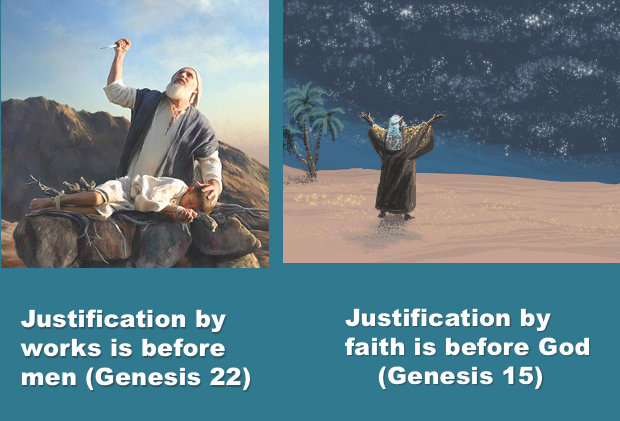
Thus, it could be translated, “You see then that a man is justified by works, and not only (justified) by faith.” There is a justification by works and a justification by faith. Justification by works is before men. “For if Abraham was justified by works, he has something to boast about, but not before God.” (Rom. 4:2). People can be justified by works, but not before God. Why? Because God can see faith without works. He knows life is there apart from our works. This is why justification before God is always by faith alone in Christ alone (Rom. 4:5; cf. Gen. 15:6). But people cannot see faith apart from works. Hence, justification by works is before men, justification by faith is before God. James never speaks of justification by faith and works before God. He doesn’t say Abraham was justified by faith and works at the same time, nor does he say Rahab was.

“Likewise, was not Rahab the harlot also justified by works when she received the messengers and sent them out another way?” (James 2:25). The story is clear. The Israelites were going to take Jericho. The Jewish spies came in to spy out the land. Rahab, “the harlot” – the prostitute, the hooker, the whore – the woman who lived a life of failure – hid them and then secretly sent them out so they could escape. Rahab’s physical life was saved because she had works. God saw Rahab’s faith when she “received the spies” (Heb. 11:31). But men could not see her faith until she acted on it by “sending them out another way” (James 2:25b). Rahab was truly a friend of God because she was their friend. While all of Jericho perished under God’s judgment, Rahab lived because her faith lived! So yes, faith can be shown to men from our works. Abraham did it and was called the friend of God. Rahab did it by sending the spies away safely. 

We are called to act upon the faith that we have. We can know what is right. We can already be saved from hell. We can come to church two or three times a week. We can be on our way to heaven and yet not experience heaven as a part of history! Until we act upon the Word of God and start living it out, what does it profit? Faith without works will not profit a brother or sister in need of food or clothing nor will it profit the Lord at the Judgment Seat of Christ.

“For as the body without the spirit is dead, so faith without works is dead also.” (James 2:26). James compares faith to the body and works to the spirit. When does a human body die? When it loses its spirit which keeps it alive. When does a Christian’s faith die? When he stops using it. Like a muscle, if you stop using it, it atrophies and withers away. You won’t experience the transforming power of God if you stop putting your faith to work! Just as the human spirit gives life to the body, good works give life to your faith (James 2:26). You can have correct belief and lots of Bible knowledge, but if you stop acting on that belief and knowledge, your faith will weaken and become a creedal corpse.

A little girl who really believed in prayer, had a brother who made a trap that caught little sparrows, and she prayed that it would fail. Suddenly, for three days her face was radiant when she prayed and her absolute faith in the futility of the trap was so noticeable that her mother asked, “Julia, how can you be so confident?” Julia smiled, “Because, dear Mama, I went out three days ago and kicked that trap to pieces.” She literally put her faith to work.

If we are going to keep our faith alive in these uncertain times, we must put it to work. Not by kicking traps, but by meeting the felt needs of the people God is calling us to reach – by introducing them to Christ and by discipling them and sending them out to do the same. We can decide today how we will live our lives in these chaotic times. Will you choose to keep your faith alive and vigorous by putting it to work in obedience to God? God wants our faith to thrive, not die. What about you?

In the message I recently heard, I understood the pastor to say that genuine saving faith is a part of justification and is accompanied by good works which will accomplish final vindication. I call this backloading the gospel. That is, one must manifest good works as a necessary proof of genuine salvation. This is also known as Calvinism or Reformed Theology. [21] Those who backload the gospel by requiring good works to stay saved represent Arminianism.  There are other teachers who mistakenly frontload the gospel by requiring good works to go to heaven (Roman Catholic & Traditional Protestantism). Whether you frontload or backload the gospel with good works, you are still teaching you MUST HAVE GOOD WORKS to ultimately go to heaven. Consider these options in this chart which are taught today:

ScenarioFaith in Jesus Christ + good works = maybe heavenFaith in Jesus Christ = maybe heaven if you maintain good works, confess your sins, remain faithful, etc.Faith in Jesus Christ = salvation + good works to ultimately arrive in heaven
ProponentsRomanism & Traditional ProtestantismArminianismCalvinism/Reformed Theology

Each of these scenarios requires good works to ultimately arrive at heaven. This is NOT GRACE. “But if it is of works, it is no longer grace.” (Rom. 11:6). Good works are not the means of obtaining or maintaining salvation from hell but are designed to be the result of receiving God’s free gift of salvation (Ephes. 2:8-10). When good works are required to enter heaven, how will you ever know when you have done enough?

Faith in Christ alone will still take us to heaven (John 6:47) even if it does not produce good works through a life of obedience. But faith without works will not save us from the damaging effects of sin now (James 1:15, 19-22) and an unfavorable experience at the Judgment Seat of Christ in the future (James 2:12-13). When we do the Word of God and not just hear it, people are able to see what we believe and benefit from our actions (2:14-20). James illustrates this principle with the lives of Abraham and Rahab (James 2:21-25). Both were justified before God through faith alone, but both were also justified before men through a faith that was made visible through good works. When we put our faith into action through obedience to God’s Word, our faith is energized and we develop a closer relationship with Christ (James 2:26; cf. John 14:21; 15:14) that other people can see and benefit from.

I pray the church would return to the true gospel which says faith alone in Christ alone gets us to heaven (John 3:15-18; Ephes. 2:8-9). But bringing heaven to earth is through the discipleship (sanctification) process and it is based upon faith plus works (Matt. 28:18-20; James 2:14-26).

Failure to distinguish salvation from discipleship (see chart below) has caused much confusion among Christians and non-Christians.
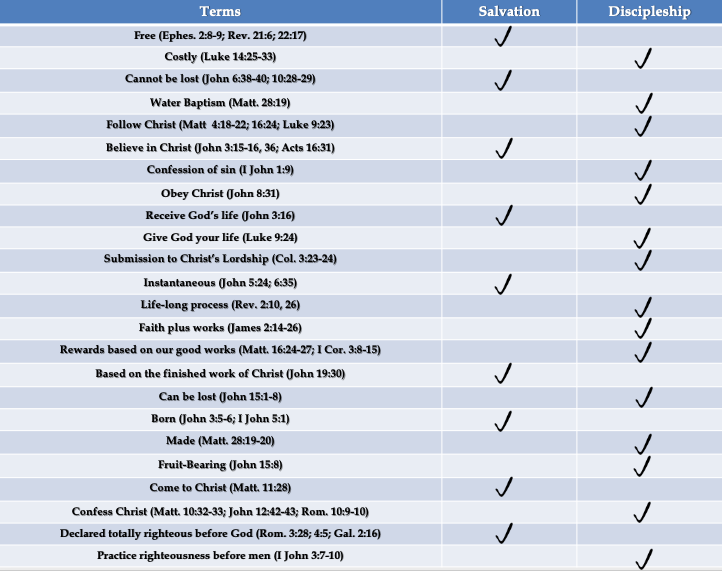
When Christians use discipleship conditions to tell a non-Christian how to get to heaven, they are making it more difficult for that unsaved person to be saved since they are missing the object of saving faith – believing in Jesus Christ alone for His gift of eternal life. They also undermine the assurance of salvation among Christians because it is impossible for them to know if they have done enough to know for certain they will go to heaven. God does not want His children doubting they are saved because they will live by fear instead of by faith (I John 5:13; cf. 2 Cor. 5:6-8). May all Christians repent or change their minds and submit to the Lordship of Christ by proclaiming the object of saving faith to a lost world – believing in Christ alone for His free gift of eternal life. And after a person believes in Jesus alone for eternal life, may Christians disciple or train that new believer to follow Jesus as His disciple all the days of his or her life (cf. Matt. 28:19-20; Mark 8:34-38; Luke 9:23-27, 57-62; 14:25-33; John 8:30-32; 13:34-35; 15:1-8) so they may glorify God now (Matt. 5:16) and throughout eternity with the eternal rewards they will receive at the Judgment Seat of Christ (I Cor. 3:8-15; 2 Cor. 5:9-11; Rev. 4:9-11).

Prayer: Precious Lord, this message really cuts deep into my apathetic heart. My knowledge of the truth can grow greatly, but if I do not put it into practice, my faith becomes dead or useless to You and to others. No wonder I have lost my fervor for You Lord Jesus. My head is swollen with Bible knowledge, but my heart is cold because I have not applied what I already know to be true. Thank You for exposing the judgmentalism of my heart. I have avoided my own responsibility of putting my faith to work by focusing on the shortcomings of others who profess faith in Jesus without any accompanying good works. Only You can determine if a person is truly saved from hell because only You can see a person’s faith in Christ apart from any works. This world would be a much better place if all Christians would put what they know into practice. Lord, I want to be a part of the solution to the world’s problems by putting my faith to work. It is so easy for me to sit back and criticize others for doing very little while I, too, talk about faith more than I live it out. Forgive me, Lord, for being preoccupied with myself and what I know to be true instead of putting it into practice. Please show me whom You want me to get involved with so they can benefit from my relationship with You and come to know You as their Savior. In Jesus’s name. Amen.

FOOTNOTES:

[1] Proponents of this view are James Arminius, The Works of James Arminius: The London Edition 3 Vol., (Baker Books, 1986); William J. Abraham, Wesley for Armchair Theologians (Louisville, KY: Westminister John Knox Press, 2005); Grace for All: The Arminian Dynamics of Salvation edited by Clark H. Pinnock and John D. Wagner (Eugene, OR: Resource Publications, 2015); Kenneth J. Collins, The Scripture Way of Salvation: The Heart of John Wesley’s Theology (Nashville, TN: Abingdon Press, 1997);  Kenneth J. Collins, The Theology of John Wesley: Holy Love and the Shape of Grace (Nashville, TN: Abingdon Press, 2007); F. Leroy Forlines, Classical Arminianism (Nashville, TN: Randall House Publications, 2011).

[2] Proponents include Donald W. Burdick, “James,” in Hebrews-Revelation Vol. 12 of The Expositor’s Bible Commentary Edited by Frank E. Gaebelein and J. D. Douglas (Grand Rapids: Zondervan Publishing House, 1981); John Calvin, Acts of the Council of Trent: with the Antidote, 6th Session, can.11; Peter H. Davids, The Epistle of James: A Commentary on the Greek Text (Grand Rapids: Wm. B. Eerdmans Publishing Co., 1982); Buist M. Fanning, “A Theology of James,” in A Biblical Theology of the New Testament Edited by Roy B. Zuck (Chicago: Moody Press, 1994), pp. 417-35; John F. MacArthur, Faith Works: The Gospel According to the Apostles (Dallas: Word Publishing, 1993), pp. 139-155; John F. MacArthur, Hard to Believe: The High Cost and Infinite Value of Following Jesus (Nashvile: Thomas Nelson, 2003), pg. 93; Douglas J. Moo, The Letter of James, The Pillar New Testament Commentary (Grand Rapids; Wm. B. Eerdmans Publishing Co., 2000); Joseph K. Pak, “A Study of Selected Passages on Distinguishing Marks of Genuine and False Believers,” PhD diss., (Dallas Theological Seminary, 2001); John Piper, “Battling the Unbelief of Bitterness (1988, Sermon 658),” http://www.desiringgod.org/resourceLibrary; John Piper, Beyond the Gold (Desiring God Radio, May 14, 2006); John Piper, The Future of Justification: A Response to N. T.  Wright (Wheaton, IL: Crossway Books, 2007); Paul A. Rainbow, The Way of Salvation: The Role of Christian Obedience in Justification (Waynesboro, GA: Paternoster, 2005); Alan P. Stanley, Did Jesus Teach Salvation by Works? The Role of Works in Salvation in the Synoptic Gospels (Eugene, OR: Pickwick Publishers, 2006).

[3] Proponents include Joseph Dillow, Final Destiny: The Future Reign of The Servant Kings: Fourth Revised Edition (Grace Theology Press, 2018 Kindle Edition), pp. 401-430; Tony Evans, CSB Bibles by Holman, The Tony Evans Bible Commentary (B & H Publishing Group, Kindle Edition, 2019), pp. 2867 – 2890; John F. Hart, “How to Energize Our Faith: Reconsidering the Meaning of James 2:14-26,” Journal of the Grace Evangelical Society 12, no. 1 (Spring 1999); Zane C. Hodges, Dead Faith: What Is It? (Dallas, Redencion Viva, 1987); Zane C. Hodges, “James,” The Grace New Testament Commentary: Revised Edition Edited by Robert N. Wilkin (Grace Evangelical Society, Kindle Edition, 2019), pp. 541-562; R. T. Kendall, Calvin and English Calvinism to 1649 (Oxford: Oxford University Press, 1979); R. T. Kendall, Once Saved, Always Saved, Reprint (Waynesboro, GA: Authentic Media, 2004 ed., London: Hodder and Straughton, 1984); John Niemela, “Faith Without Works: A Definition 1,” Chafer Theological Seminary Journal 6, no. 2 (April 2000); Robert Wilkin, “Another View of Faith and Works in James 2,” Journal of the Grace Evangelical Society 15, no. 2 (Fall 2002).

[4] John 1:7, 12, 50; 2:11, 22, 23; 3:12(2), 15, 16, 18(3), 36; 4:21, 39, 41, 42, 48, 50, 53; 5:24, 38, 44, 46(2), 47(2); 6:29, 30, 35, 36, 40, 47,  64(2), 69; 7:5, 31, 38, 39, 48; 8:24, 30, 31, 45, 46; 9:18, 35, 36, 38; 10:25, 26, 37, 38(3), 42; 11:15, 25, 26(2), 27, 40, 42, 45, 48; 12:11, 36, 37, 38, 39, 42, 44(2), 46, 47; 13:19; 14:1(2), 10, 11(2), 12, 29; 16:9, 27, 30, 31; 17:8, 20, 21; 19:35; 20:8, 25, 29(2), 31(2).

[5] Walter Bauer, A Greek-English Lexicon of the New Testament and Other Early Christian Literature: Third Edition revised and edited by Frederick William Danker (Chicago: University of Chicago Press, 2000 Kindle Edition), pp. 816-817.

[6] Scripture quotations in this article will be from the New King James Version unless otherwise noted.

[7] In John 10:10 Jesus says, “I have come that they may have life, and that they may have it more abundantly.” Jesus came so that those who believe in Him may have eternal “life” as a free gift and experience it more “abundantly” both now and in eternity. When eternal life is addressed as a present possession it is always received as a free gift by believing in Jesus alone (John 3:15-16, 36; 5:24; 6:35, 40, 47; 11:25-26; cf. I Tim. 1:16; I John 5:13). But when eternal life is referred to as a future acquisition it refers to an eternal reward (a more abundant experience of that life both now and in eternity) that is based on obedience to Christ’s Word and sacrificial living for Him (John 12:24-26; cf. Matt. 19:28-29; Mark 10:29-30; Luke 18:29-30; Gal. 6:7-9; I Tim. 6:12, 19).

[8] Constable, Dr. Constable’s Notes on James, pg. 49.

[9] Davids, The Epistle of James, pg. 120.

[10] Mē echē mē dynatai hē pistis sōsai auton?

[11] Constable, Dr. Constable’s Notes on James, pg. 50.

[12] Hodges, “James,” The Grace New Testament Commentary, pg. 549.

[13] Ibid.

[14] R. Larry Moyer, You Can Tell It! Seminar On Personal Evangelism Instructor Manual, EvanTell, Inc., 2003, 46-47; Larry Moyer, Free and Clear: Understanding & Communicating God’s Offer of Eternal Life, (Grand Rapids: Kregel Publications, 1997), pp. 108-113.

[15] The Greek word translated “brought forth” (apokueō) is the same word used in James 1:15, “And sin, when it is full-grown, brings forth [apokueō] death.” “Sin, James is saying, ‘gives birth’ to death, but God ‘gives birth’ to believers!” (Hodges, “James,” The Grace New Testament Commentary, pg. 544.)

[16] The Bible refers to three types of salvation (see diagram below): Past salvation refers to being saved from the penalty of sin the moment a person believes in Christ (Acts 16:31; John 3:16-17; Rom. 4:5; Ephes. 2:8-9) and is called justification. Present salvation involves being saved from the power of sin in the Christian life (Mark 8:34-38; Phil. 1:19-20; 2:12-13; James 1:21-22; 2:14-26) and is called sanctification. Future salvation is when we will be saved from the presence of sin (Rom. 8:18-23; Heb. 1:14; 2:3-5; 9:28; I Pet. 1:5; I John 3:2) and is called glorification. Always pay attention to the context to determine the tense of salvation.

[17]  Bauer, A Greek-English Lexicon of the New Testament, pp. 982-983.

[18] Adapted from Charlie Bing, “Demon Faith and the Misuse of James 2:19,” GraceNotes – no. 47 at gracelife.org.

[19] Ibid.

[20] Hodges, “James,” The Grace New Testament Commentary, pg. 552.

[21] Proponents of this view include John McArthur, R.C. Sproul, James Montgomery Boice, John Piper, etc.

Keeping our faith alive in uncertain times

Inspired by a true story, the movie Rugged Gold is about a pregnant newlywed named Martha Martin who is separated by an earthquake from her son and miner husband in 1950s Alaska. This is a story about survival – staying alive under horrible circumstances. Martha Martin overcomes severe injuries, delivers her own baby, faces off with a Grizzly and wins, and endures a brutal winter with the hope of being reunited with her son and newlywed husband. Martha did everything she could to keep herself alive.

As we face all kinds of challenges this year including COVID-19 and social unrest revolving around the color of a person’s skin, it is essential that we as Christians be willing to do whatever it takes to keep our faith alive.

But how does a Christian do this? How does a believer in Jesus Christ keep their faith alive and energized? Turn to James 2:14-26 and find out. Many people have understood James 2:14-26 to teach that good works are necessary for eternal salvation. These verses are misunderstood by some to be written to professing Christians whose faith must be tested to see if it is genuine. But James is not addressing the eternal destiny of his readers because they are genuine Christians. James describes them as… “brethren” (James 1:2, 16, 19; 2:5, 14; et. al.), those who are “born from above” (James1:17-18), and those who “hold the faith of our Lord Jesus Christ” (James 2:1). James understands, however, that it would be easy to downgrade works where it was taught that justification before God was by faith alone in Christ alone.

Although these were genuine Christians, they were immature and disobedient (cf. James 3:1-5:6), and they were in danger of experiencing both the damaging consequences of sin now (James 1:15-16, 21; 5:19-20) and an unfavorable evaluation at the Judgment Seat of Christ in the future (James 2:12-13; 5:7-9). To preserve their souls/lives from the ruin of sin now and a negative assessment at the Judgment Seat of Christ in the future, they are to obey God’s Word (James 1:21-25). So James is writing to them to help them put their faith into action – to keep their faith alive.

How do we keep our faith alive in these uncertain times?

1. GET INVOLVED WITH OTHERS (James 2:14-17). “What does it profit, my brethren, if someone says he has faith but does not have works? Can faith save him?” (James 2:14). This verse has caused a lot of concern for many people over the years. Martin Luther was so distraught over this verse that he wanted to take the book of James out of the Bible because he felt it contradicted the great truth that led to the Reformation – Paul’s justification by faith alone apart from works. Clearly, James makes works a condition for salvation as the question, “Can faith save him?” (James 2:14b) expects a negative answer. “Of course, faith without works cannot save him.” James says a faith without works cannot save you.

But the apostle Paul says a faith with works won’t save you. “Now to him who does not work, but believes on Him who justifies the ungodly, his faith is accounted for righteousness.” (Romans 4:5). “For by grace you have been saved through faith, and that not of yourselves; it is the gift of God, not of works, lest anyone should boast.” (Ephesians 2:8-9). Paul and James seem to contradict each other. James says you cannot be saved without works. Paul says you cannot be saved by faith with works.

The reason James and Paul differ with each other is because they are talking to two different groups.  When Paul is talking to sinners about how to become a saint, he says it is by faith alone apart from works (Romans 4:5-6). But notice who James is talking to. Christians or non-Christians? “What does it profit, my brethren, if someone says he has faith but does not have works? Can faith save him?” (James 2:14). Notice the phrase,  “My brethren…” These people are brothers in Christ. They are saved from hell. So when James talks to saints about how to experience the God who has already saved them from hell, he says it by faith with works (James 2:14-26). If you want to know how to get to heaven, read Paul. If you want to know how to bring heaven to earth because you are already saved from hell, read James.

So do works have any part in getting us to heaven? No. Faith in Christ alone is the only basis of eternal salvation from hell. Eternal salvation is a gift, not of works lest anyone should boast. No person can take credit for his salvation from hell because it is apart from works. “And if by grace, then it is no longer of works; otherwise grace is no longer grace. But if it is of works, it is no longer grace; otherwise work is no longer work.” (Romans 11:6). If works are made a condition for getting to heaven, then eternal salvation can no longer be said to be attained by grace. So James cannot be talking about eternal salvation by grace because God’s Word does not contradict itself.

So what kind of salvation is being addressed in James 2:14? Faith without works cannot save us from what? The word “save” (sozo) in the New Testament doesn’t always refer to salvation from hell. In fact 70% of the time the word “save” in the New Testament refers to deliverance from circumstances. For example,  when Jesus’s disciples were about to drown in the midst of a storm at sea, they said to Jesus, “Lord, save us! We are perishing!” (Matthew 8:25). They were referring to being saved from physical death. In I Timothy 2, when Paul was talking about the role of men and women in the church, he said, “Nevertheless she will be saved in childbearing if they continue in faith, love, and holiness, with self-control.” (1 Timothy 2:15). The context is talking about women being restricted from teaching or leading men in the local church. So Paul is talking about women being saved from this restriction through childbearing, that is,  she is able to teach and lead her children and be fulfilled doing so if her children continue in these godly virtues.

What James is telling us is that faith without works will not save us from what he has already discussed in the book. First, faith without works won’t save us from A LIFE RUINED BY SIN. James 1:19-22 says,19 So then, my beloved brethren, let every man be swift to hear, slow to speak, slow to wrath; 20 for the wrath of man does not produce the righteousness of God. 21 Therefore lay aside all filthiness and overflow of wickedness, and receive with meekness the implanted word, which is able to save your souls. 22 But be doers of the word, and not hearers only, deceiving yourselves.” James tells the saved how to save their souls from a life ruined by sin. They must be doers of the word and not merely hearers.

James warns his readers, “Then, when desire has conceived, it gives birth to sin; and sin, when it is full-grown, brings forth death.” (James 1:15).  If believers pursue sin long enough and hard enough, it will ruin their lives and the lives of those around them. So the way to be saved from a life ruined by sin is to do what God says to do.

Secondly, faith without works will not save us from AN UNFAVORABLE JUDGMENT AT THE JUDGMENT SEAT OF CHRIST. “12 So speak and so do as those who will be judged by the law of liberty. 13 For judgment is without mercy to the one who has shown no mercy. Mercy triumphs over judgment.” (James 2:12-13). The Bible tells us that all Christians will appear before the Judgment Seat of Christ after they die or are raptured to have their Christian lives evaluated to determine what if any rewards they will receive (Romans 14:10-12; I Corinthians 3:8-15; 2 Corinthians 5:9-11). If we are critical and merciless toward people now, then God will show less mercy to us when He judges our lives in the future. So can faith alone save us? No, James says faith without works cannot save us from a life ruined by sin or from an unfavorable judgment in the future at the Judgment Seat of Christ.

James then gives an illustration of this. 15 If a brother or sister is naked and destitute of daily food, 16 and one of you says to them, ‘Depart in peace, be warmed and filled,’ but you do not give them the things which are needed for the body, what does it profit?” (James 2:15-16). Just as words of assurance from some ungenerous believer cannot save his naked and starving Christian brother or sister from physical death, so too, faith without works cannot save our lives from the consequences of sin. Correct beliefs, such as Jesus is God, the Bible is God’s inerrant Word, or salvation is by grace through faith alone in Christ alone, cannot save us from a life ruined by sin any more than warm wishes will save a needy brother from physical death.

You can have accurate theology and be useless to God and others. There are Christians who have sound theology but they are useless to God! They can dot their i’s and cross their t’s but they are not seeing their souls saved from the power of sin. They are not seeing their lives transformed by the grace of God. Why? Because their orthodoxy has not become orthopraxy. Because they are not putting their faith to work. Sometimes we say, “I’m waiting on God.” But could it be that God is waiting on you? If we want to keep our faith alive in these uncertain times, we must go beyond the well wishes and desires to help others and actively get involved with them.

For example, we can say, “I love people of all colors,” but if we are not actively getting involved with people from other cultures or ethnicities, we are not demonstrating the truth of our words. Our faith will not grow in this area if we are merely hearers and not doers.  

Notice that James is talking about helping a needy Christian “brother” in these verses. He is not talking about giving handouts to some stranger who is begging for food or clothing. We are to give priority to believers first. This was especially true in James’s day when Christians were actively being persecuted by the Roman government. We need to balance this with other Scripture. Galatians 6:10 says, “As we have opportunity, let us do good to all, especially to those who are of the household of faith.” Second Thessalonians 3:10 says, “For even when we were with you, we commanded you this: If anyone will not work, neither shall he eat.” Free food (or clothing or money, etc.) should not be given to those who can work but choose not to. To do so rewards laziness and irresponsibility. God wants us to get involved in needy peoples’ lives, starting with the church.

If you are feeling down, one of the best ways to get picked up is to focus on the needs of other people. Just talking about it isn’t going to benefit the needy people in your church or community. We must put our faith into action. The more you get involved with needy people, the stronger your faith will become in the Lord.

Look at what James says next, “Thus also faith by itself, if it does not have works, is dead.” (James 2:17).Faith without works is a “dead” or useless faith that has lost its fervor or fire for Christ. Faith without works is dead – useless, unproductive just as idle words are useless to a brother or sister in need.

If all we ever do is talk about reaching and teaching people for Christ, but we never act on it, then our faith becomes useless to others. Reaching and teaching people for Christ is what the United States of America needs more than anything right now in the midst of these troubling times. Until people obtain peace with God through faith in Jesus Christ (Romans 5:1), they are not going to have peace with themselves or other people regardless of the color of their skin (cf. Ephesians 2:8-18).

A dead faith means the believer has lost his fire or fervor for Christ. If I were to visit another church and upon leaving I said to my wife, “This church is dead,” I’m not saying there are no born-again Christians there. I am saying that church is not on fire for Christ. Our faith won’t do anyone any good if we don’t exercise it.

What does a dead body and a dead faith have in common? Both are immobile and inactive. They also tend to decay and stink. If we fail to do good works, our faith will lose its vitality, it will weaken, and eventually decay and stink. Like a dead car battery, it is useless. It was once alive, but it has become dead or useless due to a lack of use. But the way to jump start a dead faith is to put it to work.

In James 2:18-19, James encounters a skeptic. This skeptic insists that there is no connection between faith and works in order to justify his carnal lifestyle (James 2:18-19). This skeptical person objects to James’s view of faith and works by saying it is absurd to see a close connection between faith and works. “But someone will say, “You have faith, and I have works.” Show me your faith without your works, and I will show you my faith by my works.” (James 2:18). In other words, this person says, “Let’s say you have faith and I have works. You can no more start with what you believe and show it to me in your works, than I can start with my works and show what it is that I believe.”

Then in James 2:19 the objector tries to illustrate that there is no connection between faith and works, “You believe that there is one God. You do well. Even the demons believe—and tremble!” (James 2:19). The skeptic is saying that the demons believe in the oneness of God, the same way James does, who does good, but they only tremble instead of doing good. He is saying that faith cannot be made visible in works! Why would someone argue this way? Because his beliefs are not supported by his behavior. “Faith and good works are not related to each other so don’t criticize me if I don’t practice what I preach.”

Some use James 2:19 to say that believing in Christ is not enough to be saved from hell because the demons believe in God, but are not saved because they have not submitted to God or obeyed Him. Let me point out some things to note about James 2:19:

1. Jesus did not die for demons, He died for people (Romans 5:8; Hebrews 2:16). Therefore, demons are not savable. Demons are unsaved because they willfully rebelled with Lucifer against God (Isaiah 14:13-15; Ezekiel 28:11-19) and are condemned to everlasting fire in hell prepared for the devil and his demons (Matthew 25:41), not because they lack insufficient faith. Nowhere in the Bible does God offer demons eternal life because demons are not savable.

2. Belief that God is one is not saving. What makes faith saving is the object of faith, not the amount or duration of faith. Demons do really believe there is only one God, but believing that God is one does not get anyone to heaven. There are many world religions and cults that believe God is one, but you will not see them in heaven because they have missed the object of saving faith – believing in Jesus Christ alone, who died for their sins and rose from the dead, to give them everlasting life (I Corinthians 15:1-6; John 3:14-18; 6:47; 14:6 20:31; Acts 4:10-12). What makes saving faith saving, is the object, not some special kind of faith. Not all facts about God are saving. Believing in Christ for eternal life is a saving fact. Believing that God is one is not a saving fact.

3. Since the words of James 2:19 belong to a skeptic, they should not be used to prove such an important theological point. Using this verse to dismiss the use of the word “believe” in gospel presentations misunderstands the author’s intended meaning and leads to misapplication. 

The second way to keep your faith alive in uncertain times is to 2. GIVE GOD YOUR OBEDIENCE (James 2:20-26). In James 2:20-25, James refutes the skeptic’s arguments by referring to two supreme examples of faith’s connection with works. The way to fire up a Christian’s faith is to PUT IT TO WORK like Rahab and Abraham put their faith to work and were justified before men (James 2:23-25). “But do you want to know, O foolish man, that faith without works is dead?” (James 2:20). James reaffirms that faith without works is dead or useless. The issue is that your faith is unproductive. The Lord is pleading with us in this passage to put our faith in gear and move out! Don’t sit back on the fact that you are saved forever and God’s never going to kick you out of His family, and therefore you become a lazy Christian.

He then states that Abraham was justified by works. “Was not Abraham our father justified by works when he offered Isaac his son on the altar?” (James 2:21). It was well known to James and his readers that Abraham was justified before God by faith alone (Genesis 15:6) about thirty years before he offered up Isaac (Genesis 22). His justification before God was apart from works (Romans 4). If Abraham had failed to obey God in offering up Isaac, would he have remained justified before the Lord? Yes, because justification before God is always based on faith alone, not good works whether before, during or after your conversion. “5 But to him who does not work but believes on Him who justifies the ungodly, his faith is accounted for righteousness, 6 just as David also describes the blessedness of the man to whom God imputes righteousness apart from works.” (Romans 4:5-6).

James goes on to say in “Do you see that faith was working together with his works, and by works faith was made perfect?” (James 2:22). Abraham’s original justifying faith was strengthened and matured by his act of obedience in offering up Isaac. How? His faith grew from a conviction that God could overcome his inability to have children to the assurance that God could actually resurrect his son’s own body from physical death. Hebrews 11:17-19 says,17 By faith Abraham, when he was tested, offered up Isaac, and he who had received the promises offered up his only begotten son, 18 of whom it was said, ‘In Isaac your seed shall be called,’ 19 concluding that God was able to raise him up, even from the dead.”

James continues, “And the Scripture was fulfilled which says, ‘Abraham believed God, and it was accounted to him for righteousness.’ And he was called the friend of God.” (James 2:23). Abraham’s original justifying faith before God was “fulfilled” or “filled-full” of meaning as a result of this act of obedience. His obedience revealed his faith to men. The Scriptures were fulfilled in that Abraham showed his faith by his works. His obedience justified him before men in such a way as to show him to be righteous on a practical level. People could say Abraham was a “friend of God.” Friendship with God requires obedience. Jesus said, “You are My friends if you do whatever I command you.” (John 15:14). Jesus was speaking to the believing disciples when He spoke these words in John 15. They were already saved. This is why James 2:24 speaks of two kinds of justification.

“You see then that a man is justified by works, and not by faith only.” (James 2:24). The word “only” is an adverb and modifies the verb “justified” implied in the second clause. Thus it could be translated, “You see then that a man is justified by works, and not only (justified) by faith.” There is a justification by works and a justification by faith. Justification by works is before men. “For if Abraham was justified by works, he has something to boast about, but not before God.” (Romans 4:2). People can be justified by works, but not before God. Why? Because God can see faith without works. He knows life is there apart from our works. This is why justification before God is by faith alone in Christ alone (Romans 4:5; cf. Genesis 15:6). But people cannot see faith apart from works. Hence, justification by works is before men, justification by faith is before God. James never speaks of justification by faith and works. He doesn’t say Abraham was justified by faith and works at the same time, nor does he say Rahab was.

“Likewise, was not Rahab the harlot also justified by works when she received the messengers and sent them out another way?” (James 2:25). The story is clear. The Israelites were going to take Jericho. The Jewish spies came in to spy out the land. Rahab, “the harlot” – the prostitute, the hooker, the whore – the woman who lived a life of failure – hid them and then secretly sent them out so they could escape. Rahab’s physical life was saved because she had works. God saw Rahab’s faith when she “received the spies” (Hebrews 11:31). But men could not see her faith until she acted on it by “sending them out another way” (James 2:25b). Rahab was truly a friend of God because she was their friend. While all of Jericho perished under God’s judgment, Rahab lived because her faith lived! So yes, faith can be shown to men from our works. Abraham did it and was called the friend of God. Rahab did it by sending the spies away safely.  

We are called to act upon the faith that we have. We can know what is right. We can already be saved from Hell. We can come to church two or three times a week. We can be on our way to heaven and yet not experience heaven as a part of history! Until we act upon the Word of God and start living it out, what does it profit? Faith without works will not profit a brother or sister in need of food or clothing nor will it profit the Lord at the Judgment Seat of Christ.

For as the body without the spirit is dead, so faith without works is dead also.” (James 2:26). James compares faith to the body and works to the spirit. When does a human body die? When it loses its spirit which keeps it alive. When does a Christian’s faith die? When he stops using it. Like a muscle, if you stop using it, it atrophies and withers away. You won’t experience the transforming power of God if you stop putting your faith to work! Just as the human spirit gives life to the body, good works give life to your faith (James 2:26). You can have correct belief and lots of Bible knowledge, but if you stop acting on that belief and knowledge, your faith will weaken and become a creedal corpse.

A little girl who really believed in prayer, had a brother who made a trap that caught little sparrows, and she prayed that it would fail. Suddenly, for three days her face was radiant when she prayed and her absolute faith in the futility of the trap was so noticeable that her mother asked, “Julia, how can you be so confident?” Julia smiled, “Because, dear Mama, I went out three days ago and kicked that trap to pieces.” She literally put her faith to work.

If we are going to keep our faith alive in these uncertain times, we must put it to work. Not by kicking traps, but by meeting the felt needs of the people God is calling us to reach – by introducing them to Christ and by discipling them and sending them out to do the same. We can decide today how we will live our lives in these chaotic times. Will you choose to keep your faith alive and vigorous by putting it to work in obedience to God? God wants our faith to thrive, not die. What about you?

Prayer: Precious Lord, this message really cuts deep into my apathetic heart. My knowledge of the truth can grow greatly, but if I do not put it into practice, my faith becomes dead or useless to You and to others. No wonder I have lost my fervor for You Lord Jesus. My head is swollen with Bible knowledge, but my heart is cold because I have not applied what I already know to be true. This world would be a much better place if all Christians would put what they know into practice. Lord, I want to be a part of the solution to the world’s problems by putting my faith to work. It is so easy for me to sit back and criticize others for doing very little while I, too, talk about faith more than I live it out. Forgive me, Lord, for being preoccupied with myself and what I know to be true instead of putting it into practice. Please show me whom You want me to get involved with so they can benefit from my relationship with You and come to know You as their Savior. In Jesus’s name. Amen.